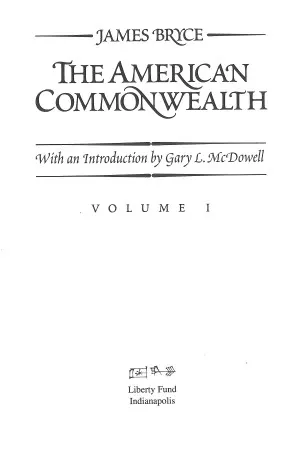
The American Commonwealth, vol. 1
Part of The American Commonwealth, 2 vols.
- Viscount James Bryce(author)
- Gary L. McDowell(introduction)
James Bryce examined “the institutions and the people of America as they are.” in The American Commonwealth, first published in London in three volumes in 1888. This edition's expanded appendix includes Bryce’s 1887 essay, “The Predictions of Hamilton and De Tocqueville,” and contemporaneous (1889) reviews of The American Commonwealth by Woodrow Wilson and Lord Acton.
Key Quotes
Passages from this text chosen by OLL editors.
- Presidents, Kings, Tyrants, & Despots“
Assuming that there was to be such a magistrate [the office of President], the statesmen of the Convention, like the solid practical men they were, did not try to construct him out of their own brains, but looked to some existing models. They therefore made an enlarged copy of the state governor, or to put the same thing differently, a reduced and improved copy of the English king. He is George III shorn of a part of his prerogative by the intervention of the Senate in treaties and appointments, of another part by the restriction of his action to federal affairs, while his dignity as well as his influence are diminished by his holding office for four years instead of for life. His salary is too small to permit him either to maintain a court or to corrupt the legislature; nor can he seduce the virtue of the citizens by the gift of titles of nobility, for such titles are altogether forbidden. Subject to these precautions, he was meant by the Constitution-framers to resemble the state governor and the British king, not only in being the head of the executive, but in standing apart from and above political parties. He was to represent the nation as a whole, as the governor represented the state commonwealth. The independence of his position, with nothing either to gain or to fear from Congress, would, it was hoped, leave him free to think only of the welfare of the people.
- Parties & Elections“
Europeans often ask, and Americans do not always explain, how it happens that this great office, the greatest in the world, unless we except the papacy, to which anyone can rise by his own merits, is not more frequently filled by great and striking men. In America, which is beyond all other countries the country of a "career open to talents," a country, moreover, in which political life is unusually keen and political ambition widely diffused, it might be expected that the highest place would always be won by a man of brilliant gifts. But from the time when the heroes of the Revolution died out with Jefferson and Adams and Madison, no person except General Grant, had, down till the end of last century, reached the chair whose name would have been remembered had he not been president, and no president except Abraham Lincoln had displayed rare or striking qualities in the chair. Who now knows or cares to know anything about the personality of James K. Polk or Franklin Pierce? The only thing remarkable about them is that being so commonplace they should have climbed so high.
- Presidents, Kings, Tyrants, & Despots“
The direct domestic authority of the president is in time of peace very small, because by far the larger part of law and administration belongs to the state governments, and because federal administration is regulated by statutes which leave little discretion to the executive. In war time, however, and especially in a civil war, it expands with portentous speed. Both as commander in chief of the army and navy, and as charged with the “faithful execution of the laws,” the president is likely to be led to assume all the powers which the emergency requires. How much he can legally do without the aid of statutes is disputed, for the acts of President Lincoln during the earlier part of the War of Secession, including his proclamation suspending the writ of habeas corpus, were subsequently legalized by Congress; but it is at least clear that Congress can make him, as it did make Lincoln, almost a dictator....
In quiet times the direct legal power of the president is not great... In troublous times it is otherwise, for immense responsibility is then thrown on one who is both the commander in chief and the head of the civil executive. Abraham Lincoln wielded more authority than any single Englishman has done since Oliver Cromwell. It is true that the ordinary law was for some purposes practically suspended during the War of Secession. But it might again have to be similarly suspended, and the suspension makes the president a sort of dictator.
Although few presidents have shown any disposition to strain their authority, it has often been the fashion in America to be jealous of the president’s action, and to warn citizens against what is called “the one man power.”
About This Edition
Citation
Bryce, Viscount James. The American Commonwealth, with an Introduction by Gary L. McDowell (Indianapolis: Liberty Fund, 1995). Vol. 1.
Bryce, Viscount James. The American Commonwealth, vol. 1. Liberty Fund, 1995. Online Library of Liberty, https://oll.libertyfund.org/titles/mcdowell-the-american-commonwealth-vol-1.
Bryce, V. J. (1995). The American Commonwealth, vol. 1. Liberty Fund. https://oll.libertyfund.org/titles/mcdowell-the-american-commonwealth-vol-1
@book{bryce19951,
  author = {Viscount James Bryce},
  title = {The American Commonwealth, vol. 1},
  publisher = {Liberty Fund},
  address = {Indianapolis},
  year = {1995},
  url = {https://oll.libertyfund.org/titles/mcdowell-the-american-commonwealth-vol-1},
  note = {Online Library of Liberty}
}TY - BOOK AU - Bryce, Viscount James TI - The American Commonwealth, vol. 1 PY - 1995 CY - Indianapolis PB - Liberty Fund UR - https://oll.libertyfund.org/titles/mcdowell-the-american-commonwealth-vol-1 DB - Online Library of Liberty ER -
Copyright
The copyright to this edition, in both print and electronic forms, is held by Liberty Fund, Inc.

About the author
Viscount James Bryce 1838–1922
Viscount James Bryce (1838-1922) was a British jurist, historian, and statesman. From 1907 to 1913 he was England’s ambassador to the United States.
More in Political Science
See all >The Collected Works of Arthur Seldon, vol. 5 - Government Failure and Over-Government
Arthur SeldonOn Executive Power in Great States
Jacques NeckerEncyclopedic Liberty: Political Articles in the Dictionary of Diderot and D’Alembert
Denis DiderotBureaucracy
Ludwig von MisesThe History of the Origins of Representative Government in Europe
François GuizotAmerican Political Writing During the Founding Era: 1760-1805, vol. 2
Charles S. HynemanAmerican Political Writing During the Founding Era: 1760-1805, vol. 1
Charles S. HynemanThe Calculus of Consent: Logical Foundations of Constitutional Democracy
James M. BuchananAmerican Political Writing During the Founding Era: 1760-1805, 2 vols.
Charles S. Hyneman