Political Theory1576
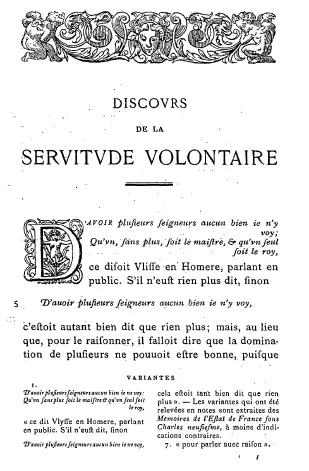
The Discourse of Voluntary Servitude
- Etienne de la Boétie(author)
- Harry Kurz(translator)
Boetie asks one of the most basic questions of political theory: why is it that a minority of rulers can remain in power over a majority of subjects who pay all the taxes. His answer is that most of the subjects willingly submit to rule by a minority.
Key Quotes
Passages from this text chosen by OLL editors.
- Origin of Government“
For the present I should like merely to understand how it happens that so many men, so many villages, so many cities, so many nations, sometimes suffer under a single tyrant who has no other power than the power they give him; who is able to harm them only to the extent to which they have the willingness to bear with him; who could do them absolutely no injury unless they preferred to put up with him rather than contradict him.[3] Surely a striking situation! Yet it is so common that one must grieve the more and wonder the less at the spectacle of a million men serving in wretchedness, their necks under the yoke, not constrained by a greater multitude than they, but simply, it would seem, delighted and charmed by the name of one man alone whose power they need not fear, for he is evidently the one person whose qualities they cannot admire because of his inhumanity and brutality toward them. A weakness characteristic of human kind is that we often have to obey force; we have to make concessions; we ourselves cannot always be the stronger. Therefore, when a nation is constrained by the fortune of war to serve a single clique, as happened when the city of Athens served the thirty Tyrants, one should not be amazed that the nation obeys, but simply be grieved by the situation; or rather, instead of being amazed or saddened, consider patiently the evil and look forward hopefully toward a happier future.
About This Edition
Citation
Boétie, Etienne de la. The Discourse of Voluntary Servitude, trans. Harry Kurz (Indianapolis: 1942).
Boétie, Etienne de la. The Discourse of Voluntary Servitude. translated by Harry Kurz, Unknown, 1942. Online Library of Liberty, https://oll.libertyfund.org/titles/kurz-the-discourse-of-voluntary-servitude.
Boétie, E. d. l. (1942). The Discourse of Voluntary Servitude. Unknown. https://oll.libertyfund.org/titles/kurz-the-discourse-of-voluntary-servitude
@book{botie1942servitude,
  author = {Etienne de la Boétie},
  title = {The Discourse of Voluntary Servitude},
  publisher = {Unknown},
  address = {Indianapolis},
  year = {1942},
  url = {https://oll.libertyfund.org/titles/kurz-the-discourse-of-voluntary-servitude},
  note = {Online Library of Liberty}
}TY - BOOK AU - Boétie, Etienne de la A3 - Kurz, Harry TI - The Discourse of Voluntary Servitude PY - 1942 CY - Indianapolis PB - Unknown UR - https://oll.libertyfund.org/titles/kurz-the-discourse-of-voluntary-servitude DB - Online Library of Liberty ER -
Copyright
The text is in the public domain.

About the author
Etienne de la Boétie 1530–1563
Estienne de la Boétie (1530-1563) was a friend of Montaigne and made a name for himself with his poetry and translations of ancient Greek authors. He is perhaps better known today for his essay “Discourse of Voluntary Servitude” where he explores why the majority too often willingly capitulates to the demands of a tiny ruling minority.
More in Political Theory
See all >The Political Writings of Jean Jacques Rousseau vol. 1
Jean-Jacques RousseauThe Writings of Thomas Paine, Vol. I (1774-1779)
Thomas PaineDissertations on Early Law and Custom
Sir Henry Sumner MaineAncient Law
Sir Henry Sumner MaineThe Political Writings of Jean Jacques Rousseau, 2 vols.
Jean-Jacques RousseauLeviathan (1909 ed)
Thomas HobbesPatriarcha, or the Natural Power of Kings
Sir Robert FilmerThe Man versus the State (1885 ed.)
Herbert SpencerThe Man versus the State, with Six Essays on Government, Society and Freedom (LF ed.)
Herbert Spencer