Posterior Analytics
- Aristotle(author)
- Edmund Spencer Bouchier(translator)
Aristotle sets out the conditions under which scientific arguments will provide true knowledge; where true conclusions are deduced from first principles and basic principles are used to explain more complex ones.
About This Edition
Citation
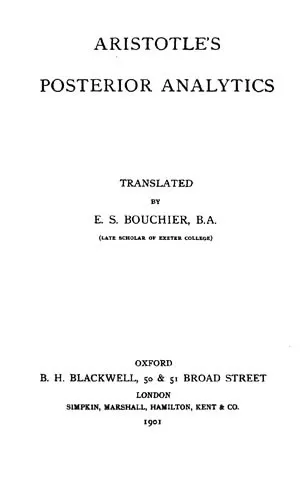
Aristotle’s Posterior Analytics, trans. E.S. Bouchier, B.A. (Oxford: Blackwell, 1901).
Aristotle. Posterior Analytics. translated by Edmund Spencer Bouchier, Blackwell, 1901. Online Library of Liberty, https://oll.libertyfund.org/titles/bouchier-posterior-analytics.
Aristotle. (1901). Posterior Analytics. Blackwell. https://oll.libertyfund.org/titles/bouchier-posterior-analytics
@book{aristotle1901analytics,
  author = {Aristotle},
  title = {Posterior Analytics},
  publisher = {Blackwell},
  address = {Oxford},
  year = {1901},
  url = {https://oll.libertyfund.org/titles/bouchier-posterior-analytics},
  note = {Online Library of Liberty}
}TY - BOOK AU - Aristotle A3 - Bouchier, Edmund Spencer TI - Posterior Analytics PY - 1901 CY - Oxford PB - Blackwell UR - https://oll.libertyfund.org/titles/bouchier-posterior-analytics DB - Online Library of Liberty ER -
Copyright
The text is in the public domain.

About the author
Aristotle 384 BCE–322 BCE
Aristotle was an ancient Greek philosopher who set up a rival academy, The Lyceum, to challenge Plato’s Academy. Aristotle wrote influential works in a range of disciplines - politics, physics, ethics, economics - and had a profound impact on Western thought.
More in Philosophy, Psychology, and Religion
See all >The Chief Works of Benedict de Spinoza, vol 1
Benedict de SpinozaThe Philosophical Works of David Hume, vol. 3 (Essays Moral, Political, and Literary) (1828 ed.)
David HumeThe English Works, vol. X (Iliad and Odyssey)
HomerDialogues, vol. 5 - Laws, Index to the Writings of Plato
PlatoDialogues, vol. 4 - Parmenides, Theaetetus, Sophist, Statesman, Philebus
PlatoDialogues, vol. 3 - Republic, Timaeus, Critias
PlatoDialogues, vol. 2
PlatoThe Works of John Locke, vol. 4 Economic Writings and Two Treatises of Government
John LockeThe Works, vol. 2 An Essay concerning Human Understanding Part 2 and Other Writings
John Locke