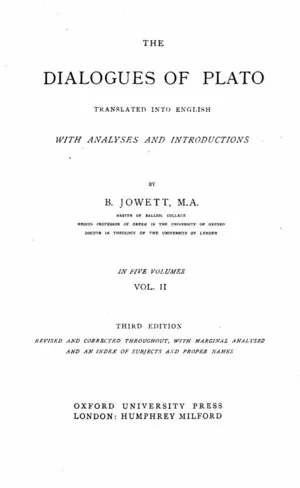
The Dialogues of Plato, vol. 2 (Meno, Euthyphro, Apology, Crito, Phaedo, Gorgias, Appendix I - Lesser, Hippias, Alcibiades I, Menexenus, Appendix II - Alcibiades II, Eryxias)
Part of The Dialogues of Plato, in 5 vols (Jowett ed.)
- Plato(author)
- Benjamin Jowett(translator)
Volume 2 (with 6 dialogues) of a 5 volume edition of Plato by the great English Victorian Greek scholar, Benjamin Jowett. The scholarly apparatus is immense and detailed. The online version preserves the marginal comments of the printed edition and has links to all the notes and comments provided by Jowett.
Key Quotes
Passages from this text chosen by OLL editors.
- Politics & Liberty“
I am the gadfly of the Athenian people, given to them by God, and they will never have another, if they kill me. And now, Athenians, I am not going to argue for my own sake, as you may think, but for yours, that you may not sin against the God by condemning me, who am his gift to you. For if you kill me you will not easily find a successor to me, who, if I may use such a ludicrous figure of speech, am a sort of gadfly, given to the state by God; and the state is a great and noble steed who is tardy in his motions owing to his very size, and requires to be stirred into life. I am that gadfly which God has attached to the state, and all day long 1and in all places am always fastening upon you, arousing and persuading and reproaching you. You will not easily find another like me, and therefore I would advise you to spare me.
- Philosophy“
“Let us reflect in another way, and we shall see that there is great reason to hope that death is a good; for one of two things—either death is a state of nothingness and utter unconsciousness, or, as men say, there is a change and migration of the soul from this world to another. Now if you suppose that there is no consciousness, but a sleep like the sleep of him who is undisturbed even by dreams, death will be an unspeakable gain. For if a person were to select the night in which his sleep was undisturbed even by dreams, and were to compare with this the other days and nights of his life, and then were to tell us how many days and nights he had passed in the course of his life better and more pleasantly than this one, I think that any man, I will not say a private man, but even the great king will not find many such days or nights, when compared with the others. Now if death be of such a nature, I say that to die is gain; for eternity is then only a single night. But if death is the journey to another place, and there, as men say, all the dead abide, what good, O my friends and judges, can be greater than this? If indeed when the pilgrim arrives in the world below, he is delivered from the professors of justice in this world, and finds the true judges who are said to give judgment there, Minos and Rhadamanthus and Aeacus and Triptolemus, and other sons of God who were righteous in their own life, that pilgrimage will be worth making. What would not a man give if he might converse with Orpheus and Musaeus and Hesiod and Homer? Nay, if this be true, let me die again and again. I myself, too, shall have a wonderful interest in there meeting and conversing with Palamedes, and Ajax the son of Telamon, and any other ancient hero who has suffered death through an unjust judgment; and there will be no small pleasure, as I think, in comparing my own sufferings with theirs. Above all, I shall then be able to continue my search into true and false knowledge; as in this world, so also in the next; and I shall find out who is wise, and who pretends to be wise, and is not. What would not a man give, O judges, to be able to examine the leader of the great Trojan expedition; or Odysseus or Sisyphus, or numberless others, men and women too! What infinite delight would there be in conversing with them and asking them questions! In another world they do not put a man to death for asking questions: assuredly not. For besides being happier than we are, they will be immortal, if what is said is true.” (FROM: Apology)
About This Edition
Citation
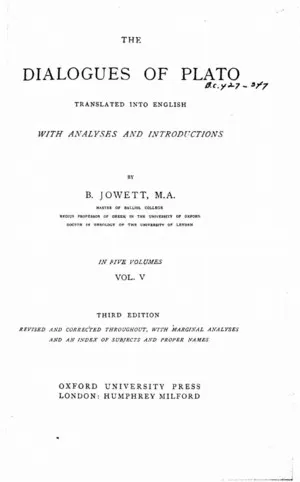
The Dialogues of Plato translated into English with Analyses and Introductions by B. Jowett, M.A. in Five Volumes. 3rd edition revised and corrected (Oxford University Press, 1892).
Plato. Dialogues, vol. 2. translated by Benjamin Jowett, Oxford University Press, 1892. Online Library of Liberty, https://oll.libertyfund.org/titles/plato-dialogues-vol-2.
Plato. (1892). Dialogues, vol. 2. Oxford University Press. https://oll.libertyfund.org/titles/plato-dialogues-vol-2
@book{plato18922,
  author = {Plato},
  title = {Dialogues, vol. 2},
  publisher = {Oxford University Press},
  address = {Oxford},
  year = {1892},
  url = {https://oll.libertyfund.org/titles/plato-dialogues-vol-2},
  note = {Online Library of Liberty}
}TY - BOOK AU - Plato A3 - Jowett, Benjamin TI - Dialogues, vol. 2 PY - 1892 CY - Oxford PB - Oxford University Press UR - https://oll.libertyfund.org/titles/plato-dialogues-vol-2 DB - Online Library of Liberty ER -
Copyright
The text is in the public domain.

About the author
Plato 429 BC–347 BC
Plato is, by any reckoning, one of the most dazzling writers in the Western literary tradition and one of the most penetrating, wide-ranging, and influential authors in the history of philosophy.
Related People
Aristotle
Author
Aristotle was Plato's most famous student and a prominent philosopher in his own right. While they shared some common ground, Aristotle's philosophical views differed from Plato's, with Aristotle being particularly influential to the development of science and logical reasoning.
Socrates
Author
Socrates was Plato's teacher and mentor. He heavily influenced Plato's philosophical ideas and was a central figure and protagonist in many of Plato's dialogues.
Lucius Annaeus Seneca
Author
Seneca was a Roman philosopher who was a central figure of the Stoic school, of which Plato acted as a significant early influence.
Homer
Author
Plato considered Homer the “poet who educated Greece”, and Homeric poetry was thought to impart virtue and knowledge upon those who studied it, making it an important part of civic education.


Critical Responses
Works that answer or challenge this text.
 Book
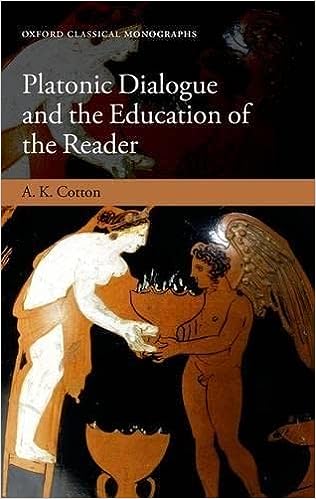
Platonic Dialogue and the Education of the Reader
A.K CottonVisit site ↗Cotton discusses the role of the reader in the dialogues as part of the greater philosophical pedagogy of the work.
- In the Reading Room
In The Reading Room with Plato, and Some Politicians
Aeon J. SkobleView title >Skoble discusses meritocracy and good governance in The Dialogues.
Connected Readings
What to read next.
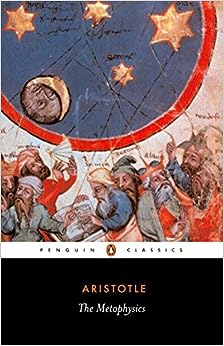 Book
Metaphysics
AristotleVisit site ↗Aristotle explores the nature of reality, being, and existence, touching upon similar ontological and metaphysical themes discussed in Plato's dialogues.
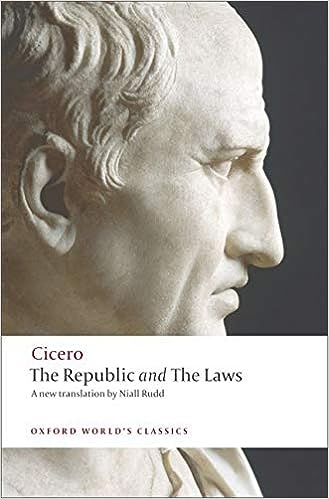 Book
The Republic
CiceroVisit site ↗Cicero engages with Plato's "Republic" and provides his insights and analysis. It offers a fresh perspective on Plato's ideas from a later Roman philosopher.
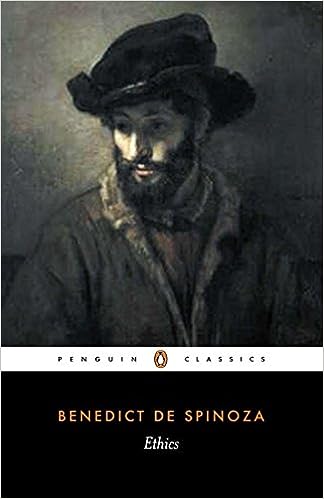 Book
The Ethics
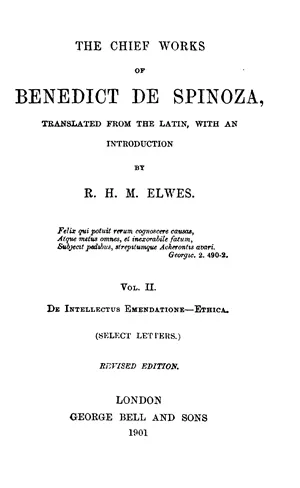
Baruch SpinozaVisit site ↗This work discusses ethics, metaphysics, and the nature of God, topics that have philosophical parallels to Plato's dialogues.
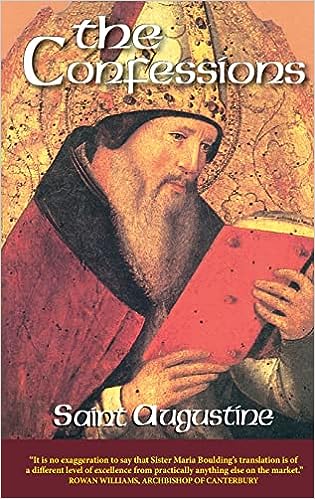 Book
The Confessions
Saint AugustineVisit site ↗This autobiographical work discusses Augustine’s journey to faith and philosophical reflections, touching on themes of self-knowledge and the search for truth present in Plato's dialogues.
 Podcast
The Life of Leadership with Hugh Liebert
Rebecca BurgessLiberty Law Talk
Visit site ↗In this podcast Liebert discusses statesmanship and systems of laws. Plato is a central figure in this discussion, from ideas of leadership to the allegory of Atlantis.
More in Philosophy, Psychology, and Religion
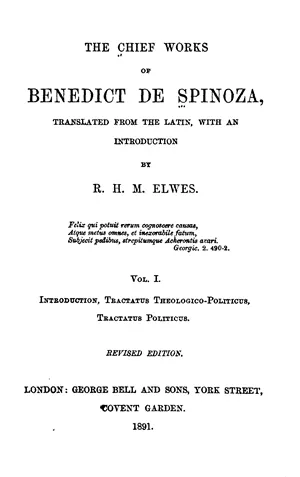
See all >The Chief Works of Benedict de Spinoza, vol 1
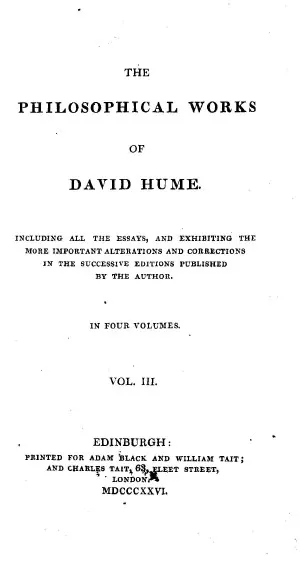
Benedict de SpinozaThe Philosophical Works of David Hume, vol. 3 (Essays Moral, Political, and Literary) (1828 ed.)
David HumeThe English Works, vol. X (Iliad and Odyssey)
HomerDialogues, vol. 5 - Laws, Index to the Writings of Plato
PlatoDialogues, vol. 4 - Parmenides, Theaetetus, Sophist, Statesman, Philebus
PlatoDialogues, vol. 3 - Republic, Timaeus, Critias
PlatoThe Works of John Locke, vol. 4 Economic Writings and Two Treatises of Government
John LockeThe Works, vol. 2 An Essay concerning Human Understanding Part 2 and Other Writings
John LockeThe Works, vol. 1 An Essay concerning Human Understanding Part 1
John Locke