

Stephanie Slade
Lead essay · Jun 07, 2021
It’s an old productivity maxim that a person who has multiple priorities in fact has no priorities. If priority denotes that item or consideration which exceeds all others in importance, then there can, as the movie trope goes, be only one.
This would seem to pose at least a potential problem for “fusionism”—the idea, most closely associated with the late National Review literary editor Frank S. Meyer, that the essence of American-style conservatism is a dual mandate to preserve bothliberty and virtue. To trade away one for the sake of the other, Meyer thought, would amount to a hollowing out of the American founding and, indeed, a rejection of the ideals of Western civilization itself.
But as our friendly neighborhood management consultant might point out, a person can’t have two No. 1 priorities. Undoubtedly, the demands of virtue and the presumption of liberty will at times conflict. In cases when one or the other must take precedence, which should it be?
There are those who insist the mark of conservatism is to err on the side of virtue over liberty when such a conflict arises. Heck, these days there are plenty of conservatives who think liberalism should be generally rejected, regardless of whether a virtue claim happens to be threatened by a liberty claim in any particular situation. The notion that freedom is a necessary component of the common good, one that we should be specially concerned with protecting, is almost entirely misguided, according to this view.
The post-liberal perspective gives surprisingly short shrift to inherited wisdom about the non-negotiable importance of individual freedom. (To choose just one among plentiful examples of the genre, Alexander Hamilton argued that “natural liberty is a gift of the beneficent Creator, to the whole human race” and “civil liberty is founded in that; and cannot be wrested from any people, without the most manifest violation of justice....It is conformable to the constitution of man, as well as necessary to the well-being of society.”)
But even those who think that freedom is important—but that it should submit to virtue when push comes to shove—are surrendering to a challenge too weak to defeat fusionism on the merits. Meyer’s writings show us that virtue and liberty can both be pre-eminent, so long as each is situated in its proper domain.
Separate Spheres
In his essay collection In Defense of Freedom: A Conservative Credo, Meyer takes pains to anticipate and dispense with the flimsiest strawmanning of his view: the accusation that fusionists think liberty is the highest good in life.
Meyer’s actual position, and a core element of the philosophy that would come to be known (against his preferences) as fusionism, is that liberty is the highest political good. To conflate that with the misrepresentation above is to conflate politics with life, reducing the richness of human existence to mere jockeying over elections and law.
In fact—as conservatives of all people should know—most of life happens in the immense space outside of politics. Faith and friendship; business and charity; art and sport—these and much else make up what might be called the non-governmental sphere of the human experience.
Here, virtue is the highest end. Freedom may be a consideration, but when it clashes with the true demands of morality, it should give way. The measure of a good life or a good society is the extent to which this principle is willingly observed.
The political domain, on the other hand—what we might call the governmental sphere,involving that entity with a monopoly on the legitimate use of physical force within a territory, in Max Weber’s famous phrase—has a humbler mandate. “The decisive criterion of any political order,” Meyer writes, “is the degree to which it establishes conditions of freedom.” Thus, the state should privilege the protection of basic rights and liberties (which includes enforcing laws against crimes like theft and assault) over the promotion of virtue.
Fusionists maintain that government exists to safeguard people’s freedom; a good government is one that fulfills this crucial but limited role in the vast social ecosystem. It does not follow that liberty is a greater good than virtue or that human beings exist for no higher end than to be free from all constraints—though that did not stop critics such as L. Brent Bozell Jr. from dismissing fusionism as “saddled with the notion that freedom comes first and virtue second.”
Meyer, for one, believed no such thing. “Ultimately, [achieving virtue] is the most important of problems,” he writes. “All that I am contending is that it is not a political problem, that it is not the concern of the state....Freedom, though it is the end of political theory and political action, is not the end of man’s existence. It is a condition, a decisive and integral condition, but still only a condition of that end, which is virtue.”
The Reason for Freedom
One of the great insights from In Defense of Freedom is that the governmental and non-governmental spheres represent “separate realms” that must be held to “very different” standards. A good life is a virtuous life, while a good state is one that respects people’s “right to live uncoerced by force or fraud in the possession of life, liberty, and property.”
The latter criterion is not arbitrarily chosen. For Meyer, it is an attempt to answer the question of “what political order, in the circumstances of any given place and era, will best conduce to the establishment and preservation of conditions most favorable to the pursuit of the ends of man’s existence.” He concludes that it is necessary to constrain the purpose of government in order to maximize the opportunity for human flourishing.
To be sure, there is no guarantee that people will reach their highest ends even under a regime of rightly limited government. Much work is required on the part of individuals, assisted by “the learned, the priestly, the prophetic”—men “devoted not to power, but to truth and good.”
But a state that makes virtue promotion its end, and is willing to sacrifice people’s freedom in the pursuit thereof, is a fox set to guard the hen house. Far from bringing about a good society, it is acutely likely to descend into tyranny. “So far as the increased power of the state to bring evil to the individual is concerned,” Meyer argues, “that power is directly proportional to the pretences the state makes to control men’s lives for good.”
Meyer was not an anarchist. He believed that government is necessary to keep society from descending into “a Hobbesian ‘war of all against all.’” Yet the concentration of power required to do that job well, he thought, ought to make us all perpetually wary.
“Since this institution must possess a monopoly of legal physical force, to give to it in addition any further power is fraught with danger,” he writes. “Step by step it amasses the decisive control of society. Each step makes the next one easier, and each step makes it harder to reverse the process.” To combat this threat, government should be limited to its essential functions—which is to say it should concern itself strictly with preserving the people’s freedom from coercion. As a popular internet meme might put it: The state has one job.
Besides the innate threat that a Leviathan presents, there is also a question of efficacy. Meyer worries that attempts to forcibly bring about a more virtuous society will instead make real virtue impossible. “Freedom can exist at no lesser price than the danger of damnation,” he writes, “and if freedom is indeed the essence of man’s being, that which distinguishes him from the beasts, he must be free to choose his worst as well as his best end. Unless he can choose his worst, he cannot choose his best.”
“To a certain extent, it is true,” he argues later: People “can be forced to act as though they were virtuous. But virtue is the fruit of well-used freedom. And no act to the degree that it is coerced can partake of virtue—or of vice.”
Better Than He Knew
Time and again, Meyer refers to the challenge posed by American conservatism having two sacrosanct pillars. It is, in essence, the dilemma identified by our productivity consultant. The pursuit of moral excellence necessarily binds and constrains us, while the prioritization of freedom necessarily brings with it the possibility of choosing vice.
“The difficulty is that both [of fusionism’s] major premises are true,” Meyer writes. “On the one hand, freedom is essential to the nature of man and neutral to virtue and vice; on the other hand, good ends are good ends, and it is the duty of man to pursue them.”
Although he denies that “these two premises are contradictories,” Meyer seems to think they are in fairly extreme tension with one another, pulling us perpetually in different ways. In other essays not included in this collection, he writes that Western civilization is “specifically distinguished by its ability” to live with that tension, even when it grows “spiritually almost unbearable.”
But is the tension unbearable? I would argue, to the contrary, that Meyer’s fusionist framework reconciles these “apparently opposed ends” by locating each in a distinct sphere where it can confidently reign supreme.
Let’s return to the initial conundrum: how to decide on a path forward in cases where the presumption of liberty points in one direction and the demands of virtue point in another. Meyer offers an elegant solution: First ask whether the question involves the use of state power. If it does, you’re in the governmental sphere, where liberty trumps. If it doesn’t, you’re in the non-governmental sphere, where virtue is the order of the day.
This method has, I admit, radical implications. It suggests that all public policy questions should be resolved on the side of libertarianism. A political program that makes virtue promotion its primary aim at the expense of individual freedom is dangerously disordered—recall the hen house. But so is a life philosophy that tries to achieve “liberation” from moral constraints. To transpose the proper end of one sphere onto the other is at least as likely to lead to ugly places as is trying to use a map of one land to navigate in another. It opens you up to either the tyranny of a too-powerful state (virtue as the highest end of government) or the tyranny of fallen man’s most vicious appetites (liberty as the highest end of life).
“A good society is possible only when both these conditions are met: when the social and political order guarantees a state of affairs in which men can freely choose,” Meyer writes, “and when the intellectual and moral leaders, the ‘creative minority,’ have the understanding and imagination to maintain the prestige of tradition and reason, and thus to sustain the intellectual and moral order throughout society.”
Under this framework, the apparent tension between virtue and liberty is dissipated. True, a good society can be achieved only if people in both spheres, armed with the courage of their fusionist convictions, are disciplined enough to resist blurring the boundaries of the two domains. But a solution to the two-priority problem is available to us, thanks in no small part to Meyer. Like the founders whose torch he saw himself carrying, he built better than he knew.
The Problem of Politics
None of this means we’re free of the problems of politics. Even if you accept that the sole purpose of government is to defend freedom, there surely will be tussling over what that charge entails.
For some, the pursuit of “freedom from want” justifies aggressive wealth distribution and other coercive interventions into the marketplace. For others, the freedom to terminate a pregnancy justifies lawsuits aimed at forcing Catholic hospitals to perform abortions. As should be clear, the fact that something can half-plausibly be defended using the rhetoric of freedom is not enough under the fusionist framework to make it proper for the state.
Luckily, Meyer gives us an able working definition of the liberty he has in mind: “The only equality that can be legitimately derived from the premises of the freedom of the person,” he writes, “is the equal right of all men to be free from coercion exercised against their life, liberty, and property.” Or as I’ve put it elsewhere, what we’re talking about is “freedom from aggression, coercion, and fraud.”
Still, there’s room for disagreement—and even grave error—when it comes to applying these ideas. Reading Meyer from the 21st century, it can be hard not to recoil from some of his substantive positions.
Consider Meyer’s view of the U.S. Civil War. In Defense of Freedom mentions this only in passing, as when he refers to “the undermining of the sovereignty of the several states by Abraham Lincoln.” But his work makes clear he has sympathy for the cause of secession—not because slavery was worth defending, but because keeping too much power from becoming concentrated at the federal level is the only way, to Meyer’s mind, of safeguarding liberty.
I don’t intend to impugn his intentions—Meyer always insisted, for example, that the cause of civil rights was eminently just, even as he denied that Washington had the right to intervene by force to end racial segregation in state or local institutions. But if you think, as Meyer did, that “what is meant by political freedom is the limitation of the power of the state to the function of preserving a free order,” it’s hard to imagine not seeing legally sanctioned slavery as an egregious violation of the government’s one job.
Under fusionism, a person’s right to be free from coercion no matter what is trumped by the obligation of the state to stop people from engaging in theft or assault. By the same logic, the federal government could be said to have a duty to step in if a lower level of government is infringing the fundamental human rights of some subset of the population.
Fusionism offers a philosophical roadmap for moving forward when liberty and virtue appear to conflict. The key is understanding whether a question is located in the domain of public policy or the domain of wider life. As Meyer demonstrated, even armed with the best possible directions and a firm grasp on our destination, we may still go astray. But it beats wandering in the wilderness unaided.
Jonathan Adler, Is Fusionism a Zombie Ideology?
In “Freedom and Virtue: Masters of Their Own Domains,” Stephanie Slade adroitly summarizes the late Frank S. Meyer’s “fusionist” political philosophy, highlighting Meyer’s insight that liberty and virtue, properly understood, are not in conflict with each other. To the contrary, true virtue can only be achieved under individual liberty. Accordingly, a proper concern for virtue is not merely compatible with an individualist political philosophy, it requires it.
The key question, and one to which Slade devotes inadequate attention, is whether Meyer’s fusionism retains any contemporary relevance. Some of Meyer’s specific policy views seem outdated and out-of-place in 21st century America, as Slade readily concedes. This is no surprise, as the issues of the day in the 1950s and 1960s, when Meyer did most of his writing, seem quite distant from the discrete policy fights of today. Accordingly, one may be tempted to discard Meyer’s fusionism as something of a Cold War relic that provides little guidance for today’s political questions, a zombie philosophy that survives in some corners but lacks any enduring insight. This view may be tempting, particularly for those who believe we have a new nationalist age, but it is mistaken.
Meyer’s philosophy was called “fusionist” because it fused the libertarian emphasis on individual liberty with a traditionalist emphasis on virtue. “A social order is a good social order to the degree that men live as free persons under conditions in which virtue can be freely realized, advanced, and perpetuated,” he wrote. A political tactician as much as he was a theorist, Meyer understood the need to build coalitions and advance practical policy programs. He got his hands dirty in policy activism and political campaigns. Yet he nonetheless believed political agendas should reflect enduring principles. His fusionist philosophy was anchored in immutable truths about human nature and the pursuit of virtue. As such, the philosophy endures, whether or not it retains the same degree of political appeal.
Meyer’s largely libertarian view of government was not based on a rejection of objective truth or embrace of moral relativism. To the contrary, it grew out of his conception of human nature. Individuals should be free to choose because that is what virtue itself requires. In his words, “good and truth cannot be enforced, because by their essential nature they cannot be made real in men unless they are freely chosen.”
Coercing individuals to engage in ostensibly virtuous acts would not actually produce virtue. At best it would produce no more than “a virtue that consisted in conforming one’s behavior to external dictation.” Granting such power to government risked the use of state power for ignoble ends. After all, those seeking to live truly virtuous lives would not be spending their days manipulating the levers of state power in an effort to control others. As Meyer often warned, power given to the state for even the best of reasons could readily be used for the worst of reasons, and often was. To hope that those in power would be prudent and virtuous themselves was “a slender reed” upon which to rest the defense of freedom or virtue. This insight is no less true today. If anything, we have decades more evidence in support of the claim.
Much of Meyer’s writing centered on an effort to distill the essence of a distinctly American conservatism. He had no interest in transplanting a conservative vision from abroad, for it would be alien to America’s governing institutions and traditions. In this sense, Meyer’s project was inherently liberal, for the American project—and our constitutional order—is founded on liberal principles. American conservatism, as Meyer saw it, consisted of six essential elements: (1) a belief in an objective moral order; (2) political individualism in opposition to collectivist ideologies; (3) anti-utopianism; (4) strict limitation of government power; (5) support for the U.S. Constitution, and (6) anti-Communism. All but the last of these remain relevant today. There is nothing outdated about a belief in traditional morality, adherence to constitutionalism, or opposition to collectivism and utopianism. To the contrary, these principles speak directly to current political conflicts.
Attempting to map the political positions of old onto the political conflicts of the moment is a risky task, but much of Meyer’s writing spoke to concerns that have re-emerged in the 21st century, albeit in an updated guise. He embraced the Hayekian critique of central economic planning, warning of the practical and political danger posed by government control of economic power. Whatever the dangers of woke capital, they are less than the danger of woke political control over capital. Meyer was also attuned to the dangers posed by the post-New Deal administrative state. Though not a dominant subject of his writing, Meyer’s critiques of overweening executive power and regulatory enforcement seem positively prophetic today.
Meyer revered the Constitution and its division and dispersal of government power, even if his understanding of our constitutional system was, at times, off-kilter. The Constitution of 1787, in Meyer’s view, “was the closest that human beings have come to establishing a polity which gives the possibility of maintaining at one and the same time individual liberty, underlying norms of law, and necessary public order.” It was this constitutional promise that a genuinely American conservatism would need to conserve.
Federalism was important to Meyer even if, under the influence of his National Review colleague James Kilpatrick, Meyer’s conception of federalism tilted a bit too far toward state sovereignty, and largely ignored the implications of the Reconstruction Amendments. This caused him to mistake the Constitution for a “compact” among the states and embrace Calhounian notions of interposition—and at a time when such notions were utilized to defend racial segregation. More than many of his contemporaries at National Review, he recognized how such notions were deployed in defense of racial subjugation and other evil purposes. Nonetheless, Meyer would not yield. He believed strict constitutional limits on federal power were essential, and needed to be observed in even the most trying circumstances. “A free constitutional order is precarious civilizational growth, he warned. “Once riven asunder, it is not easily attained again.”
Were Meyer still writing today, one suspects he would be a steadfast opponent of resurgent populism and identitarian creeds, whatever their political orientation. He disparaged the legacy of Andrew Jackson and rejected any form of racial identity. In Meyer’s view, the crude populism of George Wallace was “alien to the spirit of conservatism,” even if Wallace correctly assailed the “naked elitism” of contemporary progressives. A man of principle, no amount of liberal tears could lead to Meyer’s endorsement of Wallace’s agenda, even if the conventional Republican alternative was wanting. One suspects he would have had a similar reaction to the 21st century populism of Donald Trump. MAGA could not make America great again if it failed to preserve the limits on governmental power that were a core component of that greatness.
As a fierce opponent of collectivism in all its forms, today’s tribal politics would have caused Meyer great concern. His opposition to collectivism was nonpartisan and nonstrategic. Led by principle, he opposed collectivism in every form, even when embraced by potential political allies. He sharply criticized Russell Kirk and other “new conservatives” of the 1950s for failing to reject the “collectivist spirit of the age.” There is little reason to think he would not respond to the renewed conservative nationalism in equivalent terms. Practical political calculations would not justify an embrace of conservative identitarianism, even if divorced from its cruder ethnic manifestations. Practical political considerations could not justify the abandonment of principle.
This may be the most important message to draw from Meyer’s work. Whether or not his precise formulation of fusionism or American conservatism maintain their political resonance, his emphasis on subordinating political agendas to timeless principle can provide a compass point for contemporary debates. Winning is not its own reward. Political victories are only worthwhile insofar as they advance a worthwhile cause. And if victories on such grounds cannot be achieved today, priority must be placed on changing those underlying conditions. In this fashion, Meyer’s fusionism is not only an aid to navigating the wilderness, but a reminder of why the trek is worthwhile.
Jonathan H. Adler
Response · Jun 09, 2021 · Own page

In “Freedom and Virtue: Masters of Their Own Domains,” Stephanie Slade adroitly summarizes the late Frank S. Meyer’s “fusionist” political philosophy, highlighting Meyer’s insight that liberty and virtue, properly understood, are not in conflict with each other. To the contrary, true virtue can only be achieved under individual liberty. Accordingly, a proper concern for virtue is not merely compatible with an individualist political philosophy, it requires it.
The key question, and one to which Slade devotes inadequate attention, is whether Meyer’s fusionism retains any contemporary relevance. Some of Meyer’s specific policy views seem outdated and out-of-place in 21st century America, as Slade readily concedes. This is no surprise, as the issues of the day in the 1950s and 1960s, when Meyer did most of his writing, seem quite distant from the discrete policy fights of today. Accordingly, one may be tempted to discard Meyer’s fusionism as something of a Cold War relic that provides little guidance for today’s political questions, a zombie philosophy that survives in some corners but lacks any enduring insight. This view may be tempting, particularly for those who believe we have a new nationalist age, but it is mistaken.
Meyer’s philosophy was called “fusionist” because it fused the libertarian emphasis on individual liberty with a traditionalist emphasis on virtue. “A social order is a good social order to the degree that men live as free persons under conditions in which virtue can be freely realized, advanced, and perpetuated,” he wrote. A political tactician as much as he was a theorist, Meyer understood the need to build coalitions and advance practical policy programs. He got his hands dirty in policy activism and political campaigns. Yet he nonetheless believed political agendas should reflect enduring principles. His fusionist philosophy was anchored in immutable truths about human nature and the pursuit of virtue. As such, the philosophy endures, whether or not it retains the same degree of political appeal.
Meyer’s largely libertarian view of government was not based on a rejection of objective truth or embrace of moral relativism. To the contrary, it grew out of his conception of human nature. Individuals should be free to choose because that is what virtue itself requires. In his words, “good and truth cannot be enforced, because by their essential nature they cannot be made real in men unless they are freely chosen.”
Coercing individuals to engage in ostensibly virtuous acts would not actually produce virtue. At best it would produce no more than “a virtue that consisted in conforming one’s behavior to external dictation.” Granting such power to government risked the use of state power for ignoble ends. After all, those seeking to live truly virtuous lives would not be spending their days manipulating the levers of state power in an effort to control others. As Meyer often warned, power given to the state for even the best of reasons could readily be used for the worst of reasons, and often was. To hope that those in power would be prudent and virtuous themselves was “a slender reed” upon which to rest the defense of freedom or virtue. This insight is no less true today. If anything, we have decades more evidence in support of the claim.
Much of Meyer’s writing centered on an effort to distill the essence of a distinctly American conservatism. He had no interest in transplanting a conservative vision from abroad, for it would be alien to America’s governing institutions and traditions. In this sense, Meyer’s project was inherently liberal, for the American project—and our constitutional order—is founded on liberal principles. American conservatism, as Meyer saw it, consisted of six essential elements: (1) a belief in an objective moral order; (2) political individualism in opposition to collectivist ideologies; (3) anti-utopianism; (4) strict limitation of government power; (5) support for the U.S. Constitution, and (6) anti-Communism. All but the last of these remain relevant today. There is nothing outdated about a belief in traditional morality, adherence to constitutionalism, or opposition to collectivism and utopianism. To the contrary, these principles speak directly to current political conflicts.
Attempting to map the political positions of old onto the political conflicts of the moment is a risky task, but much of Meyer’s writing spoke to concerns that have re-emerged in the 21st century, albeit in an updated guise. He embraced the Hayekian critique of central economic planning, warning of the practical and political danger posed by government control of economic power. Whatever the dangers of woke capital, they are less than the danger of woke political control over capital. Meyer was also attuned to the dangers posed by the post-New Deal administrative state. Though not a dominant subject of his writing, Meyer’s critiques of overweening executive power and regulatory enforcement seem positively prophetic today.
Meyer revered the Constitution and its division and dispersal of government power, even if his understanding of our constitutional system was, at times, off-kilter. The Constitution of 1787, in Meyer’s view, “was the closest that human beings have come to establishing a polity which gives the possibility of maintaining at one and the same time individual liberty, underlying norms of law, and necessary public order.” It was this constitutional promise that a genuinely American conservatism would need to conserve.
Federalism was important to Meyer even if, under the influence of his National Review colleague James Kilpatrick, Meyer’s conception of federalism tilted a bit too far toward state sovereignty, and largely ignored the implications of the Reconstruction Amendments. This caused him to mistake the Constitution for a “compact” among the states and embrace Calhounian notions of interposition—and at a time when such notions were utilized to defend racial segregation. More than many of his contemporaries at National Review, he recognized how such notions were deployed in defense of racial subjugation and other evil purposes. Nonetheless, Meyer would not yield. He believed strict constitutional limits on federal power were essential, and needed to be observed in even the most trying circumstances. “A free constitutional order is precarious civilizational growth, he warned. “Once riven asunder, it is not easily attained again.”
Were Meyer still writing today, one suspects he would be a steadfast opponent of resurgent populism and identitarian creeds, whatever their political orientation. He disparaged the legacy of Andrew Jackson and rejected any form of racial identity. In Meyer’s view, the crude populism of George Wallace was “alien to the spirit of conservatism,” even if Wallace correctly assailed the “naked elitism” of contemporary progressives. A man of principle, no amount of liberal tears could lead to Meyer’s endorsement of Wallace’s agenda, even if the conventional Republican alternative was wanting. One suspects he would have had a similar reaction to the 21st century populism of Donald Trump. MAGA could not make America great again if it failed to preserve the limits on governmental power that were a core component of that greatness.
As a fierce opponent of collectivism in all its forms, today’s tribal politics would have caused Meyer great concern. His opposition to collectivism was nonpartisan and nonstrategic. Led by principle, he opposed collectivism in every form, even when embraced by potential political allies. He sharply criticized Russell Kirk and other “new conservatives” of the 1950s for failing to reject the “collectivist spirit of the age.” There is little reason to think he would not respond to the renewed conservative nationalism in equivalent terms. Practical political calculations would not justify an embrace of conservative identitarianism, even if divorced from its cruder ethnic manifestations. Practical political considerations could not justify the abandonment of principle.
This may be the most important message to draw from Meyer’s work. Whether or not his precise formulation of fusionism or American conservatism maintain their political resonance, his emphasis on subordinating political agendas to timeless principle can provide a compass point for contemporary debates. Winning is not its own reward. Political victories are only worthwhile insofar as they advance a worthwhile cause. And if victories on such grounds cannot be achieved today, priority must be placed on changing those underlying conditions. In this fashion, Meyer’s fusionism is not only an aid to navigating the wilderness, but a reminder of why the trek is worthwhile.
Henry Olsen
Response · Jun 14, 2021 · Own page

Stephanie Slade’s essay on Frank Meyer’s “fusionism” aptly reminds us how libertarian a thinker Meyer actually was. American political history, however, shows us how unrealistic his thought was and remains.
Slade contends that Meyer argued that freedom and virtue can coincide and mutually support one another only if each understands its proper domain. Freedom’s domain is politics; virtue’s domain is private life, unencumbered and unaided by support from public life. Once advocates for virtue understand their limited, but purportedly important, role, there is no inherent tension between them and those who advocate for freedom as the highest good. Virtue, shorn of any legitimate political claim upon freedom, becomes freedom’s handmaid.
In actual political life, however, those who believe that virtue ought to be the primary goal do not believe this and never have. Whether one looks at ancient Israel, the Greco-Roman world, medieval Europe, or America itself, those who contend there is a single right way of life always seek to control or influence public space and law so that that way is endorsed or made easier by public pronouncement. Sometimes it takes a “hard” interpretation of this, such as when Athens condemned Socrates to death for impiety and corrupting the young, or during the Middle Ages when the sovereign carved out space in matters temporal while giving the Church authority over matters spiritual. Nineteenth century European politics was riven by sharp clashes between Catholics, who insisted insofar as possible on controlling education, and Liberals, who fought for the establishment of public, non-sectarian schools. The very belief that there is such a thing as virtue and that all can and ought to share in its glory precludes those who believe in it from easily and readily ceding the public square to libertarian freedom.
American life is and has been no different. American religious authorities have long sought to use the public square as a surrogate pulpit, at least in matters where religious ideas can influence public mores. Hence the battles over laws mandating businesses to close on Sundays and over Prohibition, right down to modern-day battles over prayer in public schools, abortion, and same-sex marriage. Nor is this inclination limited to the right. Left-leaning religious institutions have championed government involvement in the economy and supported welfare state measures at all levels of government. Virtue, it seems, simply does not want to stay locked in the closet.
The persistence of this impulse is readily apparent in how Meyer’s concept of “fusionism” actually worked out in modern politics. Advocates of freedom and virtue did come together politically and understood that each would be master of their domain. But they understood the contours of that domain much differently than did he.
Movement conservatism, fusionism’s political expression, understood that each side would be masters of public policy respecting its primary concerns. Friends of freedom were granted primacy in matters of economics and most domestic policies, while lovers of virtue were accorded sovereignty over what became known as “social issues.” Conservatism to this day is defined by this embrace. A conservative will support cutting taxes and regulations and even in rare instances try to reduce public spending. That person will also oppose same-sex marriage and fight for pro-life legislation, and often back religious voters’ priorities on other matters that don’t require taxation or affect economic activity. That person wants to keep the state in the bedroom while getting it out of the boardroom and simply does not view those positions as contradictory.
Meyer’s views do have political expression in the Libertarian Party, and that entity’s conspicuous and copious failure to gain any political traction is stark testimony regarding the possibility that Meyer’s dream will walk. Nor is this simply a statement of current mores. There is no time in American history when the American body politic was governed by Meyer’s principles.
The Founding era, often held up as an ideal time by liberty lovers, was governed by non-libertarian principles in both the moral and the temporal spheres. Meyer, as Slade demonstrates, believed that government’s only legitimate function was to prevent people using force against one another. Yet from the earliest times the colonies and the newly independent country took much more expansive views. Thomas Jefferson’s Notes on the State of Virginia, for example, describes how local governments used public funds to support and rehabilitate the poor. The Ordinance of 1785 established the township as the central governmental entity of land in the northwest territories and mandated that one section of each township had to be reserved for a school. State governments owned and operated canals and railroads, too. Meyer’s belief that government interference in the economy is illegitimate is one that even Americans before the Civil War did not accept.
Meyer’s beliefs about that war, and about Abraham Lincoln, speak volumes about his true priorities. Slade glosses over Meyer’s views, noting that he both supported Southern secession and thought Lincoln paved the way for the expansion of federal power that would come after him. Her treatment is much too kind. Jonathan Adler’s essay on Meyer’s thought puts it more starkly. He quotes Meyer as saying Lincoln pursued a “repressive dictatorship” and promoted an “authoritarianism” that was “in terms of civil liberties, the most ruthless in American history”. This is more than hyperbole; it is hatred bordering on irrationality, one triggered by Lincoln’s refusal to allow Southern states to secede from the Union in order to preserve black chattel slavery.
The South’s desire to do that can only be understood as a warped version of a virtue claim. By 1860, Southerners who favored secession actively promoted the “positive good” theory of slavery. They believed, or at least they claimed they did, that the black man was incapable of governing himself and that as a result it was in the black man’s interest that he be held as property by the supposedly superior white man. As with all who place some version of virtue ahead of liberty as a public priority, they needed and sought public protection and control over public laws. They insisted that they be permitted to take their slaves with them into federal territories regardless of the will of Congress or the people in those territories. And when Lincoln’s Republican Party narrowly won the 1860 election, they sought to dissolve the Union rather than permit a democratic majority to even begin to enact laws based upon the idea of black man’s humanity. Meyer did not defend that position, but he so hated any exercise of federal power that he was willing to enthusiastically argue on the deceased slaveholders’ behalf over an issue that the War itself settled.
Meyer’s obsession with the power of a state vis-à-vis the federal government emerges again with regard to civil rights. He argued against Brown v. Board of Education’s desegregation of schools and opposed President Dwight D. Eisenhower’s sending of federal troops to Little Rock, Arkansas to enforce that decision. He opposed federal civil rights laws that sought to end Jim Crow as well as those that sought to end private discrimination against blacks. Nor does he appear to have backed the Voting Rights Act of 1965 or any other federal measure that would ensure that blacks could effectively exercise the right to vote guaranteed to them by the 15th Amendment. This is an appalling omission for someone whose other writings sing with praise of human liberty.
This omission is a feature, not a bug, of Meyer’s thought. That feature – the idea that issues of political power ought to take precedence over every other concern of human life – renders his thought politically impotent. The truth is that the pursuit or protection of that liberty has never been, and never will be, the central hub around which American politics radiates. American political life has always had two distinct but related hubs, justice and democratic self-government, and it is the interplay between them that defines and explains our two-plus centuries of political life. Americans, unlike most peoples in human history, have always understood that justice requires a large measure of human liberty and a substantial dose of human virtue. But Americans will always bend one or both of these ideas to force their submission to either democracy, justice, or both.
Frank Meyer, in thought or in deed, would submit to no one and no thing. As such, the libertarian “fusion” he dreamed of makes no compromise to America’s political character or political temperament. American conservatives owe him a debt of gratitude for helping inadvertently to create the modern conservative movement that defeated Soviet Communism and held socialism at bay for forty years. Beyond that, neither conservatives nor Americans more broadly owe him deference or reverence. His political tunes are and will be appreciated only by select audiences.
William C. Dennis
Response · Jun 16, 2021 · Own page
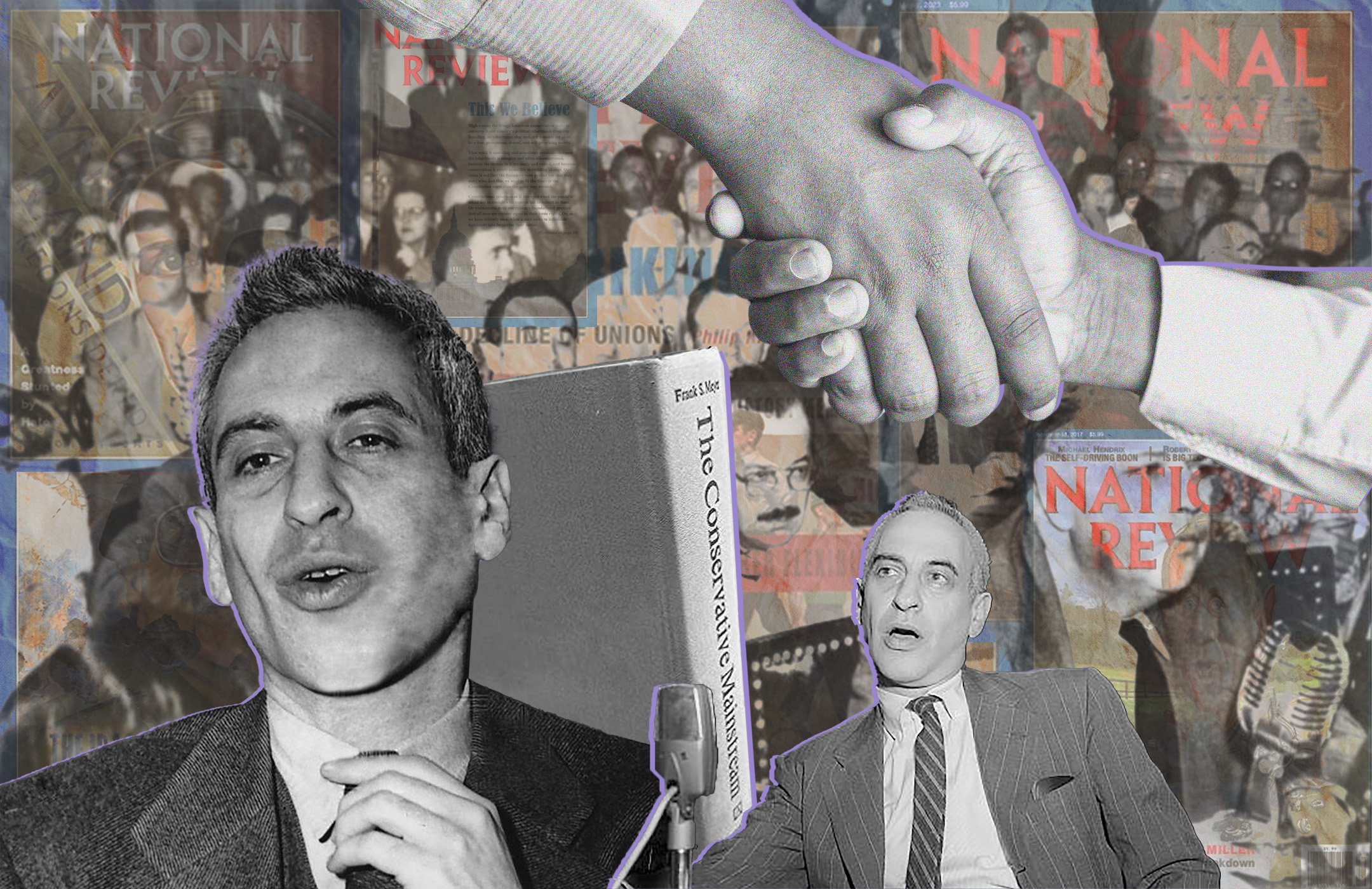
Liberty Fund has a long history with Frank S. Meyer (as do I) going back at least to 1980 with a proposal by David Franke to republish In Defense of Freedom: A Conservative Credo, a project returned to off and on and eventually completed in 1996, as In Defense of Freedom and Related Essays, which I edited, and for which I wrote a foreword along with a private memo to the Liberty Fund Board of Directors. Since then, there have been at least three Liberty Fund colloquia on Meyer and his argument for what came to be called “fusionism”.
My own history with Meyer included meetings of the Philadelphia Society in Chicago and two road trips to visit Meyer at his home in Woodstock, New York, in the 1960s. In a long memorial to Meyer in National Review, April 28,1972, C. H. Simonds wrote of his trip to Woodstock:
“The way to Frank’s wound through the little town, along and then across Tannery Brook and up Ohayo Mountain to a trim white house tucked among old trees. Frank came to the door in uniform—turtleneck, baggy pants held up by bright red suspenders with “POLICE” on the clips—ushered one in, made a drink. Elsie appeared . . .made one welcome in the kitchen . . . books from floor to ceiling . . . the house was insulated not with rock wool or Fiberglass but with the wisdom of the West.”
Yes.
Meyer died on Holy Saturday, 1972, a few hours after being baptized into the Catholic Church. I find it interesting that the author of the fine essay before us, Stephanie Slade, managing editor of the libertarian magazine Reason is herself, as she writes in the March 2021 Reason article, “Is There a Future for Fusionism,” “a churchgoing Roman Catholic,” a libertarian “uneasy with secularism and community break down.” As such she is an ideal author to bring to our attention again Meyer and the true nature of fusionism. I welcome her for it. Meyer deserves a revival.
Slade begins her essay with a summary of what she describes as “a well-worn tale” of the origins of fusionism, an uneasy coalition of economic libertarians and religious traditionalists, held together by the charisma of William F. Buckley, Jr. and the shared enemy of global communism. I would add to this list a hostility to the New Deal and its expansion after WW II. There was a large and contentious pamphlet literature about whether such a coalition was possible. Meyer’s In Defense of Freedom was his answer to this argument.
Slade shows in her article for this symposium that for Meyer the libertarian-conservative alliance was not a mere marriage of convenience, but a bond, a union, between two perspectives on the same question: how should we live? As she states well, freedom is the ideal for the political order, or governmental sphere, so that humans may choose for themselves how to act virtuously in the social order. Coerced or compelled virtue is not virtue at all. Slade gets this important point, that so many of Meyer’s critics miss, and explains it well. As Meyer argued, achieving virtue is the most important of problems, but… “I am not contending that it is a political problem, that it is not the concern of the state…. Freedom, though it is the end of political theory and action, is not the end of man’s existence.” And Slade makes another important point, also often neglected: For Meyer his formulation of the freedom/virtue tension was not a novel one but was inherent in the American Founding itself and in the philosophical roots upon which it was based. In Meyer’s own words: “Neither virtue nor freedom alone, but in the ineluctable combination of virtue and freedom is the sign and spirit of the West.”
Meyer dedicated his 1964 collection of essays, What is Conservatism? (there is a new 2015 edition of this book, with a foreword by Jonah Goldberg) to his friend Richard M. Weaver, “pioneer and protagonist of the American conservative consensus.” In his well known essay, “Conservatism and Libertarianism: The Common Ground,” Weaver writes:
In conclusion, I maintain that the conservative in his proper character and role is as a defender of liberty. He is such because he takes his stand on the real order of things and because he has a very modest estimate of man’s ability to change that order through the coercive power of the state. He is prepared to tolerate diversity of life and opinion because he knows that not all things are of his making and that it is right within reason to let each follow the law of his own being.
That is a pretty good definition of libertarianism. Meyer quotes this passage too in “Richard M. Weaver: An Appreciation” in Modern Age, Summer-Fall 1970.
Two additional points:
Slade quotes Meyer as saying that to a certain extent people can be forced to act as though they were virtuous. “But virtue is the fruit of well-used freedom. And no act to the degree that it is coerced can partake of virtue—or vice.” I would like this to be so, but I am not sure it is true. Over time, perhaps over a generation, can a coerced act become a habit or just an unquestioned situation, and can the habit then become thought of as a virtue? I have worried over this issue a long time. Relatedly how can a country have a virtuous people if they are dependent on help from their government for their daily existence. Take me as an example, I am in my eightieth year, comfortably off, yet I have Medicare, Social Security, a big mortgage, and charitable gift deductions. I did not ask for any of these benefits. Indeed, I oppose them all, but I have certainly organized a good bit of my life to take advantage of these subsidies. And I got a stimulus check!
And here is a point, for which I think Slade would have some agreement. Some think that libertarianism unchecked by State-promoted virtuous conduct will lead to a libertinism that threatens liberty itself. But I would argue that, as with the market which corrects its errors over time, unchecked libertinism, in a free society, will be largely self-correcting. But then the libertine must be allowed to pay for his own mistakes. Indeed, his freedom to act will allow him over time to discern his mistakes for himself. Yet today we live in a therapeutic society where the governmental sphere not only forgives mistakes but provides programs at public expense to repair any damages. Quoting Richard Weaver again: both conservatives and libertarians, “…believe that there is an order of things which will largely take care of itself if you leave it alone. There are operating laws in nature and human nature which are best not interfered with or not interfered very much. If you try to change or suspend them by government fiat, the cost is greater than the return, the disorganization is expensive, the ensuing frustration painful.”
In his own day Mayer, if not exactly a winner in a contest, spoke to many Americans of various persuasions on the right that fusionism made sense. Returning, in conclusion to Slade’s brief history of fusionism with which I began, “As long as the Cold War endured…each wing [of the fusionist coalition] was willing to cede some ground to the other…[T]he differences between the libertarians and the traditionalists did not seem so great. Their interests, at least, were aligned.” But with the collapse of the Soviet empire, changing mores, new technologies, conspicuous consumerism, a growing dependence on government handouts and crony capitalism, a growing sense, in some quarters, of American economic and moral decline, Slade writes that “…in the last few years the alliance’s inherent tensions have come to a head. It's increasingly common to hear that, whatever value there may have been in cooperation during the ‘50s, ‘60s, ‘70s ‘and ‘80s, the era of good conservative feelings is over.” Often the airing of these differences has been acrimonious and uncompromising without much meeting of the minds.
But Meyer loved to argue and debate too. He wrote dozens of articles and columns about fusionism and traveled widely to give speeches at colleges and seminars. Despite his somewhat ferocious style on the podium, Murray Rothbard wrote of him that it was one of Meyer’s “remarkable attributes that without giving an inch in argument, he was able to separate the personal from the ideological more clearly than almost anyone I have known: and so, he could continue to be close friends with people who differed sharply from him in many areas.” We could use more of this. Stephanie Slade has been one to do this recently, speaking and writing about Meyer and fusionism lately, at the Acton Institute, with Jonah Goldberg at the Remnant, with Oren Cass at American Compass, and elsewhere. Her interview with Oren Cass was especially cordial on both their parts. She seems to have become a new ambassador for fusionism able to exchange views cheerfully, cordially, and thoughtfully. With her work and Donald J. Devine’s new “fusionist” look at most of world history, The Enduring Tension: Capitalism and the Moral Order, fusionism has not exhausted its course.
Good.
Stephanie Slade
Righteous Meddling and Human Excellence · Jun 21, 2021

“American religious authorities have long sought to use the public square as a surrogate pulpit,” writes Henry Olsen. “Virtue, it seems, simply does not want to stay locked in the closet.”I thank him for bringing a dose of historical description to Frank Meyer’s prescriptive work. It is certainly true that “those who contend there is a single right way of life” have often sought “to control or influence public space and law so that that way is endorsed or made easier by public pronouncement.”But should we conclude that this human tendency is right, or that the struggle against it is a waste of effort? That is not so clear. Sin is a human tendency too, after all. In J.R.R. Tolkien’s masterwork, the exasperating failure of one ring bearer after another to resist the lure of power is not supposed to be taken as a sign that power isn’t dangerous or worth combatting.Meyer anticipates this very objection. “That the ideal can never be realized in an imperfect world is no more reason for giving up the effort to move towards it than—to use an analogy from mechanics—the impossibility of ever achieving the perfect frictionless machine is reason to give up the effort to reduce friction to a minimum,” he writes. “Nor, however much contemporary circumstances inhibit an easy or quick achievement of a markedly closer approximation to the ideal, is this a valid objection to the judgment of those circumstances in the light of an ideal end.”Meyer’s claim here is this: The extent to which a society operates in accordance with the “fusionist” framework—that is, the extent to which the governmental sphere is oriented to protecting individual rights and liberties and the non-governmental sphere is oriented to the pursuit of virtue—the better it is. Working toward a freer and more virtuous society is worthwhile even if mankind will never fully achieve either.It’s more or less a truism to say that the more moral a population is—concerned with the pursuit of human excellence and possessing habits and consciences well-formed for that pursuit—the better it is. Likewise, the more effectively a state carries out its duty to preserve life, liberty, and property—and the more restrained it is in exercising its awesome coercive power when it isn’t absolutely necessary—the better it is (and the better off we all are). Some states come closer than others on this score. That too is an empirical reality and should be reason enough to strive.The fact that history—including American history, Olsen helpfully reminds us—is full of righteous meddling by the state illustrates one of the points of my earlier essay: that Meyer’s fusionism was more of an innovation than even he realized.The deep-seated desire to prioritize both liberty and virtue was not new. It permeated the rhetoric of the American founders and the writings of Adam Smith. For centuries before the emergence of fusionism, people understood that both are necessary and neither alone sufficient. What they lacked was a framework for putting that intuition into practice. Meyer was the first to articulate a straightforward answer, showing us how to keep virtue and liberty from pulling antagonistically against each other. It is now within our power to move toward greater harmonization of the two, even if we continue to be limited (as in all things) by our baser natures.I thank Jonathan Adler for raising another common objection to Meyer’s thought: that it was suited to the Cold War era in which he wrote but has little modern relevance. He correctly points out that this critique misses fusionism’s timeless qualities. Meyer “believed political agendas should reflect enduring principles,” Adler writes. “His fusionist philosophy was anchored in immutable truths about human nature and the pursuit of virtue. As such, the philosophy endures, whether or not it retains the same degree of political appeal.”According to Adler, Meyer gave us more than a substantive theory about the separation of the governmental and non-governmental spheres of life. He also modeled a “nonpartisan and nonstrategic” approach to politics, one in which “practical political considerations could not justify the abandonment of principle.” For Meyer, Adler says, “winning is not its own reward. Political victories are only worthwhile insofar as they advance a worthwhile cause.” That lesson could hardly be more pertinent for conservatives today.Finally, I thank William Dennis for adding a layer to the argument about how a big, interventionist government can be a problem even from a traditionalist perspective. Meyer tended to focus on the risk that a state with enough power to enforce its idea of virtue on the population would eventually descend into tyranny. Dennis points to a softer threat: the ways that government programs breed dependence, which in turn interferes with the attainment of virtue.While a robust welfare state may seem to lead to human flourishing, the tradeoffs can be large and unexpected. I have pointed out that big government can erode not only the incentive to work hard and pursue self-sufficiency but also the sense that we are personally responsible for helping our neighbors in need. Dennis, channeling the late historian Richard M. Weaver, notes that by shielding people from the consequences of unvirtuous choices, it can become more difficult for us to learn from them. “I would argue that, as with the market which corrects its errors over time, unchecked libertinism, in a free society, will be largely self-correcting,” he writes. “But then the libertine must be allowed to pay for his own mistakes.”The attainment of human excellence is always an uphill climb. But post-liberal conservatives who believe the state can help through the coercive enforcement of virtue might need to think harder about how exercises of government power are currently making the ascent steeper than it needs to be.Jonathan H. Adler
Conservatives' Burden · Jun 23, 2021

I appreciate the opportunity to continue this discussion of Frank Meyer and fusionism with Stephanie Slade, Bill Dennis and Henry Olsen. As should be clear from my initial contribution, I agree with Slade about the merits of Meyer’s underlying vision. I also think more can be said in response to the contemporary challenges from some on the Right who urge greater governmental intervention in the name of promoting virtue or advancing the national interest.In considering whether the promotion of virtue should be the object of governmental intervention, it is necessary to consider both the nature of virtue and the capacity of governmental intervention. On the former, Meyer maintained that true virtue had to be freely chosen. Coerced observance of proper rules may minimize social conflict, if not virtue. Intent matters. When we turn to government action, however, intent is not enough. Even the most well-intentioned governmental action may fail to achieve its goals. In many cases, it may even be counterproductive.Those conservatives who would argue against Meyer’s formulation have a particularly heavy burden to carry, as they must maintain both that coercing virtue is desirable and that government—and the federal government in particular—is capable of providing inducements for virtuous conduct that will actually succeed. So even if one rejects Meyer’s individualist conception of what makes for virtuous action, one must still articulate why the federal government is going to be more proficient at directing the production of virtue than it is at directing the production of mundane goods and services.Meyer was influenced by the work of F.A. Hayek, which demonstrated the folly of central economic planning. Were he alive today, he would no doubt be further influenced by the wealth of social science research showing how governmental intervention has done far more to emasculate and hobble the institutions of civil society than it has done to reinforce them. Pervasive governmental intervention in nearly all aspects of private life has done more to atomize our existence and undermine virtuous pursuits than a libertarian conception of the state ever could.Meyer the political strategist would also likely observe that allowing the state to cater to the state of people’s souls would directly empower those forces most responsible for challenging traditional moral constraints on individual behavior. A wise sage once said that the problem with socialism is that it takes up too many of one’s afternoons. The time spent planning and directing is time few people have. Statecraft as soulcraft is no different. Should we embrace the idea that governments should intervene to direct, encourage, and proselytize virtue, it will not be those who advocate for the traditional family or classical conceptions of virtue who will be at those committee meetings or populating the bureaucracy of virtue. Those folks have better things to do with their time. Rather it will be those who seek to use the state to upset the traditional moral order and eviscerate traditional mediating institutions. Such interventions not only make the climb toward virtue “steeper than it needs to be,” as Slade warns. It is an invitation and opportunity for those who would instead encourage descent.Henry Olsen
Conservatism: A Better Guarantor of Liberty · Jun 28, 2021
Stephanie Slade’s response robustly defends Frank Meyer’s libertarian vision. Essential to that vision is the idea that virtue can be successfully cultivated without appreciable – or even any – support from society at large. This point is often where conservatives depart from libertarians, and so too it must be with Stephanie and myself. It is also why I believe American conservatism, for all its internal contradictions and faults, is a better guarantor of human liberty than libertarianism.Human beings always struggle with a battle between the “I” and the “we”. The individual “I” shares space and life with many other I’s, bringing about a “we”. Since we alone of the animals possess reason and the ability to discern right and wrong, the human “we” also always involves some attempt to define right and then apply that understanding to society’s members. This seems to be natural; one simply cannot find a human society throughout history that has not done this. The libertarian, like Meyer, struggles against this truth. The conservative accepts it and seeks to make the pursuit of ordered liberty a central part of the “we” narrative that shapes a free society.Constructing a “we” that appreciates and cultivates liberty means giving aggrieved people an opportunity to right perceived wrongs through orderly societal mechanism. There is no neat separation that applies always and everywhere as to what types of problems will be brought before that mechanism. Meyer’s libertarianism looks at the vast bulk of issues that have historically been solved through politics and says they should be excluded from consideration. In effect, he argues that society should say, “not my problem” to hurt and angry members of the society.Aggrieved by a sexual morality that breaks up marriages, spreads disease, and irretrievably damages too many children? “Not my problem”. Angry that white Southerners have subjected you, a black American, to a system that degrades, humiliates, and infantilizes you? “Not my problem”. Meyer’s formulation could work only if one believes that people aggrieved by actions of a minority that strongly disadvantage them will eschew a potential remedy out of devotion to the ideal of liberty. That’s simply not what real people do.The Great Depression is perfect example of that. Herbert Hoover’s response to the misery economic collapse caused was to argue that his hands were tied by the Constitution. He urged people to remain devoted to “the American system” of “ordered liberty” and “voluntary co-operation” regardless of the pain they were experiencing. He essentially told the American people that he really cared about their plight, but that ultimately alleviating it was not his problem. Franklin Roosevelt won that election in a landslide, ushering the New Deal and the permanent transformation of the American system in which we live today. That may not have been the best outcome for American liberty.People who are being treated unjustly, or perceive they are being treated unjustly, will not simply shrug in the face of injustice. If necessary, they will use whatever political means they possess to remedy that injustice, not infrequently placing themselves at the mercy of a leader who promised to wield untrammeled power on their behalf. In a well-ordered polity, this brings forth Abraham Lincoln or David Lloyd George. In others where the public “we” narrative does not contain strong respect for ordered liberty, it brings the tyrant.Liberty and virtue are inextricably intertwined like the two snakes on a caduceus. A good, free society supports both at once, giving public voice to both in the “we” narrative upon which it rests. Separating the two as Meyer provides would be like trying to divide Siamese twins and hoping that both live. Liberty is too precious to risk it so casually.William C. Dennis
Virtuecrats versus Liberty for All · Jun 30, 2021
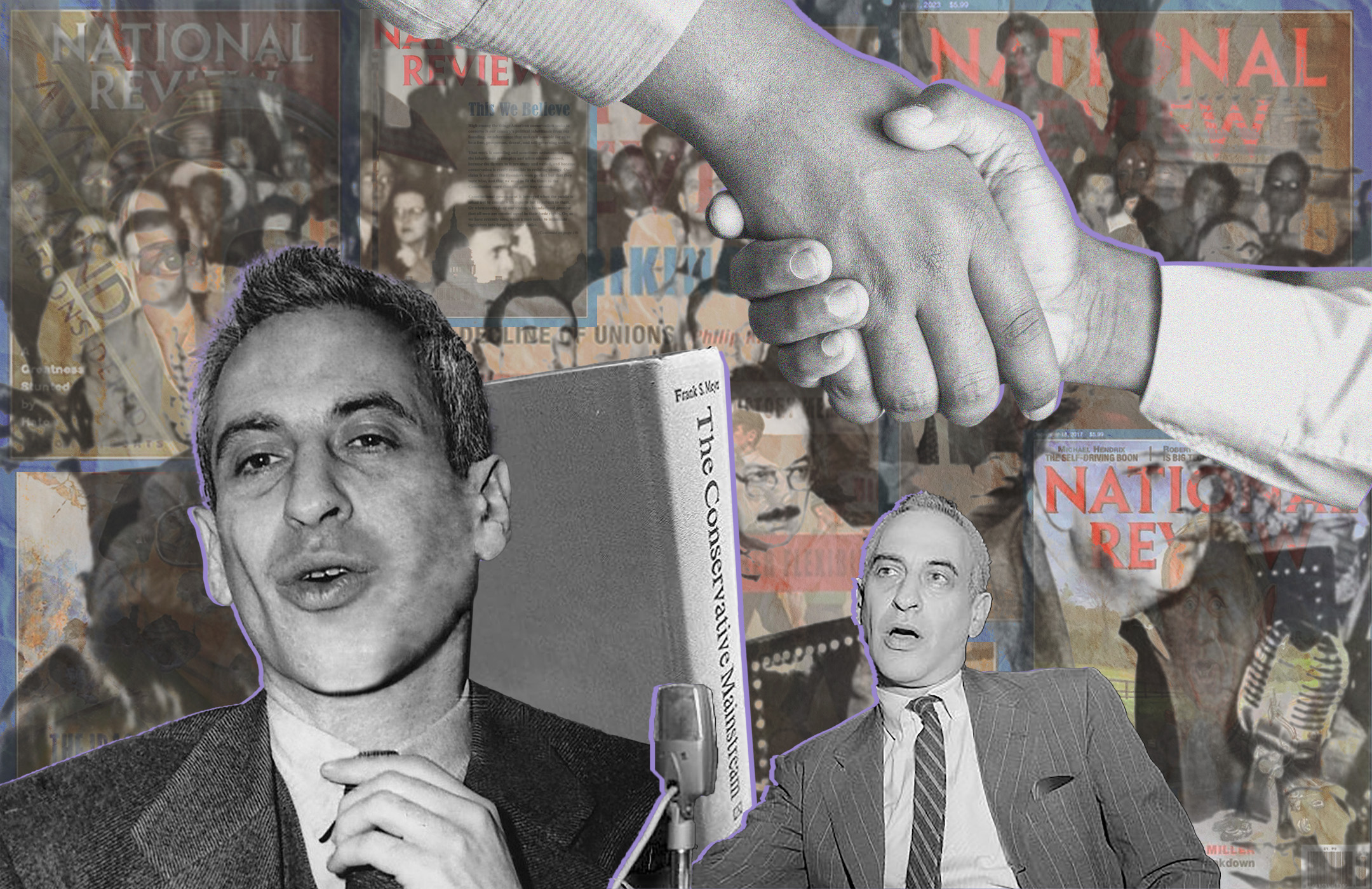
Henry Olsen appears to aspire to be the Russell Kirk of 2021 to Frank Meyer’s defense of fusionism. A worthy aspiration I suppose in many ways. But just as Kirk had it wrong, so does Olsen. Slade and Adler have already argued here that Meyer thought the first choice when confronting a public issue should be the choice for freedom and individual action. To turn too quickly to the state for resolution of a problem is to forego the creativity of personal choice. Furthermore, there is no certainty that state actors will be honest in their claims or able to accomplish their proclaimed ends. Indeed, they argue that power, even in the hands of righteous men, is likely to go astray. They also point out that Meyer was a federalist, arguing especially against national crusades for perceived popular ends such as a national trade policy, or the promotion of population growth, or some vision of social welfare and the public good. “Virtuecrats”, acting from good intentions, are especially liable to misuse their power. Olsen argues that Americans have never been, nor ever will be fusionists. They have always been willing to use government for a version of the common good. But Olsen’s own, and sometimes strange examples (e. g., the southern secessionists as defenders of virtue,) neglect to mention how politically divisive these policies were at the time to the detriment of liberty for all.On these points, let me turn to a few of Meyer’s own words from his 1955 essay “Collectivism Rebaptised”. “. . . . men will always be found, who if they possess the power, will attempt to force their interpretation on other men.” “(Kirk) can write feelingly of the dangers of the concentration of power without ever indicating by what standards overconcentration is to be judged and to what limits it is to be retrained.” “If indeed our society ever completes the fearful voyage on which it has embarked ‘from contract back to status” . . . it will not be the doing of Providence but of men.” “Only the principles of individual freedom . . . can call a halt to the march of collectivism. The New Conservatism, stripped of its pretensions, is, sad to say, but another guise for the collectivist spirit of the age.”A good warning, I think, to Olsen, and to a number of prominent, conservative political figures of our own day.Should a reader want to pursue these matters further, the Liberty Fund edition of In Defense of Freedom and Other Essays, contains a bibliographic essay that lists many of the historical articles out of which this controversy originally arose.