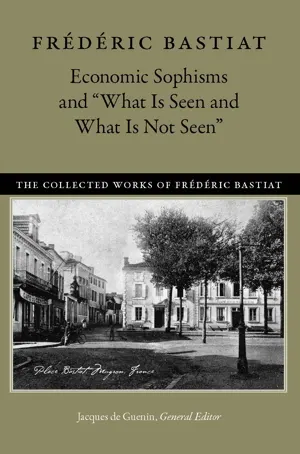
The Collected Works of Frédéric Bastiat. Vol. 3: Economic Sophisms and “What is Seen and What is Not Seen”
Part of The Collected Works of Frédéric Bastiat, in 6 Vols.
- Frédéric Bastiat(author)
- Jacques de Guenin(editor)
- David M. Hart(editor)
- Dennis O’Keeffe(translator)
Volume 3 of a 6 volume collection of the works of the 19th century French political economist Frédéric Bastiat. This volume contains the complete collection of Economic Sophisms, a third of which have never been translated before; as well as a new translation of What is Seen and What is Not Seen. A detailed glossary and several Appendices contain information about the people, institutions, and ideological issues of his day.
Key Quotes
Passages from this text chosen by OLL editors.
- War & Peace“
The Utopian politician: "[Cutting tariffs] have given me something even more precious.”
His adviser: “And what is that, if you please?”
The Utopian politician: “International relationships based on justice, and the likelihood of peace, which is almost a certainty. I would disband the army.”
Adviser: “The entire army?”
The Utopian politician: “Except for some specialized divisions, which would recruit voluntarily just like any other profession. And as you can see, conscription would be abolished.” …
His adviser: “In short, you are disarming the country based on a Utopian faith.”
The Utopian politician: “I said that I was disbanding the army and not that I was disarming the country. On the contrary, I intend to give it an invincible force.”
His adviser: “How are you going to sort out this heap of contradictions?”
The Utopian politician: “I will call on the services of all citizens.' …
The Utopian becomes excited: “Thank heavens; my budget has been reduced by 200 million! …"
About This Edition
Citation
The Collected Works of Frédéric Bastiat. Vol. 3: Economic Sophisms and “What is Seen and What is Not Seen.” Jacques de Guenin, General Editor. Translated from the French by Jane and Michel Willems, with a foreword by Robert McTeer, and an introduction and appendices by the Academic Editor David M. Hart. Annotations and Glossaries by Jacques de Guenin, Jean-Claude Paul-Dejean, and David M. Hart. Translation Editor Dennis O’Keeffe. (Indianapolis: Liberty Fund, 2017).
Bastiat, Frédéric. The Collected Works of Frédéric Bastiat. Vol. 3: Economic Sophisms and “What is Seen and What is Not Seen”. Edited by Jacques de Guenin and David M. Hart, translated by Dennis O’Keeffe, Liberty Fund, 2017. Online Library of Liberty, https://oll.libertyfund.org/titles/the-collected-works-of-frederic-bastiat-vol-3-economic-sophisms-and-what-is-seen-and-what-is-not-seen.
Bastiat, F. (2017). The Collected Works of Frédéric Bastiat. Vol. 3: Economic Sophisms and “What is Seen and What is Not Seen”. Liberty Fund. https://oll.libertyfund.org/titles/the-collected-works-of-frederic-bastiat-vol-3-economic-sophisms-and-what-is-seen-and-what-is-not-seen
@book{bastiat2017seen,
  author = {Frédéric Bastiat},
  editor = {Jacques de Guenin and David M. Hart},
  title = {The Collected Works of Frédéric Bastiat. Vol. 3: Economic Sophisms and “What is Seen and What is Not Seen”},
  publisher = {Liberty Fund},
  address = {Indianapolis},
  year = {2017},
  url = {https://oll.libertyfund.org/titles/the-collected-works-of-frederic-bastiat-vol-3-economic-sophisms-and-what-is-seen-and-what-is-not-seen},
  note = {Online Library of Liberty}
}TY - BOOK AU - Bastiat, Frédéric A2 - Guenin, Jacques de A2 - Hart, David M. A3 - O’Keeffe, Dennis TI - The Collected Works of Frédéric Bastiat. Vol. 3: Economic Sophisms and “What is Seen and What is Not Seen” PY - 2017 CY - Indianapolis PB - Liberty Fund UR - https://oll.libertyfund.org/titles/the-collected-works-of-frederic-bastiat-vol-3-economic-sophisms-and-what-is-seen-and-what-is-not-seen DB - Online Library of Liberty ER -
Copyright
The copyright to this edition, in both print and electronic forms, is held by Liberty Fund, Inc.

About the author
Frédéric Bastiat 1801–1850
Frédéric Bastiat (1801-1850) was one of the leading advocates of free markets and free trade in the mid-19th century. He was inspired by the activities of Richard Cobden and the organization of the Anti-Corn Law League in Britain in the 1840s and tried to mimic their success in France.
Related People
Henry Hazlitt
Author
After Bastiat died, his influence quickly faded away. American Journalist Henry Hazlitt reintroduced Bastiat through his book Economics in One Lesson, helping to bring him back into mainstream conversation.
Gustave de Molinari
Author
Molinari was a friend and publisher of Bastiat. He was also a political economist in his own right. After Bastiat’s untimely death, Molinari published Bastiat’s uncompleted magnum opus Economic Harmonies. Molinari is generally seen as a spiritual successor to Bastiat.
Richard Cobden
Author
Cobden was a British politician, manufacturer, and avid campaigner for free trade. Bastiat looked to Cobden as a guide to promote French liberalism and free trade. The two eventually became friends, with Bastiat spending time in England with Cobden.


Critical Responses
Works that answer or challenge this text.
 Book
Straight Talk on Trade
Dani RodrikVisit site ↗While Rodrik doesn’t directly address Bastiat in this book, he does address many of the arguments made in Economic Sophisms. Rodrik argues that more attention needs to be on political situations and that economic policy should serve politics, rather than the other way around.
- What to read next...
Bastiat's 'The Broken Window:' A Critique
Louis CarabiniVisit site ↗This is a modern critique of Bastiat. Carabini argues that the truth of “The Broken Window” holds, Bastiat undermines it by failing to offer an answer to the question Bastiat leads with: “ What would become of the glaziers if no one ever broke a window?”
Connected Readings
What to read next.
- Book
Economics in One Lesson
Henry HazlittVisit site ↗Economics in One Lesson. Hazlitt reintroduces and modernizes many of Bastiat’s concepts from “What is Seen” and Economic Sophisms in this book. He devotes an entire chapter to the “Broken Window Fallacy,” which forms the core of “What is Seen.”
Unintended Consequences
Rob NortonThe Concise Encyclopedia of Economics
Visit site ↗The law of unintended consequences, often cited but rarely defined, is that actions of people—and especially of government—always have effects that are unanticipated or unintended. Economists and other social scientists have heeded its power for centuries; for just as long, politicians and popular opinion have largely ignored it.
- Law & Liberty Essay
Bastiat, Common Sense Personified
John TamnyVisit site ↗If there’s a difficulty that comes in reading Bastiat, it has to do with the happy truth that nearly everything he writes is worth underlining. Bastiat is common sense personified, and there are lessons in seemingly every subject the great Frenchman chose to comment on. If one only skimmed, one would miss crucial lessons.
More in Economic theory. Demography
See all >Cost and Choice: An Inquiry in Economic Theory, Vol. 6 of the Collected Works
James M. BuchananAn Essay on the Principle of Population, vol. 1 [1826, 6th ed.]
Thomas Robert MalthusUniversal Economics
Armen A. AlchianCan Capitalism Survive?
Benjamin A. RoggeAn Essay on the Principle of Population [1798, 1st ed.]
Thomas Robert Malthus“The Use of Knowledge in Society” (1945)
Friedrich August von HayekDas Kapital. Kritik der politischen Oekonomie. Buch 1 (1867)
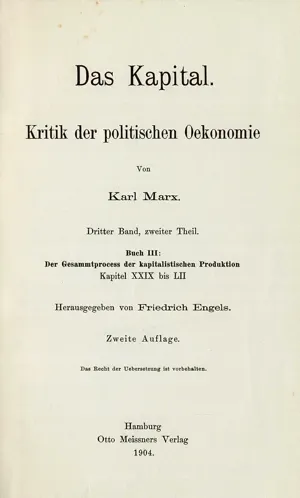
Karl MarxDas Kapital. Kritik der politischen Ökonomie. Buch III, zweiter Theil (1894)
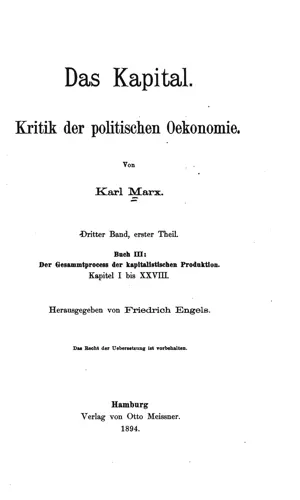
Karl MarxDas Kapital. Kritik der politischen Ökonomie. Buch III, erster Theil (1894)
Karl Marx