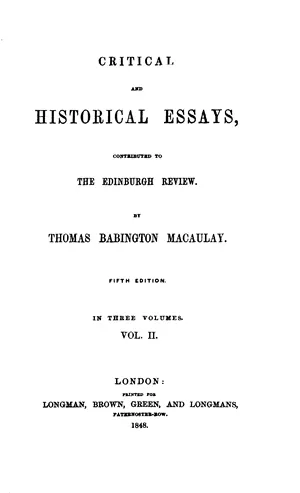
Critical and Historical Essays, Vol. 2
Part of Critical and Historical Essays contributed to the Edinburgh Review, 3 vols.
- Thomas Babington, Lord Macaulay(author)
Essays by Macaulay in the Edinburgh Review published between 1832 and 1839 on Horace Walpole, the War of Spanish Succession, William Pitt, Sir James Mackintosh, Lord Bacon, and Gladstone.
Key Quotes
Passages from this text chosen by OLL editors.
- The State“
We consider the primary end of government as a purely temporal end, the protection of the persons and property of men.
We think that government, like every other contrivance of human wisdom, from the highest to the lowest, is likely to answer its main end best when it is constructed with a single view to that end. Mr. Gladstone, who loves Plato, will not quarrel with us for illustrating our proposition, after Plato’s fashion, from the most familiar objects. Take cutlery, for example. A blade which is designed both to shave and to carve will certainly not shave so well as a razor, or carve so well as a carving-knife. An academy of painting, which should also be a bank, would, in all probability, exhibit very bad pictures and discount very bad bills. A gas company, which should also be an infant school society, would, we apprehend, light the streets ill, and teach the children ill. On this principle, we think that government should be organised solely with a view to its main end; and that no part of its efficiency for that end should be sacrificed in order to promote any other end however excellent.
- Rhetoric of Liberty“
In the thirteenth year of his age he (Francis Bacon) was entered at Trinity College, Cambridge. That celebrated school of learning enjoyed the peculiar favour of the Lord Treasurer and the Lord Keeper, and acknowledged the advantages which it derived from their patronage in a public letter which bears date just a month after the admission of Francis Bacon. The master was Whitgift, afterwards Archbishop of Canterbury, a narrow-minded, mean, and tyrannical priest, who gained power by servility and adulation, and employed it in persecuting both those who agreed with Calvin about Church Government, and those who differed from Calvin touching the doctrine of Reprobation. He was now in a chrysalis state, putting off the worm and putting on the dragon-fly, a kind of intermediate grub between sycophant and oppressor. He was indemnifying himself for the court which he found it expedient to pay to the Ministers by exercising much petty tyranny within his own college.
About This Edition
Citation
Macaulay, Thomas Babington, Lord. Critical and Historical Essays contributed to the Edinburgh Review, 5th ed. in 3 vols. (London: Longman, Brown, Green, and Longmans, 1848). Vol. 2.
Macaulay, Thomas Babington, Lord. Critical and Historical Essays, Vol. 2. Longman, Brown, Green, and Longmans, 1848. Online Library of Liberty, https://oll.libertyfund.org/titles/macaulay-critical-and-historical-essays-vol-2.
Macaulay, T. B. L. (1848). Critical and Historical Essays, Vol. 2. Longman, Brown, Green, and Longmans. https://oll.libertyfund.org/titles/macaulay-critical-and-historical-essays-vol-2
@book{macaulay18482,
  author = {Thomas Babington, Lord Macaulay},
  title = {Critical and Historical Essays, Vol. 2},
  publisher = {Longman, Brown, Green, and Longmans},
  address = {London},
  year = {1848},
  url = {https://oll.libertyfund.org/titles/macaulay-critical-and-historical-essays-vol-2},
  note = {Online Library of Liberty}
}TY - BOOK AU - Macaulay, Thomas Babington, Lord TI - Critical and Historical Essays, Vol. 2 PY - 1848 CY - London PB - Longman, Brown, Green, and Longmans UR - https://oll.libertyfund.org/titles/macaulay-critical-and-historical-essays-vol-2 DB - Online Library of Liberty ER -
Copyright
The text is in the public domain.

About the author
Thomas Babington, Lord Macaulay 1800–1859
Lord Macaulay, born Thomas Babington (1800-1859), was an English historian, peer, politician, and poet. He was an active opponent of slavery, a supporter of education and equality in India, and instrumental to parliamentary reform to increase representation of cities that had become unrepresented relative to rural areas during the rapid industrial growth. He authored a five-volume work on the History of England, and wrote numerous clear-minded, critical essays.
More in English literature
See all >The First Part of King Henry the Sixth
William ShakespeareThe Tragedy of King Richard the Second
William ShakespeareHamlet Prince of Denmark
William ShakespeareThe First Part of King Henry the Fourth
William ShakespeareThe Merchant of Venice
William ShakespeareThe Third Part of King Henry the Sixth
William ShakespeareTwelfth-Night: or, What You Will
William ShakespeareThe Second Part of King Henry the Fourth
William ShakespeareThe Winter’s Tale
William Shakespeare