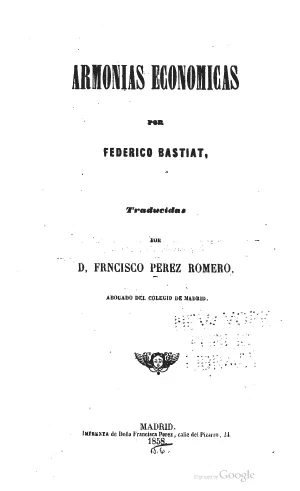
Armonias Economicas
- Frédéric Bastiat(author)
- Francisco Pérez Romero(translator)
A Spanish translation of Bastiat’s best known work on “economic harmonies” in which he explains in simple terms how the free market operates to everybody’s benefit.
About This Edition
Citation
Bastiat, Frédéric. Armonias Economicas. Traducidas por D. Francisco Pérez Romero (Madrid: Doña Francisca Pérez, 1858). The text is in the public domain. It was scanned and originally put online by Google for non-commercial, educational purposes. We have retained the Google watermark as requested but have added tables of contents, pagination, and other educational aids where appropriate.
Bastiat, Frédéric. Armonias Economicas. translated by Francisco Pérez Romero, Doña Francisca Pérez, 1851. Online Library of Liberty, https://oll.libertyfund.org/titles/bastiat-armonias-economicas.
Bastiat, F. (1851). Armonias Economicas. Doña Francisca Pérez. https://oll.libertyfund.org/titles/bastiat-armonias-economicas
@book{bastiat1851economicas,
  author = {Frédéric Bastiat},
  title = {Armonias Economicas},
  publisher = {Doña Francisca Pérez},
  address = {Madrid},
  year = {1851},
  url = {https://oll.libertyfund.org/titles/bastiat-armonias-economicas},
  note = {Online Library of Liberty}
}TY - BOOK AU - Bastiat, Frédéric A3 - Romero, Francisco Pérez TI - Armonias Economicas PY - 1851 CY - Madrid PB - Doña Francisca Pérez UR - https://oll.libertyfund.org/titles/bastiat-armonias-economicas DB - Online Library of Liberty ER -
Copyright
The text is in the public domain. It was scanned and originally put online by Google for non-commercial, educational purposes. We have retained the Google watermark as requested but have added tables of contents, pagination, and other educational aids where appropriate.

About the author
Frédéric Bastiat 1801–1850
Frédéric Bastiat (1801-1850) was one of the leading advocates of free markets and free trade in the mid-19th century. He was inspired by the activities of Richard Cobden and the organization of the Anti-Corn Law League in Britain in the 1840s and tried to mimic their success in France.