

The Online Library of Liberty

Search the library

Press Enter to see all results. Esc closes.

The State

Nassau Senior argues that government is based upon extortion (1854)

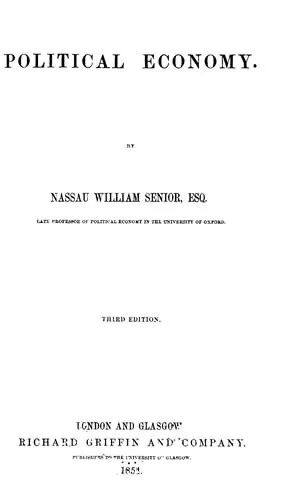
It is obvious, however, that the division of labour on which government is founded, is subject to peculiar evils. Those who are to afford protection must necessarily be intrusted with power; and those who rely on others for protection lose, in a great measure, the means and the will to protect themselves. Under such circumstances, the bargain, if it can be called one, between the government and its subjects, is not conducted on the principles which regulate ordinary exchanges. The government generally endeavours to extort from its subjects, not merely a fair compensation for its services, but all that force or terror can wring from them without injuring their powers of further production. In fact, it does in general extort much more: for if we look through the world we shall find few governments whose oppression does not materially injure the prosperity of their people.

— Nassau William Senior, Political Economy (1850 ed.)

Context

Further thoughts

  • The State
    “If a state well performed its functions of providing peace, order and security, as conditions under which the people could live and work, it would be the proudest proof of its triumphant success that it had nothing to do — that all went so smoothly that it had only to look on and was never called to interfere; just as it is the test of a good business man that his business runs on smoothly and prosperously while he is not harassed or hurried. The people who think that it is proof of enterprise to meddle and “fuss” may believe that a good state will constantly interfere and regulate, and they may regard the other type of state as “non-government.””
  • The State
    “No man can have a power over a nation otherwise than de jure, or de facto. He who pretends to have a power de jure, must prove that it is originally inherent in him or his predecessor from whom he inherits; or that it was justly acquired by him. The vanity of any pretence to an original right appears sufficiently, I hope, from the proofs already given, that the first fathers of mankind had it not; or if they had, no man could now inherit the same, there being no man able to make good the genealogy that should give him a right to the succession.”
  • The State
    “Such people as have been bred up to liberty, and subject to no other dominion but the authority of their own will, look upon all other form of government as monstrous and contrary to nature. Those who are inured to [260] monarchy do the same; and what opportunity soever fortune presents them with to change, even then, when with the greatest difficulties they have disengaged themselves from one master, that was troublesome and grievous to them, they presently run, with the same difficulties, to create another; being unable to take into hatred subjection itself.”