


Author
James Mill
1773–1836
James Mill (1773-1836) was an early 19th century Philosophic Radical, journalist, and editor from Scotland. He was very influenced by Jeremy Bentham’s ideas about utilitarianism which he applied to the study of British India, political economy, and electoral reform.
Biography
Mill wrote on the British corn laws, free trade, comparative advantage, the history of India, and electoral reform. His son, John Stuart, after a rigorous home education, became one of the leading English classical liberals in the 19th century.
See the Liberty Matters online discussion on James Mill on Liberty and Governance
Works by James Mill
21 titles in the library
James Mill · 1835
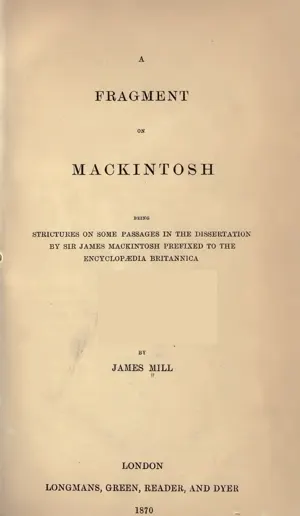
A Fragment on Mackintosh (1870)
Mill's critique of Sir James Mackintosh's "Dissertation on the Progress of Ethical Philosophy" was originally published in the seventh edition of the Encyclopædia Britannica. Mill comments on Mackintosh's interpretation…
James Mill · 1808
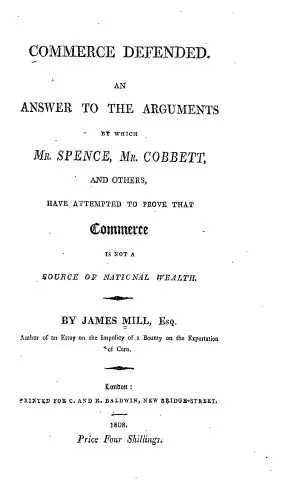
Commerce Defended (1808)
This is a critique of both the idea that only agriculture is truly a productive activity and government war-time policy which resulted in rising food prices and taxes which had a deleterious impact on the poor.
James Mill · 1804
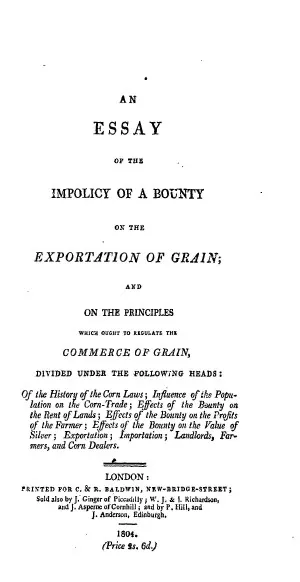
An Essay of the Impolicy of a Bounty on the Exportation of Grain (1804)
Mill provides a brief history of the Corn Laws and argues for their abolition.
James Mill · 1825
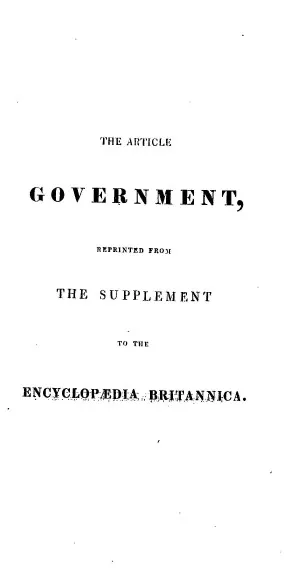
Government
One of the articles James Mill wrote for the Encyclopedia Britannica.
James Mill · 1817
The History of British India, 6 vols. (1826)
James Mill’s History is a work of Benthamite “philosophical history” from which the reader is supposed to draw lessons about human nature, reason and religion, and the deleterious impact of commercial monopolies like…
James Mill · 2013
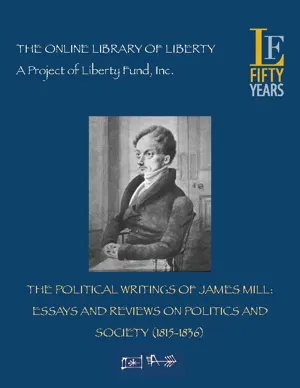
The Political Writings of James Mill (1815-1836)
This is an anthology of James Mill’s writings compiled from The British Review, and London Critical Journal [1815], the Supplement to the 4th, 5th and 6th editions of the Encyclopaedia Britannica [1815-1824],…
James Mill · 1825
Articles in the Supplement to the Encyclopedia Britannica (1825)
James Mill wrote a number of influential articles for the Encyclopedia Britannica in which he developed the Philosophic Radical view on law, government, education, colonies, and other topcis.
James Mill · 1825
Prisons and Prison Discipline
One of the articles James Mill wrote for the Encyclopedia Britannica.
James Mill · 1825
Education
One of the articles James Mill wrote for the Encyclopedia Britannica.
James Mill · 1825
Colony
One of the articles James Mill wrote for the Encyclopedia Britannica.
James Mill · 1825
Law of Nations
One of the articles James Mill wrote for the Encyclopedia Britannica.
James Mill · 1825
Liberty of the Press (1825)
One of the articles James Mill wrote for the Encyclopedia Britannica.
James Mill · 1825
Jurisprudence
One of the articles James Mill wrote for the Encyclopedia Britannica.
James Mill · 1817
The History of British India, vol. 6
James Mill’s History is a work of Benthamite “philosophical history” from which the reader is supposed to draw lessons about human nature, reason and religion, and the deleterious impact of commercial monopolies like…
James Mill · 1817
The History of British India, vol. 5
James Mill’s History is a work of Benthamite “philosophical history” from which the reader is supposed to draw lessons about human nature, reason and religion, and the deleterious impact of commercial monopolies like…
James Mill · 1817
The History of British India, vol. 4
James Mill’s History is a work of Benthamite “philosophical history” from which the reader is supposed to draw lessons about human nature, reason and religion, and the deleterious impact of commercial monopolies like…
James Mill · 1817
The History of British India, vol. 3
James Mill’s History is a work of Benthamite “philosophical history” from which the reader is supposed to draw lessons about human nature, reason and religion, and the deleterious impact of commercial monopolies like…
James Mill · 1817
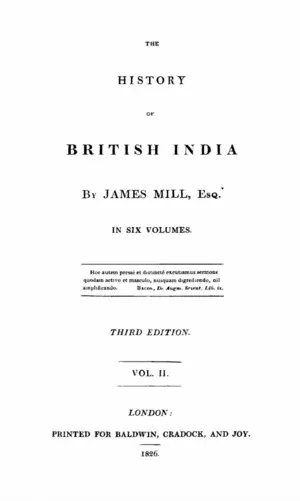
The History of British India, vol. 2
James Mill’s History is a work of Benthamite “philosophical history” from which the reader is supposed to draw lessons about human nature, reason and religion, and the deleterious impact of commercial monopolies like…
James Mill · 1817
The History of British India, vol. 1
James Mill’s History is a work of Benthamite “philosophical history” from which the reader is supposed to draw lessons about human nature, reason and religion, and the deleterious impact of commercial monopolies like…
James Mill · 1821
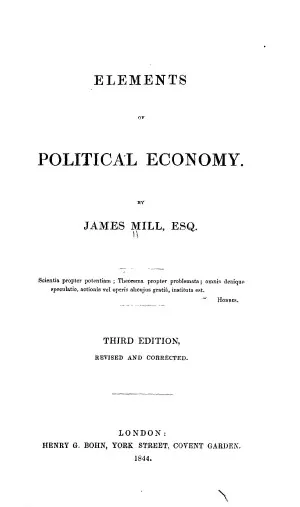
Elements of Political Economy (3rd ed. 1844)
James Mill’s work offers excellent summaries of diminishing marginal returns in Chapter II, of comparative advantage in Chapter III, Section V, of the quantity theory of money and the market for foreign exchange in…
James Mill
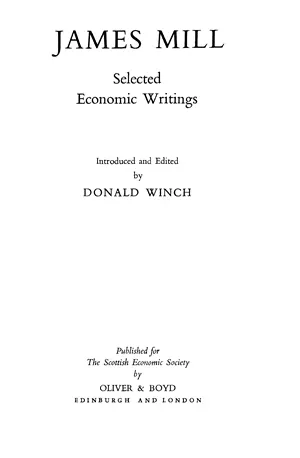
Selected Economic Writings (1966)
A collection of Mill’s writings on economics, including his early essays on The Impolicy of a Bounty on the Exportation of Grain, Commerce Defended, and selections from his Elements of Political Economy and his History…
Quotes from James Mill
9 quotes from the library