The Online Library of Liberty

Search the library

Press Enter to see all results. Esc closes.

Portrait of Gustave de Molinari

Author

Gustave de Molinari

1819–1912

See more works by Molinari ›6 titles in the library

Biography

Works by Gustave de Molinari

6 titles in the library
Quotes from Gustave de Molinari

6 quotes from the library

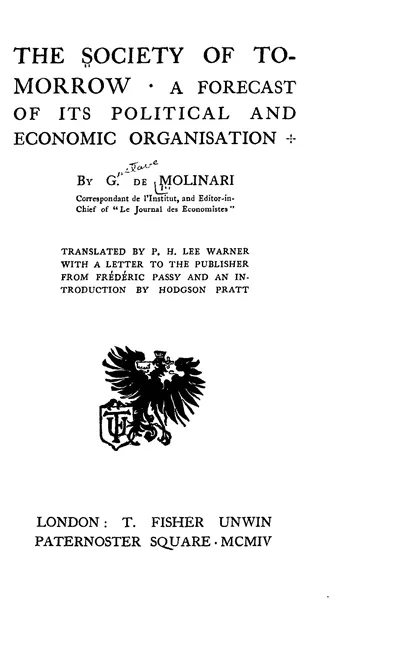
  • The Society of Tomorrow
    These associations, or political parties, are actual armies which have been trained to pursue power; their immediate objective is to so increase the number of their adherents as to control an electoral majority. Influential electors are for this purpose promised such or such share in the profits which will follow success, but such promises—generally place or privilege—are redeemable only by a multiplication of "places," which involves a corresponding increase of national enterprises, whether of war or of peace. It is nothing to a politician that the result is increased charges and heavier drains on the vital energy of the people. The unceasing competition under which they labour, first in their efforts to secure office, and next to maintain their position, compels them to make party interest their sole care, and they are in no position to consider whether this personal and immediate interest is in harmony with the general and permanent good of the nation.
  • Cyclopaedia of Political Science, Political Economy vol. 3 Oath - Zollverein
    Why should an attempt he made to establish a national trading system based upon so-called economic necessity, in states whose formation was controlled by no economic views, states of which the hazards of war and of alliances alone decided the boundaries? Is it not the height of absurdity to transform these frontiers, which chance events have alone determined, and which it may enlarge or contract to-morrow, into formal boundaries which limit trade? Is not an economic system which is founded on a political basis and which is politically modifiable, a monstrosity to which good sense objects?
  • The Society of Tomorrow
    Every State includes a governing class and a governed class. The former is interested in the immediate multiplication of employments open to its members, whether these be harmful or useful to the State, and also desires to remunerate these officials at the best possible rate. But the majority of the nation, the governed class, pays for the officials, and its only desire is to support the least necessary number. A State of War, implying an unlimited power of disposition over the lives and goods of the majority, allows the governing class to increase State employments at will—that is, to increase its own sphere of employment. A considerable portion of this sphere is found in the destructive apparatus of the civilised State—an organism which grows with every advance in the power of the rivals. In time of peace the army supports a hierarchy of professional soldiers, whose career is highly esteemed, and is assured if not particularly remunerative. In time of war the soldier obtains an additional remuneration, more glory, and an increased hope of professional advancement, and these advantages more than compensate the risks which he is compelled to undergo. In this way a State of War continues to be profitable both to the governing class as a whole, and to those officials who administer and officer the army.
  • The Society of Tomorrow
    Economist and socialist, we may be adversaries, but our ideal and purpose is one. We seek a society in which there will be no stint in the production of all that is needful, whether to support or to embellish human existence. We seek a society where the distribution of these products between their creators will accord with the dictates of pure justice. We seek—in one word—an ideal that may be stated in two words, Justice and Plenty! None among you will deny this truth, and, if we say that we seek by different paths, that is the sum of our difference. Your way lies along the obscure and hitherto unexplored defile of the organisation of labour, ours down the broad, well-trodden highway of liberty. Both, we seek to lead a hesitating and halting society, nations looking—but in vain—towards the horizon in hopes of a new column of light to lead them by the way whereon it guided the slaves of Pharaoh to a Land of Promise.
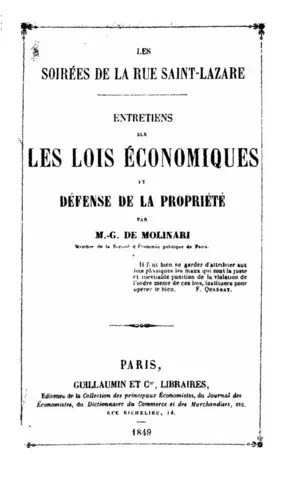
  • Les Soirées de la Rue Saint-Lazare (1849)
    Liberty! That was the cry of the captives of Egypt, the slaves of Spartacus, the peasants of the Middle Ages, and more recently of the bourgeoisie oppressed by the nobility and religious corporations, of the workers oppressed by masters and guilds. Liberty! That was the cry of all those who found their property confiscated by monopoly and privilege. Liberty! That was the burning aspiration of all those whose natural rights had been forcibly repressed.
  • Les Soirées de la Rue Saint-Lazare (1849)
    Society, according to the Economists of the eighteenth century, is organized on the basis of natural laws, whose essence is Justice and Utility. When these laws are misunderstood, society suffers. When they are fully respected, society enjoys the greatest possible abundance and justice reigns in human relations. Are these laws of providence respected or unrecognized today? Do the sufferings of the masses have their origin in the economic laws which govern society or in the obstacles placed in the way of their beneficent operation? Such is the question which recent events have raised for us. To this question the Socialist schools reply, sometimes by denying that the economic world is governed, as is the physical world, by natural laws, and at other times by the affirmation that these laws are imperfect or vicious, and that the ills of society stem from this imperfect or vicious character. The more timid claim that we must modify these laws; the more intrepid claim we should totally eliminate what are radically imperfect arrangements and replace them with new ones.