

Bruce Frohnen
b. 1962 · 1 title


Textbooks
13 items in this collection
These are textbooks which are published by Liberty Fund.
In this collection
3 titles, earliest first.

Lance Banning · 1787
An anthology of primary sources which documents the first great party struggle in American history between the Federalists and the Anti-Federalists over the proper construction of the new Constitution, political…
John Marshall · 1838
A one volume abridgement of the first major biography of Washington by John Marshall who became the third Chief Justice of the Supreme Court. An influential conservative interpretation. The volume also contains 5 of the…
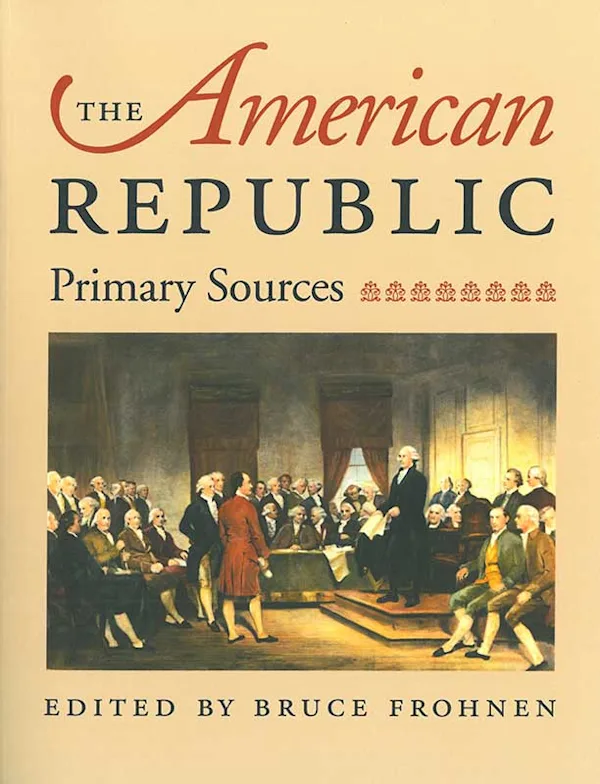
Bruce Frohnen · 2002
The American Republic is an excellent textbook for classroom use which provides, in a single volume, critical, original documents revealing the character of American discourse on the nature and importance of local…
In this collection
Authors, editors and translators of these titles, most titles first.
b. 1962 · 1 title

1732–1799 · 1 title

1755–1835 · 1 title

1942–2006 · 1 title

1 title
1 title
Passages on this subject, chosen by OLL editors.
The primary focus of economic analysis is on (a) competition in exchange of rights to services and goods and (b) coordinated cooperation in creating wealth. Competition by offers of exchange is a form of cooperation. “I’ll do this for you if you’ll do that for me—at better terms than someone else.” Though competing, we also cooperate—in the market, in the family, in firms, and in governments. We cooperate to make the “pie” larger; we compete over how much of the pie each of us gets. Any effective combination of cooperation and competition requires a control of the permissible types of competition so as to not obstruct social cohesion and cooperation. (FROM: COMPETITION, Competitive Cooperation by Exchanges)
Since the discouraging fiasco in the Garden of Eden, all the world has been a place conspicuous in its scarcity of resources, contributing heavily to an abundance of various sorrows and sins. People have had to adjust and adapt to limitations of what is available to satisfy unlimited desires. Some individuals and societies have been much more successful than others in thus making do. (FROM: PART ONE: DEMAND, EXCHANGE, AND PROPERTY RIGHTS, CHAPTER 1: WELCOME TO ECONOMICS)
However, a reason for the ban on your unlimited future control is that it reduces the influence of future market values on the way that resource will then be used. The “dead hand of the past” is not allowed to overrule the “invisible hand” of future generations’ market values. The rule against perpetuities permits restrictions on use and salability of resources for only about twenty-one years after the death of persons who were alive at the time of the death of the donor. If that rule were not enforced, resources today would still be used in ways they were generations ago—a potentially unattractive result. (FROM: THE RULE AGAINST PERPETUITIES) - Armen Alchian
Differences in political opinions are as unavoidable as, to a certain point, they may, perhaps, be necessary; but it is exceedingly to be regretted that subjects cannot be discussed with temper on the one hand, or decisions submitted to without having the motives which led to them improperly implicated on the other: and this regret borders on chagrin when we find that men of abilities, zealous patriots, having the same general objects in view, and the same upright intentions to prosecute them, will not excercise more charity in deciding on the opinions and actions of one another. When matters get to such lengths, the natural inference is, that both sides have strained the Cords beyond their bearing, and, that a middle course would be found the best, until experience shall have decided on the right way, or, which is not to be expected, because it is denied to mortals, there shall be some infallible rule by which we could fore-judge events. (FROM TO THE SECRETARY OF THE TREASURY (Alexander Hamilton) August 26, 1792)

History of the Americas
343 titles · 67 publications · 239 people

Language and Literature
282 titles · 6 publications · 321 people

History of the Americas
181 titles · 80 publications · 149 people
Language and Literature
112 titles · 156 people

History of the Americas
17 titles · 39 people

Political Science
14 titles · 7 publications · 17 people