De Monarchia
- Dante Alighieri(author)
- Aurelia Henry Reinhardt(translator)
The great Italian poet turns his hand to political thought and defends the reign of a single monarch ruling over a universal empire. He believed that peace was only achievable when a single monarch replaced divisive and squabbling princes and kings. However, he also believed in a separation of powers in that the Emperor has jurisdiction over temporal matters, whilst the Pope administered over things spiritual.
Key Quotes
Passages from this text chosen by OLL editors.
- War & Peace“
It has now been satisfactorily explained that the proper function of the human race, taken in the aggregate, is to actualize continually the entire capacity of the possible intellect, primarily in speculation, then, through its extension and for its sake, secondarily in action. And since it is true that whatever modifies a part modifies the whole, and that the individual man seated in quiet grows perfect in knowledge and wisdom, it is plain that amid the calm and tranquillity of peace the human race accomplishes most freely and easily its given work. How nearly divine this function is revealed in the words, “Thou hast made him a little lower than the angels.” Whence it is manifest that universal peace is the best of those things which are ordained for our beatitude. And hence to the shepherds sounded from on high the message not of riches, nor pleasures, nor honors, nor length of life, nor health, nor beauty; but the message of peace. For the heavenly host said, “Glory to God in the highest, and on earth peace among men in whom he is well pleased.” Likewise, “Peace be unto you” was the salutation of the Saviour of men. It befitted the supreme Saviour to utter the supreme salutation. It is evident to all that the disciples desired to preserve this custom; and Paul likewise in his words of greeting.
About This Edition
Citation
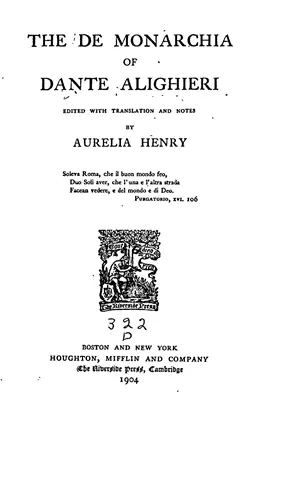
The De Monarchia of Dante Alighieri, edited with translation and notes by Aurelia Henry (Boston and New York: Houghton, Miflin and Company, 1904).
Alighieri, Dante. De Monarchia. translated by Aurelia Henry Reinhardt, Houghton, Mifflin, and Company, 1904. Online Library of Liberty, https://oll.libertyfund.org/titles/reinhardt-de-monarchia.
Alighieri, D. (1904). De Monarchia. Houghton, Mifflin, and Company. https://oll.libertyfund.org/titles/reinhardt-de-monarchia
@book{alighieri1904monarchia,
  author = {Dante Alighieri},
  title = {De Monarchia},
  publisher = {Houghton, Mifflin, and Company},
  address = {Boston},
  year = {1904},
  url = {https://oll.libertyfund.org/titles/reinhardt-de-monarchia},
  note = {Online Library of Liberty}
}TY - BOOK AU - Alighieri, Dante A3 - Reinhardt, Aurelia Henry TI - De Monarchia PY - 1904 CY - Boston PB - Houghton, Mifflin, and Company UR - https://oll.libertyfund.org/titles/reinhardt-de-monarchia DB - Online Library of Liberty ER -
Copyright
The text is in the public domain.

About the author
Dante Alighieri 1265–1321
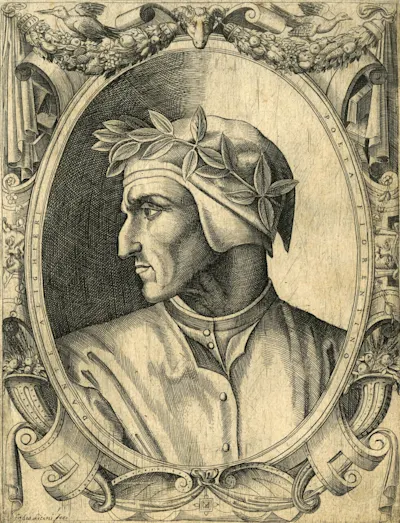
Dante Alighieri (1265-1321) was a Florentine poet and philosopher who wrote at the end of the Medieval period and the beginning of the Renaissance. His most famous work, The Divine Comedy, is a literary landmark and a synthesis of his political, religious and social views. His embrace of individuality and happiness and the use of Italian instead of Latin are often considered to mark a transition to a new way of thinking about humanity.
More in French literature
See all >Complete Works, vol. 2 The Spirit of Laws
Charles Louis de Secondat, Baron de MontesquieuThe Works of Voltaire, Vol. I (Candide)
VoltaireThe Works of Voltaire, Vol. 22 (Index and an appreciation by Leigh)
Oliver Herbrand Gordon LeighMy Thoughts (Mes Pensées) (1720, 2012)
Charles Louis de Secondat, Baron de MontesquieuThe Divine Comedy, vol. 3 (Paradiso) (English trans.)
Dante AlighieriThe Divine Comedy, Vol. 2 (Purgatorio) (English only trans.)
Dante AlighieriSome Love Songs
Francesco PetrarchEssays of Montaigne, in 10 vols.
Michel de MontaigneThe Works of Voltaire. A Contemporary Version, in 21 vols.
Voltaire