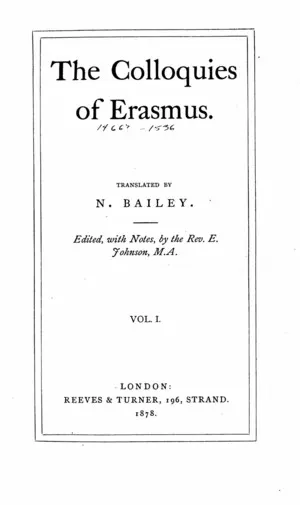
The Colloquies vol. 1
Part of The Colloquies 2 vols.
- Desiderius Erasmus(author)
- Rev. E. Johnson(editor)
- Nathan Bailey(translator)
In the guise of a school textbook on sound Latin prose Erasmus is able to mix sound language teaching, homilies on Christian ethics, and social criticism of some of the injustices and follies of his day.
Key Quotes
Passages from this text chosen by OLL editors.
- Food & Drink“
Austin: And you, my Christian, that I may return the Compliment, seem to have been Scholar to Epicurus, or brought up in the Catian School. For what’s more delicate or nice than your Palate?
Christian: Nor indeed would I myself, who am but an ordinary Man, change my Philosophy for Diogenes’s; and I believe your Catius would refuse to do it too. The Philosophers of our Time are wiser, who are content to dispute like Stoicks, but in living out–do even Epicurus himself. And yet for all that, I look upon Philosophy to be one of the most excellent Things in Nature, if used moderately. I don’t approve of philosophising too much, for it is a very jejune, barren, and melancholy Thing. When I fall into any Calamity or Sickness, then I betake myself to Philosophy, as to a Physician; but when I am well again, I bid it farewell.
Austin: I like your Method. You do philosophize very well. Your humble Servant, Mr. Philosopher; not of the Stoick School, but the Kitchen.
Christian: If I understood Oratory so well as I do Cookery, I’d challenge Cicero himself.
Austin: Indeed if I must be without one, I had rather want Oratory than Cookery.
Christian: I am entirely of your Mind, you judge gravely, wisely, and truly. For what is the Prattle of Orators good for, but to tickle idle Ears with a vain Pleasure? But Cookery feeds and repairs the Palate, the Belly, and the whole Man, let him be as big as he will. Cicero says, Concedat laurea linguæ; but both of them must give place to Cookery. I never very well liked those Stoicks, who referring all things to their (I can’t tell what) honestum, thought we ought to have no regard to our Persons and our Palates. Aristippus was wiser than Diogenes beyond Expression in my Opinion.
Austin: I despise the Stoicks with all their Fasts. But I praise and approve Epicurus more than that Cynic Diogenes, who lived upon raw Herbs and Water; and therefore I don’t wonder that Alexander, that fortunate King, had rather be Alexander than Diogenes.
About This Edition
Citation
The Colloquies of Erasmus. Translated by Nathan Bailey. Edited with Notes, by the Rev. E. Johnson, M.A. (London: Reeves and Turner, 1878). Vol. 1.
Erasmus, Desiderius. The Colloquies vol. 1. Edited by Rev. E. Johnson, translated by Nathan Bailey, Reeves and Turner, 1878. Online Library of Liberty, https://oll.libertyfund.org/titles/erasmus-the-colloquies-vol-1.
Erasmus, D. (1878). The Colloquies vol. 1. Reeves and Turner. https://oll.libertyfund.org/titles/erasmus-the-colloquies-vol-1
@book{erasmus18781,
  author = {Desiderius Erasmus},
  editor = {Rev. E. Johnson},
  title = {The Colloquies vol. 1},
  publisher = {Reeves and Turner},
  address = {London},
  year = {1878},
  url = {https://oll.libertyfund.org/titles/erasmus-the-colloquies-vol-1},
  note = {Online Library of Liberty}
}TY - BOOK AU - Erasmus, Desiderius A2 - Johnson, Rev. E. A3 - Bailey, Nathan TI - The Colloquies vol. 1 PY - 1878 CY - London PB - Reeves and Turner UR - https://oll.libertyfund.org/titles/erasmus-the-colloquies-vol-1 DB - Online Library of Liberty ER -
Copyright
The text is in the public domain.

About the author
Desiderius Erasmus 1466–1536
Desiderius Erasmus (1466-1536) was a Christian, humanist scholar; the first editor of the New Testament; a classicist; and a leading voice in the theological debates of the early Reformation in northern Europe. He contended with the reformer Martin Luther (1483-1546), emphasizing the importance of free will in human actions against Luther’s belief in the absolute bondage of the will to sin.
More in Greek and Latin Literature
See all >The Comedies of Aristophanes, vol. 2
AristophanesThe Comedies of Aristophanes, 2 vols.
AristophanesIn Praise of Folly
Desiderius ErasmusThe Colloquies vol. 2
Desiderius ErasmusThe Works of Tacitus, 4 vols. (1737)
Publius Cornelius TacitusPlutarch’s Morals, 5 vols.
PlutarchTreatise on the Commonwealth
Marcus Tullius CiceroThe Works of Tacitus, vol. 3 - Gordon’s Discourses II, History (Books 1-2)
Publius Cornelius TacitusThe Tragedies of Sophocles
Sophocles