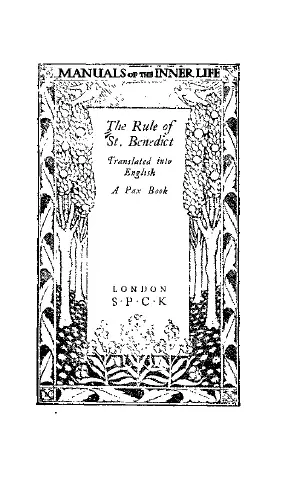
The Rule of St. Benedict
- Saint Benedict(author)
- William Kemp Lowther Clarke(foreword)
The Benedictine Rule was much more than a spiritual plan; it was a complete administrative package that included a workable daily regime. Moreover, Saint Benedict recognized the limitations of humanity and provided for differences in age, ability, needs, disposition, and faith. The flexibility of the Benedictine Rule largely accounts for the success of the order among different peoples, places, and times.
About This Edition
Citation
The Rule of St. Benedict, translated into English. A Pax Book, preface by W.K. Lowther Clarke (London: S.P.C.K., 1931).
Benedict, Saint. The Rule of St. Benedict. S. P. C. K., 1931. Online Library of Liberty, https://oll.libertyfund.org/titles/clarke-the-rule-of-st-benedict.
Benedict, S. (1931). The Rule of St. Benedict. S. P. C. K.. https://oll.libertyfund.org/titles/clarke-the-rule-of-st-benedict
@book{benedict1931benedict,
  author = {Saint Benedict},
  title = {The Rule of St. Benedict},
  publisher = {S. P. C. K.},
  address = {London},
  year = {1931},
  url = {https://oll.libertyfund.org/titles/clarke-the-rule-of-st-benedict},
  note = {Online Library of Liberty}
}TY - BOOK AU - Benedict, Saint TI - The Rule of St. Benedict PY - 1931 CY - London PB - S. P. C. K. UR - https://oll.libertyfund.org/titles/clarke-the-rule-of-st-benedict DB - Online Library of Liberty ER -
Copyright
The text is in the public domain.

About the author
Saint Benedict 480–547
Saint Benedict 480-547) is generally considered to be the father of Western monasticism. His founding of the monastery at Monte Cassino and composition of the rules governing the Benedictine monks initiated a monastic movement that spread throughout Europe.