

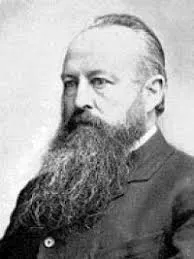
Acton-Creighton Correspondence
In one of these 3 letters to Archbishop Creighton Lord Acton makes his famous statement about “power corrupts and absolute power absolutely”. He also makes other remarks about the proper role for moral judgments in history.
Key Quotes
Passages from this text chosen by OLL editors.
- Presidents, Kings, Tyrants, & Despots“
I cannot accept your canon that we are to judge Pope and King unlike other men, with a favourable presumption that they did no wrong. If there is any presumption it is the other way against holders of power, increasing as the power increases. Historic responsibility has to make up for the want of legal responsibility. Power tends to corrupt and absolute power corrupts absolutely. Great men are almost always bad men, even when they exercise influence and not authority: still more when you superadd the tendency or the certainty of corruption by authority. There is no worse heresy than that the office sanctifies the holder of it. That is the point at which the negation of Catholicism and the negation of Liberalism meet and keep high festival, and the end learns to justify the means. You would hang a man of no position, like Ravaillac; but if what one hears is true, then Elizabeth asked the gaoler to murder Mary, and William III ordered his Scots minister to extirpate a clan. Here are the greater names coupled with the greater crimes. You would spare these criminals, for some mysterious reason. I would hang them, higher than Haman, for reasons of quite obvious justice; still more, still higher, for the sake of historical science.
About This Edition
Citation
Acton-Creighton Correspondence (1887) The text is in the public domain.
Acton, John Emerich Edward Dalberg, Lord. Acton-Creighton Correspondence. Unknown, 1887. Online Library of Liberty, https://oll.libertyfund.org/titles/acton-acton-creighton-correspondence.
Acton, J. E. E. D. L. (1887). Acton-Creighton Correspondence. Unknown. https://oll.libertyfund.org/titles/acton-acton-creighton-correspondence
@book{acton1887correspondence,
  author = {John Emerich Edward Dalberg, Lord Acton},
  title = {Acton-Creighton Correspondence},
  publisher = {Unknown},
  address = {Indianapolis},
  year = {1887},
  url = {https://oll.libertyfund.org/titles/acton-acton-creighton-correspondence},
  note = {Online Library of Liberty}
}TY - BOOK AU - Acton, John Emerich Edward Dalberg, Lord TI - Acton-Creighton Correspondence PY - 1887 CY - Indianapolis PB - Unknown UR - https://oll.libertyfund.org/titles/acton-acton-creighton-correspondence DB - Online Library of Liberty ER -
Copyright
The text is in the public domain.

About the author
John Emerich Edward Dalberg, Lord Acton 1834–1902
Lord Acton (1834-1902) was one of the great historians of the Victorian period and one of the greatest classical liberal historians of all time. His theme was “the history of liberty” and even though he was never able to complete his magnum opus of that name he did write numerous essays, book reviews, and lectures. He also was the inspiration behind the multi-volume Cambridge Modern History.
Related People
Alexis de Tocqueville
Author
Acton read both Democracy in America and The Old Regime and the French Revolution. Both were concerned with liberty and equality in the modern world.
Edmund Burke
Author
Acton admired Burke and was especially fond of Burke’s Reflections on the Revolution in France. Burke’s views on liberty and power very much influenced Acton. Both also saw religion as necessary for social order.
Hayek was directly influenced by Acton especially on the threats posed by centralized power. Acton’s general liberal political values were also a part of Hayek intellectual lineage.


Critical Responses
Works that answer or challenge this text.
 Book
The Whig Interpretation of History
Herbert ButterfieldVisit site ↗While The Whig Interpretation of History does not directly attack the Acton–Creighton
Correspondence by name, it functions as a powerful critique of the moral-historical stance
that Acton defended in that correspondence. Book
Acton and History
Owen ChadwickVisit site ↗Acton and History serves as a scholarly critique of the moral philosophy expressed in the
Acton–Creighton Correspondence. While the correspondence shows Acton demanding
absolute moral judgment from historians, Acton and History analyzes and questions that
demand — exploring its theological roots, logical consistency, and historiographical
limitations.
Connected Readings
What to read next.
 Book
A History of the Papacy During the Period of the Reformation
Bishop CreightonVisit site ↗Without History of the Papacy, the Acton-Creighton Correspondence would never have
occurred. The correspondence is essentially Acton’s response to Creighton’s approach in
that work — a critique of its perceived moral indifference to the corruption and abuses of
papal power.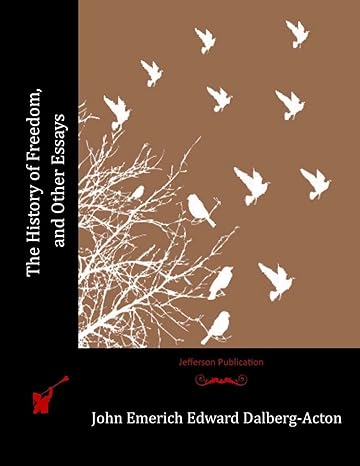 Book
The History of Freedom in Antiquity
Lord ActonView title >Acton chastises Creighton for treating corrupt Renaissance popes with too much leniency,
writing that historians must judge moral evil even when committed by powerful figures.
His guiding principle — “Power tends to corrupt, and absolute power corrupts absolutely”
— reflects the same conviction that liberty and morality are inseparable. Podcast
Who Was Lord Acton?
Visit site ↗The podcast draws on the correspondence from Acton as a defining episode in his life — the moment where his ethical theory of history came into full view.
- Journal Article
Lord Acton on liberty, power, and the light of conscience
Eugénio LopesVisit site ↗This article is intimately connected, because both center on Lord Acton’s moral philosophy — especially his belief that liberty and conscience are inseparable, and that power must always be judged by moral law.

