

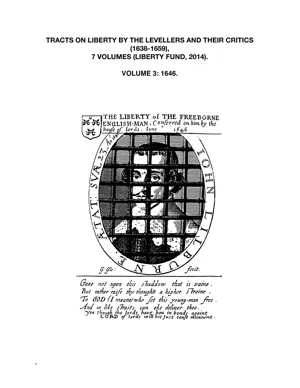
Tracts on Liberty by the Levellers and their Critics Vol. 3 (1646).
Part of Tracts on Liberty by the Levellers and their Critics (1638-1660), 7 vols.
- John Lilburne(author)
- Richard Overton(author)
- William Walwyn(author)
- David M. Hart(editor)
- Ross Kenyon(editor)
The Levellers were a political movement active in England from 1646 to 1649. They were a populist movement that emphasized equal rights, religious toleration, and reformation of political and judicial corruption. They are particularly known for their pamphlets and popular outreach. This collection consists of shorter Leveller “tracts” or pamphlets which were published cheaply and distributed on the streets throughout England during the 1640s and 1650s.
Key Quotes
Passages from this text chosen by OLL editors.
- Natural Rights“
To every individual in nature is given an individual property by nature not to be invaded or usurped by any. For every one, as he is himself, so he has a self-propriety, else could he not be himself; and of this no second may presume to deprive any of without manifest violation and affront to the very principles of nature and of the rules of equity and justice between man and man. Mine and thine cannot be, except this be. No man has power over my rights and liberties, and I over no man's. I may be but an individual, enjoy my self and my self-propriety and may right myself no more than my self, or presume any further; if I do, I am an encroacher and an invader upon another man's right — to which I have no right. For by natural birth all men are equally and alike born to like propriety, liberty and freedom; and as we are delivered of God by the hand of nature into this world, every one with a natural, innate freedom and propriety — as it were writ in the table of every man's heart, never to be obliterated — even so are we to live, everyone equally and alike to enjoy his birthright and privilege; even all whereof God by nature has made him free.
- Liberty“
Why therefore shall I crave my own, or beg my right? to turn supplicant in such a case is a disfranchising of my self, and an acknowledgement that the thing is not my own, but at another mans pleasure; so that I forsake and cast off my property, and am inslav’d to his arbitrary pleasure: if the other will, I may have possession, otherwise not. Which indignity to my own, or to my Countreys rights, their Lordships shall never enforce me; for it is no better then a branch of tyranny to force a man to turn supplicant for his own, and of self-robbery to submit thereto. Though this inslaved Nation be most deeply and miserably involved in that intolerable condition, so that indeed we cannot have our own naturall rights and immunities, but we must be either patient sufferers, or actuall Petitioners, as if our own were not our own of right, but of favour.
- Religion & Toleration“
This is hee (Policy) whose councell he hath long time followed, he it was that first inticed him to undertake this unhappy worke, which contrary to all reason and Religion, he calleth the building of Gods house, &c. though I shewed him plainly, he went about therein to destroy the living houses of God: the vexing and molesting of his most deare (because most consciencious and peaceable) servants: though I told him plainly, any that differed with him, might as justly compell him to conforme unto them, as he could compell them: though I manifested that he was as liable to errour, as any that he complained off, and that therefore there was no reason why he should endevour to make men odious for opinions: I shewed him it was impossible, so long as knowledge was imperfect, but men must differ: I shewed how neverthelesse, every man was bound equally as himselfe, to worship God according to his own and not another mans understanding of the word of God. I told him he would bring upon himselfe, the odium of all judicious Religious people.
- Natural Rights“
(T)he greatest good that I know of, that any man can do unto the Sons of Men besides the discovery of the knowledge of Christ, and the benefits and priviledges that are to be injoyed by him; is, rationally to discover the privilege, that is, the Right, Due, and Propriety of all the Sons of Adam, as men: that so they may not live in beastlinesse, by devouring one another: and not onely so, but also to stand for, and maintain those Rights and Priviledges in any Kingdome, or Nation, wheresoever they are in any measure established: that so the trusted, made great and potent, by a power conferred upon them; may not there-with (as is too commonly seene) Lord it, domineer over, and destroy by their Prerogative-will and pleasure, the Betrusters: yea, and also to maintain the liberties and priviledges established in a Land, by Law, against the incroaching usurpations of some great and mighty Nimrods of the world, made so by wayes and meanes; more immediatly and properly flowing from the Divell, then God: and by their false-assumed incroaching power, tyrant-like tread under their feet, all just, and innocent persons: and protect, defend, and countenance none but those, that will comply, applaud, and assist them, in their brutish, woolvish, and tyrant-like proceedings: which practises are contrary to the very end of Government; and Magistracy; ...
- Rhetoric of Liberty“
... these extorting, barbarous and murthering Gaolors, and all other ministers of State, who make their rise and fortunes, by the mines and spoylings of the people, and as they tread in the steppes of their predecessours (and rather exceed them in iniquity) so small they run into the same destruction, for as the overflowing of water doe at length make the river loose its proper channell, so those that seeke to extend their power beyond their bounds, have ever hitherto lost not only their powers by them usurped, but often even that also which by right belonged unto them ...
About This Edition
Citation
Lilburne, John. Tracts on Liberty by the Levellers and their Critics (1638-1660), 7 vols. Edited by David M. Hart and Ross Kenyon (Indianapolis: Liberty Fund, 2014-2018). Vol. 3 (1646).
Lilburne, John, et al. Tracts on Liberty by the Levellers and their Critics Vol. 3 (1646).. Edited by David M. Hart and Ross Kenyon, Liberty Fund, 2014. Online Library of Liberty, https://oll.libertyfund.org/titles/hart-tracts-on-liberty-by-the-levellers-and-their-critics-vol-3-1646.
Lilburne, J., Overton, R., & Walwyn, W. (2014). Tracts on Liberty by the Levellers and their Critics Vol. 3 (1646).. Liberty Fund. https://oll.libertyfund.org/titles/hart-tracts-on-liberty-by-the-levellers-and-their-critics-vol-3-1646
@book{lilburne20141646,
  author = {John Lilburne and Richard Overton and William Walwyn},
  editor = {David M. Hart and Ross Kenyon},
  title = {Tracts on Liberty by the Levellers and their Critics Vol. 3 (1646).},
  publisher = {Liberty Fund},
  address = {Indianapolis},
  year = {2014},
  url = {https://oll.libertyfund.org/titles/hart-tracts-on-liberty-by-the-levellers-and-their-critics-vol-3-1646},
  note = {Online Library of Liberty}
}TY - BOOK AU - Lilburne, John AU - Overton, Richard AU - Walwyn, William A2 - Hart, David M. A2 - Kenyon, Ross TI - Tracts on Liberty by the Levellers and their Critics Vol. 3 (1646). PY - 2014 CY - Indianapolis PB - Liberty Fund UR - https://oll.libertyfund.org/titles/hart-tracts-on-liberty-by-the-levellers-and-their-critics-vol-3-1646 DB - Online Library of Liberty ER -
Copyright
The text is in the public domain.

About the author
John Lilburne 1615–1657
John Lilburne (1615-1657) was a leader in the Leveller movement of the 1640s. A prolific pamphleteer, he was imprisoned several times for his religious views and became an ardent defender of religious liberty. He was active in the army of parliament and rose to the rank of Lieutenant-Colonel. His more important works include England’s Birthright Justified (1645), England’s New Chains Discovered (1649), The Hunting of the Foxes (1649).

