
Literature & Music
“So you must be the first that gives this sentence, And he that suffers. O! it is excellent To have a giant’s strength, but it is tyrannous To use it like a giant.”

Literature & Music
WHEN in disgrace with Fortune and men's eyes,
I all alone beweep my out-cast state,
And trouble deaf heaven with my bootless cries,
And look upon my self and curse my fate,
Wishing me like to one more rich in hope,
Featured like him, like him with friends possessed,
Desiring this mans art, and that mans scope,
With what I most enjoy contented least,
Yet in these thoughts my self almost despising,
Haply I think on thee, and then my state,
(Like to the Lark at break of day arising)
From sullen earth sings hymns at Heaven's gate,
For thy sweet love rememb'red such wealth brings,
That then I scorn to change my state with kings.
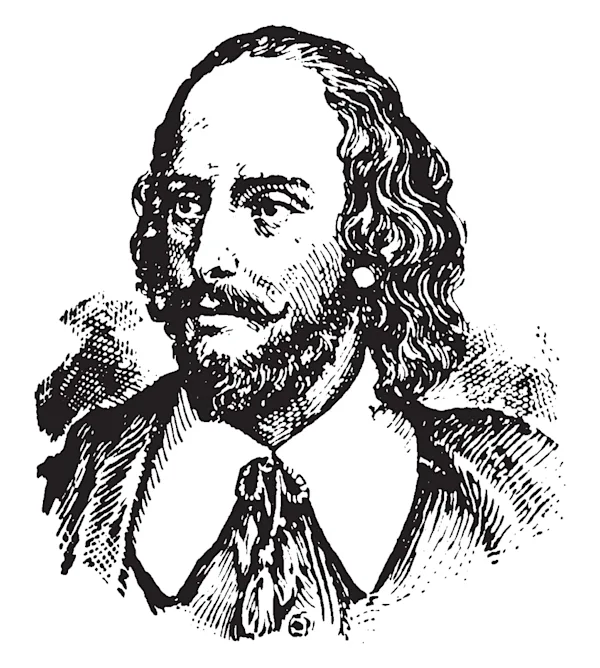
In his 29th Sonnet William Shakespeare (1564-1616) describes a young man who is disgraced, outcast, shoeless, friendless, full of envy of others more successful than he, and without hope. Yet, he remembers the "sweet love" he feels for his lover and decides he would not swap his current situation for that of even a king:
This poem was put online on St. Valentine's Day, along with Adam Smith's comment on passion/love and one of Petrarch's love poems to Laura, to show some of the range of thinking on this subject by authors in the Online Library of Liberty. It was also chosen because of its several political references to various "states" - the outcast state where men are exiled from their communities, the state of poverty and failure of the young man, the state of heaven (implied not stated explicitly), and the state ruled by Kings. Although this is a poem about how the love of another can raise one's hopes and spirits, it also shows how often Shakespeare resorted to the vocabulary of other occupations and disciplines to make his points. In this case it is the political language of states, hierarchies, and monarchs; in other cases it is the language of law or commerce.
Read the passage in context, or cite the edition.
“So you must be the first that gives this sentence, And he that suffers. O! it is excellent To have a giant’s strength, but it is tyrannous To use it like a giant.”
“Candide, as he was returning home, made profound reflections on the Turk’s discourse. “This good old man,” said he to Pangloss and Martin, “appears to me to have chosen for himself a lot much preferable to that of the six kings with whom we had the honor to sup.” ... “Neither need you tell me,” said Candide, “that we must take care of our garden.” “You are in the right,” said Pangloss; “for when man was put into the garden of Eden, it was with an intent to dress it: and this proves that man was not born to be idle.” “Work then without disputing,” said Martin; “it is the only way to render life supportable.””
The Works of Voltaire, Vol. I (Candide)
“They set themselves in armour bright, These mischiefs to prevent; With all the yeomen brave and bold That were in fruitful Kent. At Canterbury did they meet, Upon a certain day, With sword and spear, with bill and bow, And stopt the conqueror’s way. “Let us not yield, like bond-men poor, To Frenchmen in their pride, But keep our ancient liberty, What chance so e’er betide: “And rather die in bloody field, With manly courage prest, Than to endure the servile voke, Which we so much detest.””
History of the Conquest of England by the Normans vol. 1