

The Online Library of Liberty

Search the library

Press Enter to see all results. Esc closes.

Money & Banking

Mises on classical liberalism and the gold standard (1928)

Monetary policy of the preliberal era was either crude coin debasement, for the benefit of financial administration (only rarely intended as Seisachtheia, i.e., to nullify outstanding debts), or still more crude paper money inflation. However, in addition to, sometimes even instead of, its fiscal goal, the driving motive behind paper money inflation very soon became the desire to favor the debtor at the expense of the creditor...

With the attainment of gold monometallism, liberals believed the goal of monetary policy had been reached.... The value of gold was then independent of any direct manipulation by governments, political policies, public opinion or parliaments. So long as the gold standard was maintained, there was no need to fear severe price disturbances from the side of money. The adherents of the gold standard wanted no more than this, even though it was not clear to them at first that this was all that could be attained.

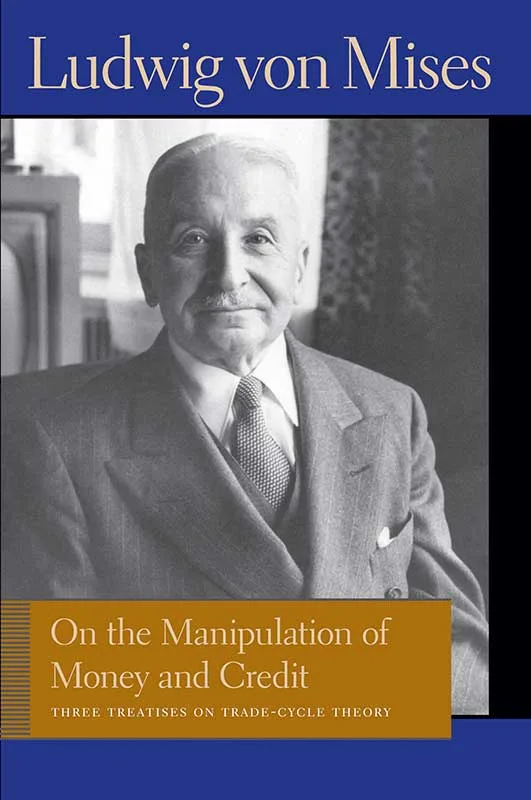
— Ludwig von Mises, On the Manipulation of Money and Credit: Three Treatises on Trade-Cycle Theory

Context

Further thoughts

More on Money & Banking

  • Money & Banking
    “It is worthy of observation, that every case of failure in finances, since the system of paper began, has produced a revolution in governments, either total or partial. A failure in the finances of France produced the French revolution. A failure in the finance of the assignats broke up the revolutionary government, and produced the present French Constitution. A failure in the finances of the Old Congress of America, and the embarrassments it brought upon commerce, broke up the system of the old confederation, and produced the federal Constitution. If, then, we admit of reasoning by comparison of causes and events, the failure of the English finances will produce some change in the government of that country.”
  • Money & Banking
    “Economics recommends neither inflationary nor deflationary policy. It does not urge the governments to tamper with the market’s choice of a medium of exchange. It establishes only the following truths: 1. By committing itself to an inflationary or deflationary policy a government does not promote the public welfare, the commonweal, or the interests of the whole nation. It merely favors one or several groups of the population at the expense of other groups. 2. It is impossible to know in advance which group will be favored by a definite inflationary or deflationary measure and to what extent. These effects depend on the whole complex of the market data involved. They also depend largely on the speed of the inflationary or deflationary movements and may be completely reversed with the progress of these movements. 3. At any rate, a monetary expansion results in misinvestment of capital and overconsumption. It leaves the nation as a whole poorer, not richer. These problems are dealt with in Chapter 20. 4. Continued inflation must finally end in the crack-up boom, the complete breakdown of the currency system. 5. Deflationary policy is costly for the treasury and unpopular with the masses. But inflationary policy is a boon for the treasury and very popular with the ignorant. Practically, the danger of deflation is but slight and the danger of inflation tremendous.”
  • Money & Banking
    “The principle of sound money that guided nineteenth-century monetary doctrines and policies was a product of classical political economy. It was an essential part of the liberal program as developed by eighteenth-century social philosophy and propagated in the following century by the most influential political parties of Europe and America...It is impossible to grasp the meaning of the idea of sound money if one does not realize that it was devised as an instrument for the protection of civil liberties against despotic inroads on the part of governments. Ideologically it belongs in the same class with political constitutions and bills of rights. The demand for constitutional guarantees and for bills of rights was a reaction against arbitrary rule and the nonobservance of old customs by kings. The postulate of sound money was first brought up as a response to the princely practice of debasing the coinage. It was later carefully elaborated and perfected in the age which—through the experience of the American continental currency, the paper money of the French Revolution and the British restriction period—had learned what a government can do to a nation’s currency system... Thus the sound-money principle has two aspects. It is affirmative in approving the market’s choice of a commonly used medium of exchange. It is negative in obstructing the government’s propensity to meddle with the currency system.”