

“The College breaks up in the beginning of June and does not sit down again till the beginning of October. During this interval I propose that he should learn french and Dancing and fencing and that besides he should read with me the best greek, latin and french Authors on Moral Philosophy for two or three hours every morning, so that he will not be idle in the vacation.”
Education
Mary Wollstonecraft, Education, and the Young Mind
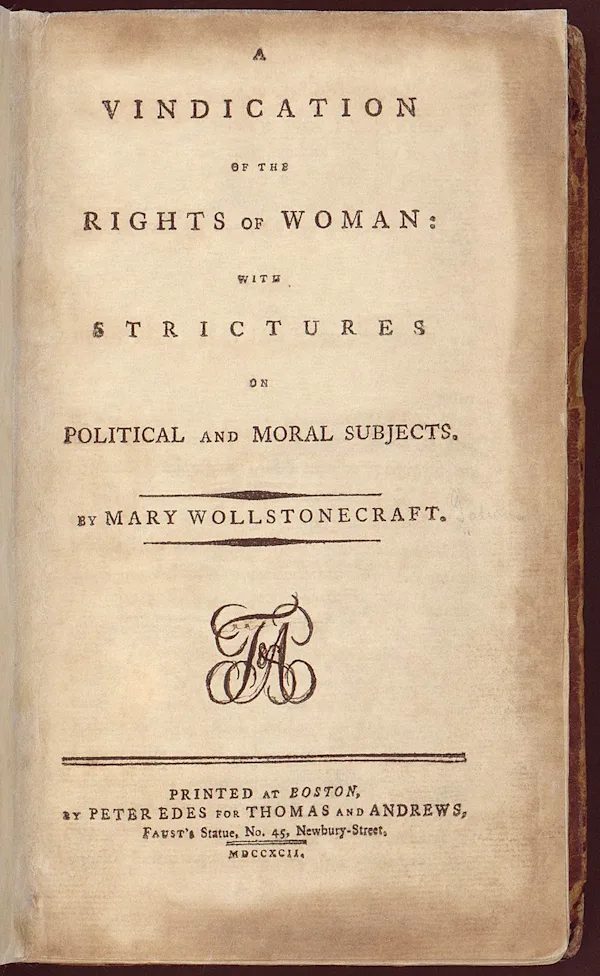
Indeed, the necessity of a master’s giving the parents some sample of the boys abilities, which during the vacation is shewn to every visitor, is productive of more mischief than would at first be supposed. For it is seldom done entirely, to speak with moderation, by the child itself; thus the master countenances falsehood, or winds the poor machine up to some extraordinary exertion, that injures the wheels, and stops the progress of gradual improvement. The memory is loaded with unintelligible words, to make a shew of, without the understanding’s acquiring any distinct ideas: but only that education deserves emphatically to be termed cultivation of mind, which teaches young people how to begin to think. The imagination should not be allowed to debauch the understanding before it gained strength, or vanity will become the forerunner of vice: for every way of exhibiting the acquirements of a child is injurious to its moral character. (FROM: CHAPTER XII: on national education)
Context
It was common practice, during Mary Wollstonecraft's lifetime, for school masters to invite parents to visit the school for a day to listen to the children demonstrate what they had learned. It would be a mistake to think of this as a modern day school recital, however. Children were grilled on Latin, Greek, and mathematics and were expected from a very young age to memorize and recite long pieces of prose or poetry for performance in front of the assembled audience. Wollstonecraft was unpersuaded that the practice did anything useful. She writes:
Further thoughts
Perhaps most telling is Wollstonecraft's choice to refer to the performing child as a "poor machine" who is wound too tightly, damaged, and prevented from doing well in the future by this tremendous pressure at an early stage.
Rather than rote memorization of unintelligible words, Wollstonecraft encourages the "cultivation of mind" and teaching children to "begin to think."
This is, she argues, necessary for their intellect, but also for their character. Being taught to perform without understanding encourages children to show off, not to learn.
Found in
Read the passage in context, or cite the edition.
More on Education
- Education
- Education
“The reading of these speeches added much to my limited stock of language, and enabled me to give tongue to many interesting thoughts which had often flashed through my mind and died away for want of words in which to give them utterance. The mighty power and heart-searching directness of truth penetrating the heart of a slave-holder, compelling him to yield up his earthly interests to the claims of eternal justice, were finely illustrated in the dialogue; and from the speeches of Sheridan I got a bold and powerful denunciation of oppression and a most brilliant vindication of the rights of man. Here was indeed a noble acquisition. If I had ever wavered under the consideration that the Almighty, in some way, had ordained slavery, and willed my enslavement for His own glory, I wavered no longer. I had now penetrated to the secret of all slavery and all oppression, and had ascertained their true foundation to be in the pride, the power, and the avarice of man. With a book in my hand so redolent of the principles of liberty, with a perception of my own human nature, and the facts of my past and present experience, I was equal to a contest with the religious advocates of slavery, whether white or black,—for blindness in this matter was not confined to the white people.”
Frederick Douglass: The ex-slave Frederick Douglass reveals that reading speeches by English politicians produced in him a deep love of liberty and hatred of oppression (1882)
The Life and Times of Frederick Douglass: From 1817-1882
- Education
“... despite their differences the Revolutionary generation did achieve independence, they did write a number of strikingly similar state constitutions, and they did draft and put into operation the federal Constitution. What underlay and made possible these monumental accomplishments, however, was not a universally accepted set of philosophical principles. Rather, I suggest, most Americans shared a common matrix of ideas and assumptions about government and society, about liberty and property, about politics and law. These ideas and assumptions, together with the belief (however inaccurate) that they shared a common historical heritage, made their achievements possible. They derived those ideas and assumptions, as well as their perception of their heritage, from a variety of sources, but the principal wellspring was the printed word. [Reading Habits of Early Americans]”
Forrest McDonald: Forrest McDonald discusses the reading habits of colonial Americans and concludes that their thinking about politics and their shared values was based upon their wide reading, especially of history (1978)
Literature of Liberty, January/March 1978, vol. 1, No. 1


