

The Online Library of Liberty

Search the library

Press Enter to see all results. Esc closes.

Women’s Rights

Mary Wollstonecraft on Women's Education

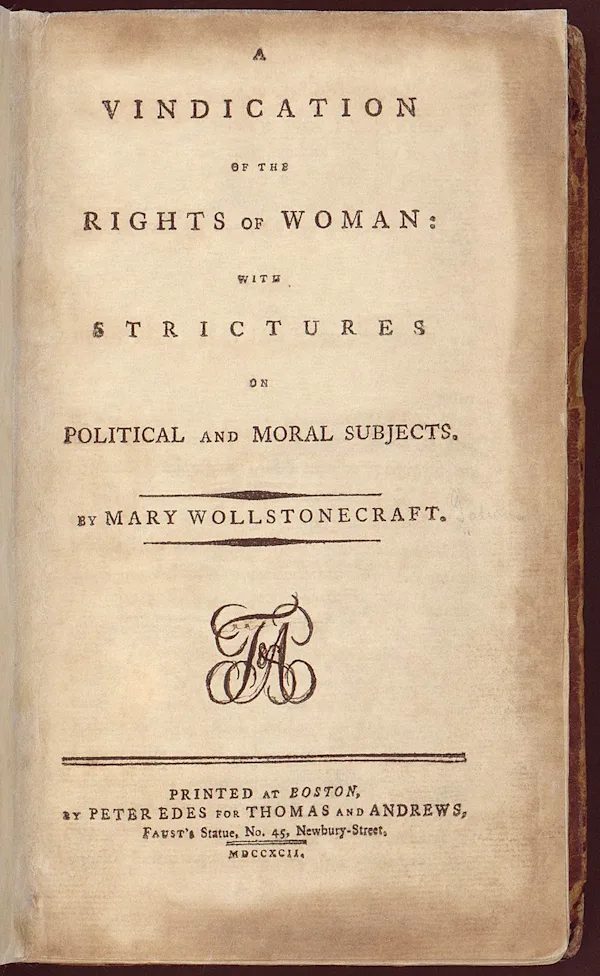
Contending for the rights of women, my main argument is built upon this simple principle, that if she be not prepared by education to become the companion of man, she will stop the progress of knowledge and virtue; for truth must be common to all, or it will be inefficacious with respect to its influence on general practice. And how can women be expected to co-operate unless she knows why she ought to be virtuous? unless freedom strengthens her reason till she comprehends her duty, and see in what manner is connected with her real good. If children are to be educated to understand the true principle of patriotism, their mother must be a patriot; and the love of mankind, from which an orderly train of virtues spring, can only be produced by considering the moral and civil interest of mankind; but the education and situation of woman at present shuts her out from such investigations.

--Mary Wollstonecraft, A Vindication of the Rights of Women

— Mary Wollstonecraft, A Vindication of the Rights of Woman

Context

Further thoughts

More on Women’s Rights

  • Women’s Rights
    “One thing we may be certain of—that what is contrary to women’s nature to do, they never will be made to do by simply giving their nature free play. The anxiety of mankind to interfere in behalf of nature, for fear lest nature should not succeed in effecting its purpose, is an altogether unnecessary solicitude. What women by nature cannot do, it is quite superfluous to forbid them from doing. What they can do, but not so well as the men who are their competitors, competition suffices to exclude them from; since nobody asks for protective duties and bounties in favour of women; it is only asked that the present bounties and protective duties in favour of men should be recalled. If women have a greater natural inclination for some things than for others, there is no need of laws or social inculcation to make the majority of them do the former in preference to the latter. Whatever women’s services are most wanted for, the free play of competition will hold out the strongest inducements to them to undertake. And, as the words imply, they are most wanted for the things for which they are most fit; by the apportionment of which to them, the collective faculties of the two sexes can be applied on the whole with the greatest sum of valuable result.”
  • Women’s Rights
    “... the principle which regulates the existing social relations between the two sexes—the legal subordination of one sex to the other—is wrong in itself, and now one of the chief hindrances to human improvement; and that it ought to be replaced by a principle of perfect equality, admitting no power or privilege on the one side, nor disability on the other.”
  • Women’s Rights
    “One thing is pretty clear, that all those individuals whose interests are indisputably included in those of other individuals, may be struck off without inconvenience. In this light may be viewed all children, up to a certain age, whose interests are involved in those of their parents. In this light, also, women may be regarded, the interests of almost all of whom are involved either in that of their fathers or that of their husbands.”

    James Mill: James Mill on Women and Representative Government

    Articles in the Supplement to the Encyclopedia Britannica (1825)