

“But souls which are pregnant—for there certainly are men who are more creative in their souls than in their bodies—conceive that which is proper for the soul to conceive or contain. And what are these conceptions?—wisdom and virtue in general. And such creators are poets and all artists who are deserving of the name inventor. But the greatest and fairest sort of wisdom by far is that which is concerned with the ordering of states and families, and which is called temperance and justice. And he who in youth has the seed of these implanted in him and is himself inspired, when he comes to maturity desires to beget and generate. He wanders about seeking beauty that he may beget offspring—for in deformity he will beget nothing—and naturally embraces the beautiful rather than the deformed body; above all when he finds a fair and noble and well–nurtured soul, he embraces the two in one person, and to such an one he is full of speech about virtue and the nature and pursuits of a good man; and he tries to educate him; and at the touch of the beautiful which is ever present to his memory, even when absent, he brings forth that which he had conceived long before, and in company with him tends that which he brings forth; and they are married by a far nearer tie and have a closer friendship than those who beget mortal children, for the children who are their common offspring are fairer and more immortal. Who, when he thinks of Homer and Hesiod and other great poets, would not rather have their children than ordinary human ones? Who would not emulate them in the creation of children such as theirs, which have preserved their memory and given them everlasting glory?”
Philosophy
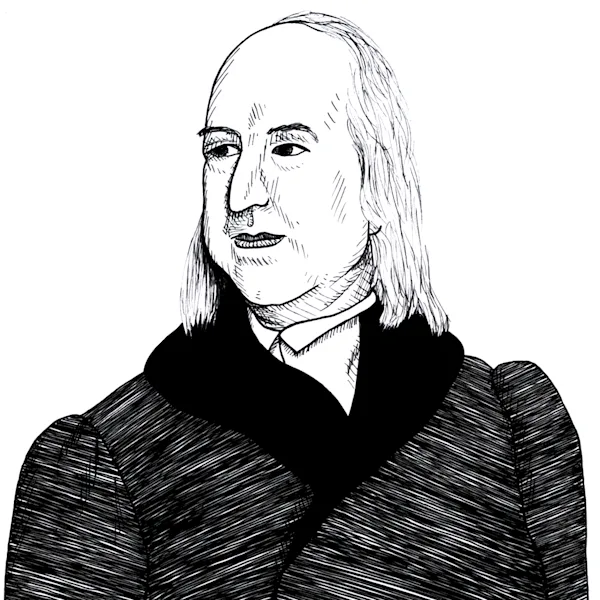
Jeremy Bentham on the Utility Principle
Correspondent to discovery and improvement in the natural world, is reformation in the moral: if that which seems a common notion be, indeed, a true one, that in the moral world there no longer remains any matter for discovery. Perhaps, however, this may not be the case: perhaps among such observations as would be best calculated to serve as grounds for reformation, are some which, being observations of matters of fact hitherto either incompletely noticed, or not at all, would, when produced, appear capable of bearing the name of discoveries: with so little method and precision have the consequences of this fundamental axiom, It is the greatest happiness of the greatest number that is the measure of right and wrong, been as yet developed.
Context
This quotation is one of the clearest formulations of the implications of what has been called Jeremy Bentham's “Utility Principle,” which forms the foundation of his entire philosophical architecture.
Further thoughts
The Principle in its earliest and most basic form appears in Bentham’s first major work, An Introduction to the Principles of Morals and Legislation, where he defined the Principle of Utility as “that principle which approves or disapproves of every action whatsoever, according to the tendency which it appears to have to augment or diminish the happiness of the party whose interest is in question.”
The term “the greatest happiness of the greatest number” as used as a guide to action (especially legislative action) predated Bentham, who seems to have encountered it in the work of Cesare Beccaria. Bentham spent much of the rest of his life trying to clarify the meaning and implications of this concept, sometimes called the “Greatest-Happiness Principle.”
One of his most important revisions to this principle (in his own estimation) was based on the insight that the loss of something we have usually causes more distress than gaining something gives us pleasure. He used the example of theft; the pain we feel from being robbed of, say, $100 is greater than the corresponding pleasure we would have if we won $100 in a lottery. This had important implications for Bentham in the stress he placed on the protection of private property. Importantly, however, he also argued that legislation aimed at alleviating of suffering (especially suffering due to loss) was better at producing general happiness than policies aimed at wealth creation.
Found in
Read the passage in context, or cite the edition.
More on Philosophy
- Philosophy
- Philosophy
“Hence it is evident that the state is a creation of nature, and that man is by nature a political animal. And he who by nature and not by mere accident is without a state, is either above humanity, or below it; he is the ‘Tribeless, lawless, hearthless one,’ whom Homera denounces—the outcast who is a lover of war; he may be compared to a bird which flies alone.”
- Philosophy
“The Specters may impose on us, whilst we refuse to turn ’em every way, and view their Shapes and Complexions in every light. For that which can be shewn only in a certain Light, is questionable. Truth, ’tis suppos’d, may bear all Lights: and one of those principal Lights or natural Mediums, by which Things are to be view’d, in order to a thorow Recognition, is Ridicule it-self, or that Manner of Proof by which we discern whatever is liable to just Raillery in any Subject. So much, at least, is allow’d by All, who at any time appeal to this Criterion. The gravest Gentlemen, even in the gravest Subjects, are suppos’d to acknowledg this: and can have no Right, ’tis thought, to deny others the Freedom of this Appeal; whilst they are free to censure like other Men, and in their gravest Arguments make no scruple to ask, Is it not Ridiculous? (FROM: PART I, SECTION I)”
Anthony Ashley Cooper, Earl of Shaftesbury: Shaftesbury on Raillery and Truth
Characteristicks of Men, Manners, Opinions, Times, vol. 1


