

The Online Library of Liberty

Search the library

Press Enter to see all results. Esc closes.

The State

James Buchanan on chaining Leviathan (1975)

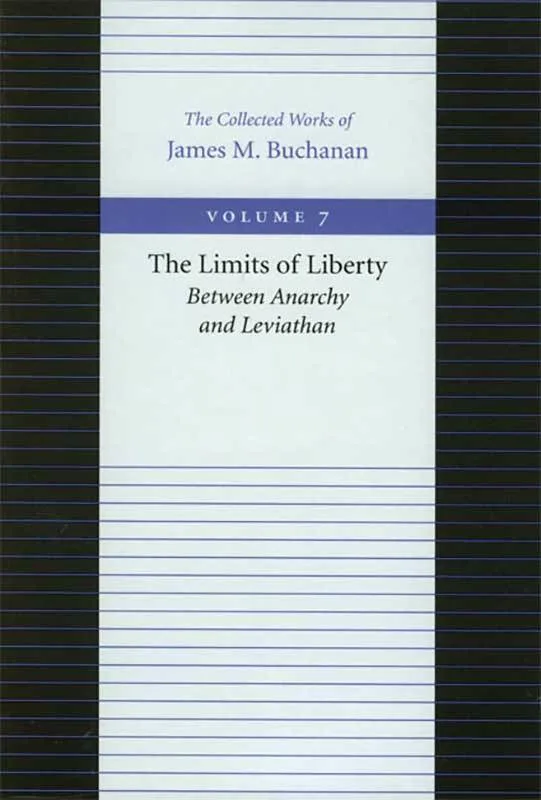
If, however, the collectivity is empowered to enforce individual rights, how is it to be prevented from going beyond these limits? What are the “rights” of the enforcing agent itself, the state? If we are able, conceptually, to discuss the enforcement of rights and of contracts involving exchanges of rights among persons apart from questions involving exogenous changes in the assignment of rights, we must also be able to specify, again conceptually, the rights of the collectivity to do things. We cannot simply move one step further back and conceive of the appointment or selection of some superior enforcing agent, one that will protect and limit the rights of both individuals and the state. The enforcement hierarchy must stop somewhere, and for our purpose it is well to restrict discussion to the first level. It is relatively easy to think of the collectivity fulfilling its role in protecting person and property from “unlawful” acts carried out by persons. It becomes much more difficult to think of means through which individuals can enforce and protect their rights from “unlawful” acts on behalf of the collectivity itself. How can Leviathan be chained? This problem has worried political philosophers of all ages, but no fully satisfactory answer has been advanced, either as an ideal to be approached or as a practical program to be experienced.

— James M. Buchanan, The Collected Works of James M. Buchanan, vol. 7 (The Limits of Liberty)

Context

Further thoughts

  • The State
    “If a state well performed its functions of providing peace, order and security, as conditions under which the people could live and work, it would be the proudest proof of its triumphant success that it had nothing to do — that all went so smoothly that it had only to look on and was never called to interfere; just as it is the test of a good business man that his business runs on smoothly and prosperously while he is not harassed or hurried. The people who think that it is proof of enterprise to meddle and “fuss” may believe that a good state will constantly interfere and regulate, and they may regard the other type of state as “non-government.””
  • The State
    “No man can have a power over a nation otherwise than de jure, or de facto. He who pretends to have a power de jure, must prove that it is originally inherent in him or his predecessor from whom he inherits; or that it was justly acquired by him. The vanity of any pretence to an original right appears sufficiently, I hope, from the proofs already given, that the first fathers of mankind had it not; or if they had, no man could now inherit the same, there being no man able to make good the genealogy that should give him a right to the succession.”
  • The State
    “Such people as have been bred up to liberty, and subject to no other dominion but the authority of their own will, look upon all other form of government as monstrous and contrary to nature. Those who are inured to [260] monarchy do the same; and what opportunity soever fortune presents them with to change, even then, when with the greatest difficulties they have disengaged themselves from one master, that was troublesome and grievous to them, they presently run, with the same difficulties, to create another; being unable to take into hatred subjection itself.”