

The Online Library of Liberty

Search the library

Press Enter to see all results. Esc closes.

Education

Sir Francis Bacon on Doubts, Patience, and Certainties

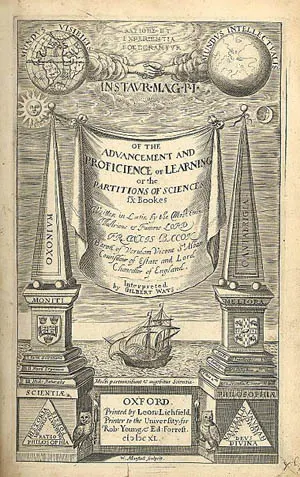
Another error is, an impatience of doubting and a blind hurry of asserting without a mature suspension of judgment. For the two ways of contemplation are like the two ways of action so frequently mentioned by the ancients; the one plain and easy at first, but in the end impassable; the other rough and fatiguing in the entrance, but soon after fair and even: so in contemplation, if we begin with certainties, we shall end in doubts; but if we begin with doubts, and are patient in them, we shall end in certainties. (FROM: ON THE DIGNITY AND ADVANCEMENT OF LEARNING, FIRST BOOK)

— Sir Francis Bacon, The Advancement of Learning

Context

Further thoughts

  • Education
    “The College breaks up in the beginning of June and does not sit down again till the beginning of October. During this interval I propose that he should learn french and Dancing and fencing and that besides he should read with me the best greek, latin and french Authors on Moral Philosophy for two or three hours every morning, so that he will not be idle in the vacation.”
  • Education
    “The reading of these speeches added much to my limited stock of language, and enabled me to give tongue to many interesting thoughts which had often flashed through my mind and died away for want of words in which to give them utterance. The mighty power and heart-searching directness of truth penetrating the heart of a slave-holder, compelling him to yield up his earthly interests to the claims of eternal justice, were finely illustrated in the dialogue; and from the speeches of Sheridan I got a bold and powerful denunciation of oppression and a most brilliant vindication of the rights of man. Here was indeed a noble acquisition. If I had ever wavered under the consideration that the Almighty, in some way, had ordained slavery, and willed my enslavement for His own glory, I wavered no longer. I had now penetrated to the secret of all slavery and all oppression, and had ascertained their true foundation to be in the pride, the power, and the avarice of man. With a book in my hand so redolent of the principles of liberty, with a perception of my own human nature, and the facts of my past and present experience, I was equal to a contest with the religious advocates of slavery, whether white or black,—for blindness in this matter was not confined to the white people.”
  • Education
    “... despite their differences the Revolutionary generation did achieve independence, they did write a number of strikingly similar state constitutions, and they did draft and put into operation the federal Constitution. What underlay and made possible these monumental accomplishments, however, was not a universally accepted set of philosophical principles. Rather, I suggest, most Americans shared a common matrix of ideas and assumptions about government and society, about liberty and property, about politics and law. These ideas and assumptions, together with the belief (however inaccurate) that they shared a common historical heritage, made their achievements possible. They derived those ideas and assumptions, as well as their perception of their heritage, from a variety of sources, but the principal wellspring was the printed word. [Reading Habits of Early Americans]”