“What should ye do then, should ye suppress all this flowery crop of knowledge and new light sprung up and yet springing daily in this city? Should ye set an oligarchy of twenty engrossers over it, to bring a famine upon our minds again, when we shall know nothing but what is measured to us by their bushel? ... Give me the liberty to know, to utter, and to argue freely according to conscience, above all liberties.”
Freedom of Speech
Benjamin Constant and the Freedom of the Press (1815)
If you once grant the need to repress the expression of opinion, either the State will have to act judicially or the government will have to arrogate to itself police powers which free it from recourse to judicial means. In the first case the laws will be eluded. Nothing is easier than presenting an opinion in such variegated guises that a precisely defined law cannot touch it. In the second case, by authorizing the government to deal ruthlessly with whatever opinions there may be, you are giving it the right to interpret thought, to make inductions, in a nutshell to reason and to put its reasoning in the place of the facts which ought to be the sole basis for government counteraction. This is to establish despotism with a free hand. Which opinion cannot draw down a punishment on its author? You give the government a free hand for evildoing, provided that it is careful to engage in evil thinking. You will never escape from this circle. The men to whom you entrust the right to judge opinions are quite as susceptible as others to being misled or corrupted, and the arbitrary power which you will have invested in them can be used against the most necessary truths as well as the most fatal errors.
Context
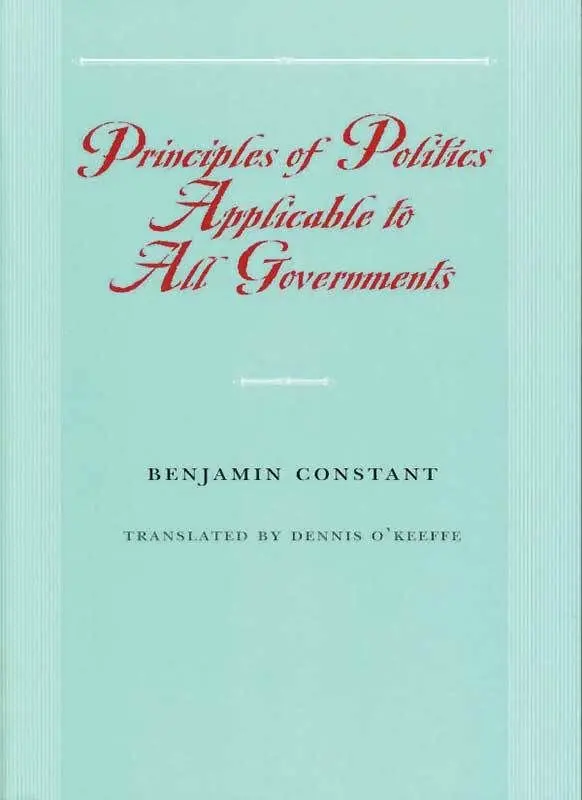
In France one of the leading theorists of the principle of free speech was Benjamin Constant (1767-1830) who had been called upon by Napoleon during his brief return to power between March-July 1815 (The Hundred Days) to draw up a new constitution with more constitutional limits on government power. Constant's ideas were elaborated in a book he wrote at the time Principles of Politics Applicable to All Governments (1815) which included chapters on freedom of thought and religion. A typical passage reads:
Further thoughts
After the strict and heavy handed censorship of the Napoleonic Empire there was a brief period of press freedom during the First Restoration of the Bourbon monarchy under King Louis XVIII (April 1814 - March 1815). The restored Bourbon monarchy declared freedom of the press on 4 June 1814 which led to the creation of a full spectrum of political debate and argument among the 20 new titles which emerged. However, by October 1814 new censorship laws had been passed in order to control political criticism of the new regime. All publications less than 20 pages long (so most papers and journals) had to have their material approved by government officials before they could be published. These laws were made even more restrictive in November 1815. There was another liberalizaton of the censorship laws in late 1818 under the ministry of Dessoles-Decazes with the Serre press laws but this was short lived as the assassination of the Duke de Berry in February 1820 led to a severe crackdown on press liberties. In the wake of this many journals were forced to close, including the liberal La Minerve française for which Benjamin Constant wrote as well as the successor to Le Censeur of Comte and Dunoyer, Le Censeur européen.
During this period classical liberals on both sides of the channel fought for an expansion of press freedom (Constant in France and James Mill in England should be mentioned). Their arguments were that educated people should have the right to know what politicians and government officials were doing with their tax money (so the proceedings of parliament should be openly published in newspapers), that corruption and nepotism by senior figures should be exposed and condemned, and that the interests of the middle and working classes should be expressed and defended in the press and that governments should take these interests into account when passing laws.

Found in
Read the passage in context, or cite the edition.
More on Freedom of Speech
- Freedom of Speech
- Freedom of Speech
“...books are not absolutely dead things, but do contain a potency of life in them to be as active as that soul was whose progeny they are; nay, they do preserve as in a vial the purest efficacy and extraction of that living intellect that bred them. I know they are as lively, and as vigorously productive, as those fabulous dragon’s teeth: and being sown up and down, may chance to spring up armed men. And yet, on the other hand, unless wariness be used, as good almost kill a man as kill a good book: who kills a man kills a reasonable creature, God’s image; but he who destroys a good book, kills reason itself, kills the image of God, as it were, in the eye.”
- Freedom of Speech
“The people are the only censors of their governors: and even their errors will tend to keep these to the true principles of their institution. To punish these errors too severely would be to suppress the only safeguard of the public liberty. The way to prevent these irregular interpositions of the people is to give them full information of their affairs thro’ the channel of the public papers, & to contrive that those papers should penetrate the whole mass of the people. The basis of our governments being the opinion of the people, the very first object should be to keep that right; and were it left to me to decide whether we should have a government without newspapers or newspapers without a government, I should not hesitate a moment to prefer the latter. But I should mean that every man should receive those papers & be capable of reading them.”
Thomas Jefferson: Jefferson's preference for "newspapers without government" over "government without newspapers" (1787)
The Works, vol. 5 (Correspondence 1786-1789)