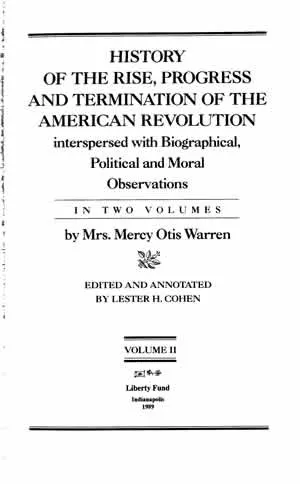
Warren knew many of the New Englanders involved in the beginning of the colonial revolt against Great Britain, and had started writing a history of the American Revolution in the form of letters to friends as events unfolded. She then began to arrange her materials in a more systematic fashion and by 1787 had completed a draft covering the entire war, beginning with the Stamp Act in 1765 and concluding with the end of hostilities in 1783. She saved the manuscript but made no effort to publish it, believing that a history of the revolution from a republican and Anti Federalist perspective would be of little interest to the reading public. After the election of Thomas Jefferson in 1800, an old family friend, Dr. James Forman of King’s Chapel in Boston, persuaded her to publish her history.
Entitled History of the Rise, Progress and Termination of the American Revolution, the volume carried a descriptive subtitle, interspersed with Biographical, Political, and Moral Observations. Published in three volumes in 1805, the printed version contained a new concluding chapter that outlined political developments since the end of the War, including government under the Articles of Confederation, the adoption of the Constitution, Washington’s Presidency, and a brief character sketch of Washington’s successor, John Adams.
At the end of the war, Warren argued, America had three distinct advantages allowing it to become a world power: ocean borders protected America from corrupt foreign powers; it possessed a vast and fertile territory; it was free from foreign domination. “Nothing seemed wanting to the United States but a continuance of their union and virtue.” In politics, virtue was tied a commitment to republican principles; in religion, virtue demanded “a strict adherence to a sublime code of morals, which has never been equaled by the sages of ancient times, nor can ever be abolished by the sophistical reasonings of modern philosophers.”
This apparent optimism, however, may have been a case of Warren whistling past the graveyard. Historian and Warren biographer Rosemarie Zagarri argues that even in the early days of the revolution, “Mercy perceived the beginnings of a decline in public virtue, a drift away from the spirit of thriftiness, restraint, and self-sacrifice for the public good that had, in her eyes, made the Revolution possible. In its place, self-indulgence, luxury, and greed sapped the martial spirit and made republican government nearly impossible” (A Woman’s Dilemma: Mercy Otis Warren and the American Revolution [Harlan Davidson, 1995, p.96]).
Warren offers thumbnail sketches of the decline of republican liberty in Greece and Rome in the ancient world, and the terrors of the French Revolution in the modern world, and the current precarious status of liberty in England, and concludes that the rise of skepticism and irreligion threatened liberty in all four nations. Is this to be the fate of the United States?
Warren concludes chapter 30—the last chapter of her original manuscript—with the following reflection. “It is an unpleasing part of history, when ‘corruption begins to prevail, when degeneracy marks the manners of the people, and weakens the sinews of the state.’ If this should ever become the deplorable situation of the United States, let some unborn historian, in a far distant day, detail the lapse, and hold up the contrast between a simple, virtuous, and free people, and a degenerate, servile race of beings, corrupted by wealth, effeminate by luxury, impoverished by licentiousness, and become the automatons of intoxicated ambition.” In writing chapter 31 a decade and a half after completing her history of the Revolution, perhaps she thought of herself as the first historian to note the beginning of America’s decline.