

The Online Library of Liberty

Search the library

Press Enter to see all results. Esc closes.

War & Peace

Trenchard on the dangers posed by a standing army (1698)

I will venture to say, that if this Army does not make us Slaves, we are the only People upon Earth in such Circumstances that ever escaped it, with the 4th part of their number... If this Army does not enslave us, it is barely because we have a virtuous Prince that will not attempt it; and it is a most miserable thing to have no other Security for our Liberty, than the Will of a Man, though the most just Man living: For that is not a free Government where there is a good Prince (for even the most arbitrary Governments have had sometimes a Relaxation of their Miseries) but where it is so constituted, that no one can be a Tyrant if he would. Cicero says, though a Master does not tyrannize, yet it is a lamentable consideration that it is in his Power to do so; and therefore such a Power is to be trusted to none, which if it does not find a Tyrant, commonly makes one; and if not him, to be sure a Successor.

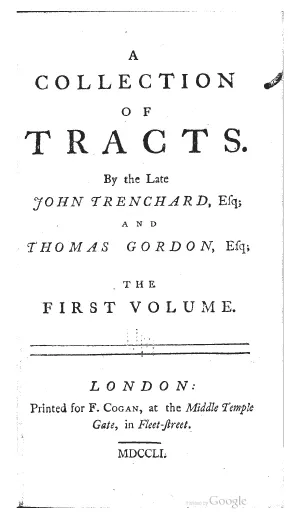
— John Trenchard, A Collection of Tracts, vol. I

Context

Further thoughts

More on War & Peace

  • War & Peace
    “Our battalions for the continental service were some time ago so far filled as rendered the recommendation of a draught from the militia hardly requisite, and the more so as in this country it ever was the most unpopular and impracticable thing that could be attempted. Our people, even under the monarchical government, had learnt to consider it as the last of all oppressions.”
  • War & Peace
    “Is this, sir, consistent with the character of a free government? Is this civil liberty? Is this the real character of our Constitution? No sir, indeed it is not. The Constitution is libelled, foully libelled. The people of this country have not established for themselves such a fabric of despotism. They have not purchased at a vast expense of their own treasure and their own blood a Magna Charta to be slaves. Where is it written in the Constitution, in what article or section is it contained, that you may take children from their parents, and parents from their children, and compel them to fight the battles of any war in which the folly or the wickedness of government may engage it? Under what concealment has this power lain hidden which now for the first time comes forth, with a tremendous and baleful aspect, to trample down and destroy the dearest rights of personal liberty? Who will show me any Constitutional injunction which makes it the duty of the American people to surrender everything valuable in life, and even life itself, not when the safety of their country and its liberties may demand the sacrifice, but whenever the purposes of an ambitious and mischievous government may require it? Sir, I almost disdain to go to quotations and references to prove that such an abominable doctrine has no foundation in the Constitution of the country.”
  • War & Peace
    “But in a country, where the perpetual menacings of danger oblige the government to be always prepared to repel it, her armies must be numerous enough for instant defence. The continual necessity for his services enhances the importance of the soldier, and proportionably degrades the condition of the citizen. The military state becomes elevated above the civil. The inhabitants of territories often the theatre of war, are unavoidably subjected to frequent infringements on their rights, which serve to weaken their sense of those rights; and by degrees, the people are brought to consider the soldiery not only as their protectors, but as their superiors.”