

“8th. ... that if the acts before specified should stand, these conclusions would flow from them; that the general government may place any act they think proper on the list of crimes and punish it themselves whether enumerated or not enumerated by the constitution as cognizable by them: that they may transfer its cognizance to the President, or any other person, who may himself be the accuser, counsel, judge and jury, whose suspicions may be the evidence, his order the sentence, his officer the executioner, and his breast the sole record of the transaction... ... that these and successive acts of the same character, unless arrested at the threshold, necessarily drive these States into revolution and blood and will furnish new calumnies against republican government, and new pretexts for those who wish it to be believed that man cannot be governed but by a rod of iron: that it would be a dangerous delusion were a confidence in the men of our choice to silence our fears for the safety of our rights: that confidence is everywhere the parent of despotism — free government is founded in jealousy, and not in confidence; it is jealousy and not confidence which prescribes limited constitutions, to bind down those whom we are obliged to trust with power: that our Constitution has accordingly fixed the limits to which, and no further, our confidence may go; and let the honest advocate of confidence read the Alien and Sedition acts, and say if the Constitution has not been wise in fixing limits to the government it created, and whether we should be wise in destroying those limits, Let him say what the government is, if it be not a tyranny, which the men of our choice have conferred on our President, and the President of our choice has assented to, and accepted over the friendly stranger to whom the mild spirit of our country and its law have pledged hospitality and protection: that the men of our choice have more respected the bare suspicion of the President, than the solid right of innocence, the claims of justification, the sacred force of truth, and the forms and substance of law and justice. In questions of powers, then, let no more be heard of confidence in man, but bind him down from mischief by the chains of the Constitution.”
Presidents, Kings, Tyrants, & Despots
Thomas Gordon asks whether tyranny is worse than anarchy (1728)
IT is usually said, that bad Government is better than none; a proposition which is far from self-evident. I am apt to think that absolute Tyranny is worse than Anarchy; for I can easily suppose popular confusion to be less mischievous than a settled active Tyranny, that it will do no less harm, and is likely to end sooner. All tumults are in their nature, and must be, short in duration, must soon subside, or settle into some order. But Tyranny may last for ages, and go on destroying, till at last it has left nothing to destroy. What can the most dreadful Anarchy produce but a temporary work of desolation and fury, what but violation of Law and Life? And can Government be said to exist, where all Justice is neglected, where all Violence and Oppression is committed, where lawless Will is the only reason, where the ravages of blind appetite, and of the blind sword; are the only administration?
Context
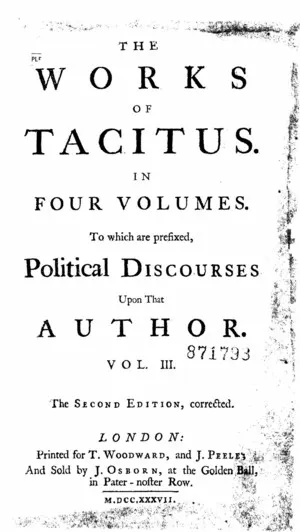
The English radical Whig and Commonwealthman Thomas Gordon (1692-1750) argues in his Discourses on Tacitus (1728) that “a settled active Tyranny” is worse than no government at all:
Further thoughts
After excoriating the British empire in his journalistic writings in the early 1720s (such as Cato’s Letters) Gordon turned to translating and commenting upon the works of the Roman historians Tacitus and Sallust in a series of Political Discourses which appeared between 1828 and 1744. He appended to each volume lengthy “discourses” in which he compared the abuses of power the historians found in the Roman Empire with the abuses he saw the British Empire replicating in his own times. One of his major themes was the idea that war and empire abroad inevitably led to tyranny and corruption at home. These translations and accompanying discourses were much read by the colonists in north America who were not slow to see the comparisons Gordon was making. We have gathered together in one volume Gordon’s complete Political Discourses for the first time - Thomas Gordon’s Political Discourses on Tacitus and Sallust: Tyranny, Empire, War, and Corruption (1728-1744). Three of his Discourses on Tacitus, which were rather cheekily dedicated to the Prince of Wales, deal with the the proper behaviour of Princes. The advice Gordon gives to a Prince is not surprisingly very un-Machiavellian.
Found in
Read the passage in context, or cite the edition.
More on Presidents, Kings, Tyrants, & Despots
- Presidents, Kings, Tyrants, & Despots
“What astonishing changes a few years are capable of producing! I am told that even respectable characters speak of a monarchical form of government without horror. From thinking proceeds speaking, thence to acting is often but a single step. But how irrevocable and tremendous! What a triumph for the advocates of despotism to find that we are incapable of governing ourselves, and that systems founded on the basis of equal liberty are merely ideal and fallacious! Would to God that wise measures may be taken in time to avert the consequences we have but too much reason to apprehend.”
- Presidents, Kings, Tyrants, & Despots
“But admitt, that monarchy of it self may be convenient to som nations, yet to us who have thrown it out, received back again, it cannot but prove pernicious. For [the] kings to com, never forgetting thir former ejection, will be sure to fortifie and arme themselves sufficiently for the future against all such attempts heerafter from the people: who shall be then so narrowly watch’d and kept so low, [as that besides the loss of all thir blood, and treasure spent to no purpose,], that though they would never so fain and at the same rate of thir blood and treasure, they never shall be able to regain what they now have purchasd and may enjoy, or to free themselves from any yoke impos’d upon them. nor will they dare to go about it; utterly disheartn’d for the future, if these thir highest attempts prove unsuccesfull; which will be the triumph of all tyrants heerafter over any people that shall resist oppression; and thir song will then be, to others, how sped the rebellious English? to our posteritie, how sped the rebells your fathers?”


