The Online Library of Liberty

Search the library

Press Enter to see all results. Esc closes.

The State

Spooner on the difference between a government and a highwayman (1870)

But this theory of our government is wholly different from the practical fact. The fact is that the government, like a highwayman, says to a man: Your money, or your life. And many, if not most, taxes are paid under the compulsion of that threat.

The government does not, indeed, waylay a man in a lonely place, spring upon him from the road side, and, holding a pistol to his head, proceed to rifle his pockets. But the robbery is none the less a robbery on that account; and it is far more dastardly and shameful.

The highwayman takes solely upon himself the responsibility, danger, and crime of his own act. He does not pretend that he has any rightful claim to your money, or that he intends to use it for your own benefit. He does not pretend to be anything but a robber. He has not acquired impudence enough to profess to be merely a “protector,” and that he takes men’s money against their will, merely to enable him to “protect” those infatuated travellers, who feel perfectly able to protect themselves, or do not appreciate his peculiar system of protection. He is too sensible a man to make such professions as these. Furthermore, having taken your money, he leaves you, as you wish him to do. He does not persist in following you on the road, against your will; assuming to be your rightful “sovereign,” on account of the “protection” he affords you. He does not keep “protecting” you, by commanding you to bow down and serve him; by requiring you to do this, and forbidding you to do that; by robbing you of more money as often as he finds it for his interest or pleasure to do so; and by branding you as a rebel, a traitor, and an enemy to your country, and shooting you down without mercy, if you dispute his authority, or resist his demands. He is too much of a gentleman to be guilty of such impostures, and insults, and villanies as these. In short, he does not, in addition to robbing you, attempt to make you either his dupe or his slave.


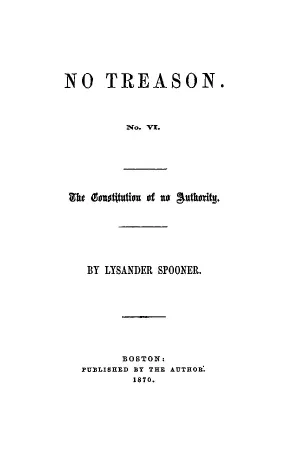
— Lysander Spooner, No Treason. No. VI. The Constitution of No Authority (1870)

Context

Further thoughts

  • The State
    “If a state well performed its functions of providing peace, order and security, as conditions under which the people could live and work, it would be the proudest proof of its triumphant success that it had nothing to do — that all went so smoothly that it had only to look on and was never called to interfere; just as it is the test of a good business man that his business runs on smoothly and prosperously while he is not harassed or hurried. The people who think that it is proof of enterprise to meddle and “fuss” may believe that a good state will constantly interfere and regulate, and they may regard the other type of state as “non-government.””
  • The State
    “No man can have a power over a nation otherwise than de jure, or de facto. He who pretends to have a power de jure, must prove that it is originally inherent in him or his predecessor from whom he inherits; or that it was justly acquired by him. The vanity of any pretence to an original right appears sufficiently, I hope, from the proofs already given, that the first fathers of mankind had it not; or if they had, no man could now inherit the same, there being no man able to make good the genealogy that should give him a right to the succession.”
  • The State
    “Such people as have been bred up to liberty, and subject to no other dominion but the authority of their own will, look upon all other form of government as monstrous and contrary to nature. Those who are inured to [260] monarchy do the same; and what opportunity soever fortune presents them with to change, even then, when with the greatest difficulties they have disengaged themselves from one master, that was troublesome and grievous to them, they presently run, with the same difficulties, to create another; being unable to take into hatred subjection itself.”