

The Online Library of Liberty

Search the library

Press Enter to see all results. Esc closes.

Law

Pollock on "our lady" the common law and her devoted servants (1911)

There seems to be no ground for affirming that the Common Law is especially attached to any one form of government, or is incompatible with any that makes substantial provision for civic liberty and the representation of the governed. Those fundamental conditions may be satisfied in many ways, perhaps in ways not yet found out. It might be hard to say how much of our lady’s house has been rebuilt, but it is sure that the fashion of the furniture has been changed many times. ... Our lady does not, in truth, care much by what name the chief magistrate is called, whether his office is elective or hereditary, whether he has as much active discretion of his own as the President of the United States or as little as a modern King of Great Britain. What she does care for is that government, whatever its forms, shall be lawful and not arbitrary; that it shall have the essential attribute for which Chief Justice Fortescue’s word was ‘political’ as far back as the fifteenth century. She looks for trusty servants who will stand by her in the day of need. She demands fearless and independent judges drawn from a fearless and independent Bar, men who will not swerve from the straight path to the right hand for any pleasure of rulers, be they aristocratic or democratic, nor be drawn aside to the left by the more insidious temptation of finding popular favour in opposition. If our lady’s servants are not of that spirit, all the learning of all their books will not save them from disgrace or her realm from ruin. If they are, we shall never see the enemy whom she and they will be afraid to speak with in the gate.

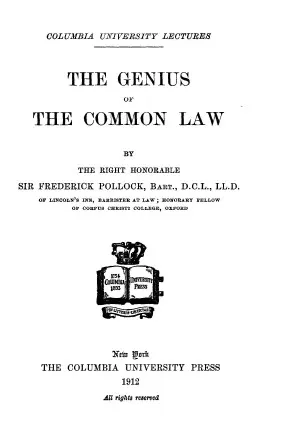
— Sir Frederick Pollock, The Genius of the Common Law

Context

Further thoughts

  • Law
    “It is manifest, therefore, that the jury must judge of and try the whole case, and every part and parcel of the case, free of any dictation or authority on the part of the government. They must judge of the existence of the law; of the true exposition of the law; of the justice of the law; and of the admissibility and weight of all the evidence offered; otherwise the government will have everything its own way; the jury will be mere puppets in the hands of the government; and the trial will be, in reality, a trial by the government, and not a “trial by the country.” By such trials the government will determine its own powers over the people, instead of the people’s determining their own liberties against the government; and it will be an entire delusion to talk, as for centuries we have done, of the trial by jury, as a “palladium of liberty,” or as any protection to the people against the oppression and tyranny of the government.”
  • Law
    “No man can be judged a criminal until he be found guilty; nor can society take from him the public protection, until it have been proved that he has violated the conditions on which it was granted. What right, then, but that of power, can authorise the punishment of a citizen, so long as there remains any doubt of his guilt? The dilemma is frequent. Either he is guilty, or not guilty. If guilty, he should only suffer the punishment ordained by the laws, and torture becomes useless, as his confession is unnecessary. If he be not guilty, you torture the innocent; for, in the eye of the law, every man is innocent, whose crime has not been proved.”
  • Law
    “Of great importance to the public is the preservation of this personal liberty; for if once it were left in the power of any the highest magistrate to imprison arbitrarily whomever he or his officers thought proper, (as in France it is daily practised by the crown,) there would soon be an end of all other rights and immunities. Some have thought that unjust attacks, even upon life or property, at the arbitrary will of the magistrate, are less dangerous to the commonwealth than such as are made upon the personal liberty of the subject. To bereave a man of life, or by violence to confiscate his estate, without accusation or trial, would be so gross and notorious an act of despotism, as must at once convey the alarm of tyranny throughout the whole kingdom; but confinement of the person, by secretly hurrying him to jail, where his sufferings are unknown or forgotten, is a less public, a less striking, and therefore a more dangerous engine of arbitrary government.”