

The Online Library of Liberty

Search the library

Press Enter to see all results. Esc closes.

Economics

Philip Wicksteed on “non-tuism” in economic relations (1910)

There is surely nothing degrading or revolting to our higher sense in this fact of our mutually furthering each other’s purposes because we are interested in our own. There is no taint or presumption of selfishness in the matter at all. The economic nexus indefinitely expands our freedom of combination and movement; for it enables us to form one set of groups linked by cohesion of faculties and resources, and another set of groups linked by community of purpose, without having to find the “double coincidence” which would otherwise be necessary. This economy and liberty will be equally valued by altruistic and by egoistic groups or individuals, and it would be just as true, and just as false, to say that the business motive ignores egoistic as to say that it ignores altruistic impulses. The specific characteristic of an economic relation is not its “egoism,” but its “non-tuism.”

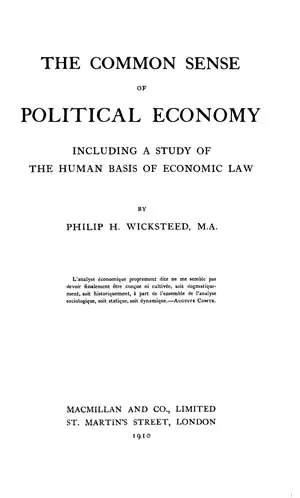
— Philip H. Wicksteed, The Commonsense of Political Economy

Context

Further thoughts

  • Economics
    “One argument used by a very enlightened member of Parliament, during a late discussion on the rate of interest charged by the Bank, was rather a singular one: he said that the Bank of France, and other banks on the Continent, lent at a low rate, and therefore the Bank of England should do so. I can see no connexion between his premises and conclusion. The Bank of France ought to be governed by the market rate of interest and the rate of profits in France; the Bank of England by the market rate of interest and the rate of profit in England. One may be very different from the other. From the whole of his argument, I should infer that he considered a low rate of interest, in itself, beneficial to a country. The very contrary, I imagine, is the truth. A low rate of interest is a symptom of a great accumulation of capital; but it is also a symptom of a low rate of profits, and of an advancement to a stationary state; at which the wealth and resources of a country will not admit of increase. As all savings are made from profits, as a country is most happy when it is in a rapidly progressive state, profits and interest cannot be too high. It would be a poor consolation, indeed, to a country for low profits and low interest, that landlords were enabled to raise money on mortgage with diminished sacrifices. Nothing contributes so much to the prosperity and happiness of a country as high profits. (FROM: ON PROTECTION TO AGRICULTURE: Section V.: On the Effect produced on the Price of Corn by Mr Peel's Bill for restoring the Ancient Standard.)”

    David Ricardo: David Ricardo and the Happiness of a Country

    The Works of David Ricardo (McCulloch ed. 1846, 1888)

  • Economics
    “Motivating nearly all behavior is the inevitable existence of “scarcity”—simply put, our wants and desires exceed what is available to satisfy them. Most of what you enjoy is acquired by your efforts, accompanied by strain, sweat, and anxiety. However, no matter how successful are your efforts, you want even more. (FROM: SCARCITY)”
  • Economics
    “A right of free speech is not an “economically free” right. It uses scarce resources. “Free speech” means the right to communicate with your own resources to other willing listeners—without political intervention about what you say. I can’t force you to hear or read my “speech” any more than I can force you to give me your wealth. I can’t take property of others to communicate, nor can I regard the attention of other people as “free” to me. I must use my own, or rented, resources to communicate, and then only to willing persons. Both these critical features, (1) use of one’s owned or rented resources by the speaker and (2) a willing listener, are often ignored. (FROM: ALERT! FREE SPEECH IS NOT “FREE RESOURCES”)”