

The Online Library of Liberty

Search the library

Press Enter to see all results. Esc closes.

Economics

Philip Wicksteed on how impersonal economic relations help others (1910)

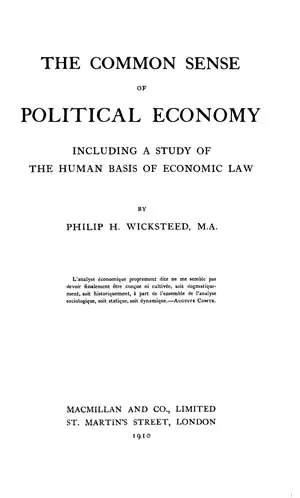
We shall find that the economic relations constitute a machinery by which men devote their energies to the immediate accomplishment of each other's purposes in order to secure the ultimate accomplishment of their own, irrespective of what those purposes of their own may be, and therefore irrespective of the egoistic or altruistic nature of the motives which dictate them and which stimulate efforts to accomplish them. And the things and doings with which economic investigation is concerned will therefore be found to include everything which enters into the circle of exchange—that is to say, everything with which men can supply each other, or which men can do for each other, in what we may call an impersonal capacity; or, in other words, the things a man can give to or do for another independently of any personal and individualised sympathy with him or with his motives or reasons.

— Philip H. Wicksteed, The Commonsense of Political Economy

Context

Further thoughts

  • Economics
    “One argument used by a very enlightened member of Parliament, during a late discussion on the rate of interest charged by the Bank, was rather a singular one: he said that the Bank of France, and other banks on the Continent, lent at a low rate, and therefore the Bank of England should do so. I can see no connexion between his premises and conclusion. The Bank of France ought to be governed by the market rate of interest and the rate of profits in France; the Bank of England by the market rate of interest and the rate of profit in England. One may be very different from the other. From the whole of his argument, I should infer that he considered a low rate of interest, in itself, beneficial to a country. The very contrary, I imagine, is the truth. A low rate of interest is a symptom of a great accumulation of capital; but it is also a symptom of a low rate of profits, and of an advancement to a stationary state; at which the wealth and resources of a country will not admit of increase. As all savings are made from profits, as a country is most happy when it is in a rapidly progressive state, profits and interest cannot be too high. It would be a poor consolation, indeed, to a country for low profits and low interest, that landlords were enabled to raise money on mortgage with diminished sacrifices. Nothing contributes so much to the prosperity and happiness of a country as high profits. (FROM: ON PROTECTION TO AGRICULTURE: Section V.: On the Effect produced on the Price of Corn by Mr Peel's Bill for restoring the Ancient Standard.)”

    David Ricardo: David Ricardo and the Happiness of a Country

    The Works of David Ricardo (McCulloch ed. 1846, 1888)

  • Economics
    “Motivating nearly all behavior is the inevitable existence of “scarcity”—simply put, our wants and desires exceed what is available to satisfy them. Most of what you enjoy is acquired by your efforts, accompanied by strain, sweat, and anxiety. However, no matter how successful are your efforts, you want even more. (FROM: SCARCITY)”
  • Economics
    “A right of free speech is not an “economically free” right. It uses scarce resources. “Free speech” means the right to communicate with your own resources to other willing listeners—without political intervention about what you say. I can’t force you to hear or read my “speech” any more than I can force you to give me your wealth. I can’t take property of others to communicate, nor can I regard the attention of other people as “free” to me. I must use my own, or rented, resources to communicate, and then only to willing persons. Both these critical features, (1) use of one’s owned or rented resources by the speaker and (2) a willing listener, are often ignored. (FROM: ALERT! FREE SPEECH IS NOT “FREE RESOURCES”)”