

The Online Library of Liberty

Search the library

Press Enter to see all results. Esc closes.

Rhetoric of Liberty

John Thelwall on political sheep shearing (1795)

COME to a song of rustic growth
List all my jolly hearers,
Whose moral plainly tends to prove
That all the world are sheerers,
How shepherds sheer their silly sheep,
How statesmen sheer the state,
And all when they can sheer no more
Are sheer’d themselves by fate.
Then a sheering we will go, &c.

But these are petty sheerers all,
And fleece a little flock;
Behold where haughty ministers
Fleece the whole nations stock:
The while pretended patriots,
A still more venal race,
With liberty and bawling cant,
Would fleece them of their place—
When a fleecing they, &c.

But cease ye fleecing senators
Your country to undo—
Or know we British Sans Cullottes
Hereafter may fleece you,
For well we know if tamely thus
We yield our wool like drones
Ye will not only fleece our backs,
By God you’ll pick our bones—
When a fleecing ye, &c.

Since then, we every rank and state
May justly fleecers call,
And since Corruption’s venal pack
Would fleece us worse than all,
May we Oppression’s out-stretch’d sheers
With dauntless zeal defy,
Resolv’d fair Freedom’s golden fleece
To vindicate or die.
When a fleecing they do go.

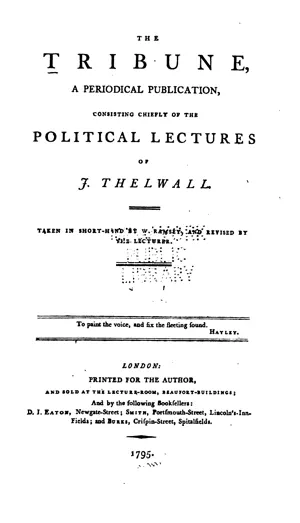
— John Thelwall, The Tribune

Context

Further thoughts

More on Rhetoric of Liberty

  • Rhetoric of Liberty
    “What is the work of the voluntaryist? It is to destroy the love of power; to destroy alike in himself and in his fellow-men the desire to force opinions or interests—whatever they may be—upon others; to be content to be a self-ruler, not a ruler of others; to strengthen belief in the moral weapons of reason, discussion and example; to bear patiently many evils rather than to weaken at any point the principle of self-ownership and self-direction; and to live in the faith that there is no evil which cannot be overcome by courage and resolution, no moral failure that cannot be remedied, except the one evil, the one moral failure, of abandoning self-ownership and self-direction.”
  • Rhetoric of Liberty
    “... these extorting, barbarous and murthering Gaolors, and all other ministers of State, who make their rise and fortunes, by the mines and spoylings of the people, and as they tread in the steppes of their predecessours (and rather exceed them in iniquity) so small they run into the same destruction, for as the overflowing of water doe at length make the river loose its proper channell, so those that seeke to extend their power beyond their bounds, have ever hitherto lost not only their powers by them usurped, but often even that also which by right belonged unto them ...”

    John Lilburne: John Lilburne rails against his unjust imprisonment (1646)

    Tracts on Liberty by the Levellers and their Critics Vol. 3 (1646).

  • Rhetoric of Liberty
    “In the thirteenth year of his age he (Francis Bacon) was entered at Trinity College, Cambridge. That celebrated school of learning enjoyed the peculiar favour of the Lord Treasurer and the Lord Keeper, and acknowledged the advantages which it derived from their patronage in a public letter which bears date just a month after the admission of Francis Bacon. The master was Whitgift, afterwards Archbishop of Canterbury, a narrow-minded, mean, and tyrannical priest, who gained power by servility and adulation, and employed it in persecuting both those who agreed with Calvin about Church Government, and those who differed from Calvin touching the doctrine of Reprobation. He was now in a chrysalis state, putting off the worm and putting on the dragon-fly, a kind of intermediate grub between sycophant and oppressor. He was indemnifying himself for the court which he found it expedient to pay to the Ministers by exercising much petty tyranny within his own college.”