
Literature & Music
“So you must be the first that gives this sentence, And he that suffers. O! it is excellent To have a giant’s strength, but it is tyrannous To use it like a giant.”

Literature & Music
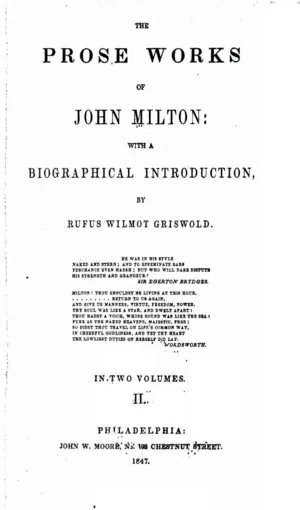
For it is of no little consequence, O citizens, by what principles you are governed, either in acquiring liberty, or in retaining it when acquired. And unless that liberty, which is of such a kind as arms can neither procure nor take away, which alone is the fruit of piety, of justice, of temperance, and unadulterated virtue, shall have taken deep root in your minds and hearts, there will not long be wanting one who will snatch from you by treachery what you have acquired by arms. War has made many great whom peace makes small. If after being released from the toils of war, you neglect the arts of peace, if your peace and your liberty be a state of warfare, if war be your only virtue, the summit of your praise, you will, believe me, soon find peace the most adverse to your interests. Your peace will be only a more distressing war; and that which you imagined liberty will prove the worst of slavery. (FROM: ADVIS’D, LEARN JUSTICE, AND REVERE THE GODS.)
These lines, taken from Milton's Second Defense of the English People, were written after Milton and his fellow revolutionaries had succeeded in ending the English monarchy forever...or so they thought. With our perfect historical hindsight we can see that, as Milton is writing the Second Defense he is poised almost perfectly at the midpoint between the revolutionary overthrow of the monarchy and the monarchy's restoration.
While Milton could not have known what was to come, he does not merely use his Second Defense to triumph over his party's successes or to engage in a defense of his own actions and character. He also uses the work to caution his fellow-travelers about remaining true to the principles which have animated them and the virtues which have sustained them. He knows that once the war for a nation is won, the hard work of governing it honestly, prudently, and virtuously remains.
Read the passage in context, or cite the edition.
“So you must be the first that gives this sentence, And he that suffers. O! it is excellent To have a giant’s strength, but it is tyrannous To use it like a giant.”
“Candide, as he was returning home, made profound reflections on the Turk’s discourse. “This good old man,” said he to Pangloss and Martin, “appears to me to have chosen for himself a lot much preferable to that of the six kings with whom we had the honor to sup.” ... “Neither need you tell me,” said Candide, “that we must take care of our garden.” “You are in the right,” said Pangloss; “for when man was put into the garden of Eden, it was with an intent to dress it: and this proves that man was not born to be idle.” “Work then without disputing,” said Martin; “it is the only way to render life supportable.””
The Works of Voltaire, Vol. I (Candide)
“They set themselves in armour bright, These mischiefs to prevent; With all the yeomen brave and bold That were in fruitful Kent. At Canterbury did they meet, Upon a certain day, With sword and spear, with bill and bow, And stopt the conqueror’s way. “Let us not yield, like bond-men poor, To Frenchmen in their pride, But keep our ancient liberty, What chance so e’er betide: “And rather die in bloody field, With manly courage prest, Than to endure the servile voke, Which we so much detest.””
History of the Conquest of England by the Normans vol. 1