
Literature & Music
“So you must be the first that gives this sentence, And he that suffers. O! it is excellent To have a giant’s strength, but it is tyrannous To use it like a giant.”

Literature & Music
The mind is its own place, and in itself
Can make a heav’n of hell, a hell of heav’n.
What matter where, if I be still the same,
And what I should be, all but less than he
Whom thunder hath made greater? Here at least
We shall be free: th’Almighty hath not built
Here for his envy, will not drive us hence:
Here we may reign secure, and in my choice
To reign is worth ambition, though in hell;
Better to reign in hell than serve in heav’n.--Paradise Lost, Book One, lines 254-263
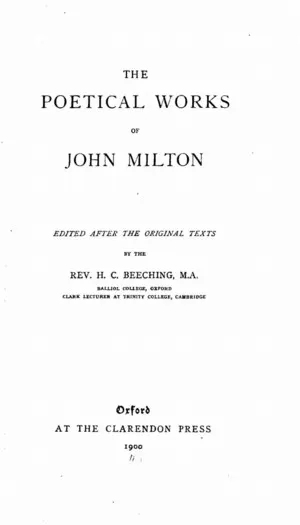
The poet William Blake famously argued that, in Paradise Lost, John Milton was “of the Devil’s party without knowing it.” Satan gets most of the best lines in the poem, is arguably a more exciting character than any of the heavenly occupants or newly created humans, and he had a strong appeal to the idealistic Romanticism ushered in by Blake and brought to a peak by poets like Byron and Shelly. For them, Satan’s arguments for independence and freedom held a great attraction. This passage from one of Satan’s speeches in Paradise Lost contains two of the poem’s most quoted lines, and neatly sums up the kind of bold argumentation that attracted readers like Blake.
The problem, of course, is that the authority against which Satan is declaring his independence and the ruler whom he declines to serve is God. While Milton, and others, may have felt that this kind of rebellion against earthly authority was acceptable, such rebellion against God--the only monarch whose divine right to rule could be thought of as incontestable--is sheerest folly.
Satan’s insistence that he can transform heaven to hell and hell to heaven merely by his state of mind, and his assertion that it is “better to reign in hell than serve in heaven” sound like glorious cries for liberty when taken out of context. In the context of the poem, however, they demonstrate instead how misdirected Satan’s pride and ambition really are. Milton’s readers must be careful not to fall--like Blake-- into the seductive trap Satan’s arguments set for them. The liberty Milton urges them to seek is not the liberty found in hell.
Read the passage in context, or cite the edition.
“So you must be the first that gives this sentence, And he that suffers. O! it is excellent To have a giant’s strength, but it is tyrannous To use it like a giant.”
“Candide, as he was returning home, made profound reflections on the Turk’s discourse. “This good old man,” said he to Pangloss and Martin, “appears to me to have chosen for himself a lot much preferable to that of the six kings with whom we had the honor to sup.” ... “Neither need you tell me,” said Candide, “that we must take care of our garden.” “You are in the right,” said Pangloss; “for when man was put into the garden of Eden, it was with an intent to dress it: and this proves that man was not born to be idle.” “Work then without disputing,” said Martin; “it is the only way to render life supportable.””
The Works of Voltaire, Vol. I (Candide)
“They set themselves in armour bright, These mischiefs to prevent; With all the yeomen brave and bold That were in fruitful Kent. At Canterbury did they meet, Upon a certain day, With sword and spear, with bill and bow, And stopt the conqueror’s way. “Let us not yield, like bond-men poor, To Frenchmen in their pride, But keep our ancient liberty, What chance so e’er betide: “And rather die in bloody field, With manly courage prest, Than to endure the servile voke, Which we so much detest.””
History of the Conquest of England by the Normans vol. 1