

“... [in the ancient world] a very small number of men managed to live without working, supported by the labor of the oppressed masses. This small leisured group made their slaves construct sumptuous palaces, vast castles, or somber fortresses. They loved to surround themselves with all the sensuous pleasures of life and with all the monuments of art. They delighted in discoursing on philosophy and cosmogony; and, above all, they carefully cultivated the two sciences to which they owed their supremacy and their enjoyments: the science of force and the science of fraud. For beneath this aristocracy were the countless multitudes occupied in creating, for themselves, the means of sustaining life and, for their oppressors, the means of surfeiting them with pleasures. Since the historians never make the slightest mention of these multitudes, we forget their existence; they do not count for us at all. We have eyes only for the aristocracy. [in ancient life] ... the only difference was that the labor that a few men had managed to escape fell crushingly on the oppressed masses, to the great detriment of justice, liberty, property, wealth, equality, and progress...”
Origin of Government
Alexander Hamilton on the Federal Army versus the Individual States
The Confederation gives the States, individually, too much influence in the affairs of the army. They should have nothing to do with it. The entire formation and disposal of our military forces ought to belong to Congress. It is an essential cement of the union; and it ought to be the policy of Congress to destroy all ideas of State attachments in the army, and make it look up wholly to them. For this purpose all appointments, promotions, and provisions, whatsoever, ought to be made by them. It may be apprehended that this may be dangerous to liberty. But nothing appears more evident to me than that we run much greater risk of having a weak and disunited federal government, than one which will be able to usurp upon the rights of the people. (FROM: Alexander Hamilton to James Duane, September 3, 1780)
Context
This quotation comes from one of the most important documents illustrating the evolution taking place in Alexander Hamilton’s thought from a fairly typical colonial American Whig to a concerned nationalist, worried about the viability of his newly independent country.
Further thoughts
In the mid-1770s, Hamilton had argued strenuously in favor of colonial rights against the claims of Parliamentary supremacy and had even contended strongly against the maintenance of a standing imperial army, asserting that “such would be introduced under pretext of defending us, but, in fact, ... make our bondage and misery complete.” (From “The Farmer Refuted,” February 23, 1775, in, The Revolutionary Writings of Alexander Hamilton, Richard B. Vernier, ed., Liberty Fund, 2007, p. 60).
Having experienced the inefficiencies of the confederal government under the second Continental Congress while serving as an officer on General George Washington’s staff, Hamilton came to reconsider the need for preserving a uniform and coherent military force under national, and not state, controls. This letter was written to his fellow New Yorker, James Duane, who was serving as a representative to Congress. Duane was known for being of a more conservative disposition, concerned about the potentially destabilizing and disorderly tendencies of the more radical elements in the revolutionary movement. The letter anticipates Hamilton’s writings in both The Continentalist Essays in 1781 and 1782 and his later defense of the US Constitution at the end of the decade...in the Federalist Papers.
Found in
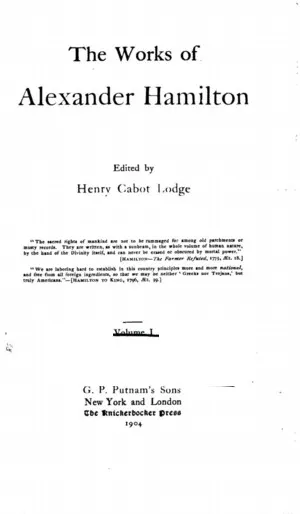
Read the passage in context, or cite the edition.
More on Origin of Government
- Origin of Government
“It is impossible that such governments as have hitherto existed in the world, could have commenced by any other means than a total violation of every principle sacred and moral. The obscurity in which the origin of all the present old governments is buried, implies the iniquity and disgrace with which they began. The origin of the present government of America and France will ever be remembered, because it is honourable to record it; but with respect to the rest. even Flattery has consigned them to the tomb of time, without an inscription. It could have been no difficult thing in the early and solitary ages of the world, while the chief employment of men was that of attending flocks and herds, for a banditti of ruffians to overrun a country, and lay it under contributions. Their power being thus established, the chief of the band contrived to lose the name of Robber in that of Monarch; and hence the origin of Monarchy and Kings.”
Thomas Paine: Thomas Paine asks how it is that established governments came into being, his answer, is "banditti of ruffians" seized control and turned themselves into monarchs (1792)
The Writings of Thomas Paine, Vol. II (1779-1792)
- Origin of Government
“There are two fundamentally opposed means whereby man, requiring sustenance, is impelled to obtain the necessary means for satisfying his desires. These are work and robbery, one’s own labor and the forcible appropriation of the labor of others... I propose in the following discussion to call one’s own labor and the equivalent exchange of one’s own labor for the labor of others, the “economic means” for the satisfaction of needs, while the unrequited appropriation of the labor of others will be called the “political means.””


