
Literature & Music
“So you must be the first that gives this sentence, And he that suffers. O! it is excellent To have a giant’s strength, but it is tyrannous To use it like a giant.”

Literature & Music
Rouse, Hibernians, from your slumbers!
See the moment just arrived,
Imperious tyrants for to humble,
Our French brethren are at hand.
Vive la united heroes,
Triumphant always may they be,
Vive la our gallant brethren,
That have come to set us free...
To arms quickly, and be ready,
Join the ranks, and never flee.
Determined stand by one another,
And from tyrants you’ll be free.
Vive la united heroes, &c.
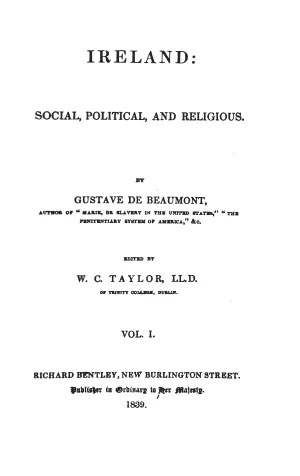
In his analysis of the Irish problem in the late 1830s Gustave de Beaumont (1802-1866) provides some historical background, especially the belief some Irish radicals had in the principles of the French Revolution. He sympathetically quotes one of the songs of the United Irishmen from 1789:
Gustave de Beaumont was Tocqueville’s traveling companion on his famous trip to America in 1831 which was undertaken in order to observe the American prison system for the French government. Along the way they observed and collected material which would later produce Tocqueville’s book Democracy in America (1835, 1840) and Beaumont’s book Marie on slavery. Shortly afterwards Beaumont married the daughter of General Lafayette and spent his honeymoon in Ireland where he gathered material for yet another book, this time on the problems in Ireland. He attributed the problems of Irish poverty and lack of political representation to the system of aristocratic rule. The first volume deals with the historical origins of aristocratic rule in Ireland, especially land ownership, while the second volume deals with how aristocratic could be liberalized without causing a revolution like the one which broke in France in 1789. This song comes from volume one where Beaumont cites it to show the feeling for liberty held by many Irish radicals at the time of the French revolution. The song calls for the "Self-will’d slaves" to rise up against the "imperious tyrants" with the assistance of their "French brethren."
Read the passage in context, or cite the edition.
“So you must be the first that gives this sentence, And he that suffers. O! it is excellent To have a giant’s strength, but it is tyrannous To use it like a giant.”
“Candide, as he was returning home, made profound reflections on the Turk’s discourse. “This good old man,” said he to Pangloss and Martin, “appears to me to have chosen for himself a lot much preferable to that of the six kings with whom we had the honor to sup.” ... “Neither need you tell me,” said Candide, “that we must take care of our garden.” “You are in the right,” said Pangloss; “for when man was put into the garden of Eden, it was with an intent to dress it: and this proves that man was not born to be idle.” “Work then without disputing,” said Martin; “it is the only way to render life supportable.””
The Works of Voltaire, Vol. I (Candide)
“They set themselves in armour bright, These mischiefs to prevent; With all the yeomen brave and bold That were in fruitful Kent. At Canterbury did they meet, Upon a certain day, With sword and spear, with bill and bow, And stopt the conqueror’s way. “Let us not yield, like bond-men poor, To Frenchmen in their pride, But keep our ancient liberty, What chance so e’er betide: “And rather die in bloody field, With manly courage prest, Than to endure the servile voke, Which we so much detest.””
History of the Conquest of England by the Normans vol. 1