

The Online Library of Liberty

Search the library

Press Enter to see all results. Esc closes.

War & Peace

Hugo Grotius on civil right being derived from civil power

"We will begin with the human as more generally known. Now this is either a civil right, or a right more or less extensive than the civil right. The civil right is that which is derived from the civil power. The civil power is the sovereign power of the state. A state is a perfect body of free men, united together in order to enjoy common rights and advantages. The less extensive right, and not derived from the civil power itself, although subject to it, is various, comprehending the authority of parents over children, masters over servants, and the like. But the law of nations is a more extensive right, deriving its authority from the consent of all, or at least of many nations."

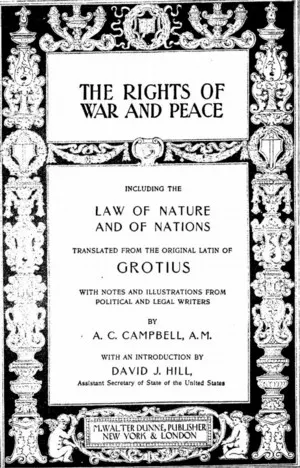
— Hugo Grotius, The Rights of War and Peace (1901 ed.)

Context

Further thoughts

More on War & Peace

  • War & Peace
    “Our battalions for the continental service were some time ago so far filled as rendered the recommendation of a draught from the militia hardly requisite, and the more so as in this country it ever was the most unpopular and impracticable thing that could be attempted. Our people, even under the monarchical government, had learnt to consider it as the last of all oppressions.”
  • War & Peace
    “Is this, sir, consistent with the character of a free government? Is this civil liberty? Is this the real character of our Constitution? No sir, indeed it is not. The Constitution is libelled, foully libelled. The people of this country have not established for themselves such a fabric of despotism. They have not purchased at a vast expense of their own treasure and their own blood a Magna Charta to be slaves. Where is it written in the Constitution, in what article or section is it contained, that you may take children from their parents, and parents from their children, and compel them to fight the battles of any war in which the folly or the wickedness of government may engage it? Under what concealment has this power lain hidden which now for the first time comes forth, with a tremendous and baleful aspect, to trample down and destroy the dearest rights of personal liberty? Who will show me any Constitutional injunction which makes it the duty of the American people to surrender everything valuable in life, and even life itself, not when the safety of their country and its liberties may demand the sacrifice, but whenever the purposes of an ambitious and mischievous government may require it? Sir, I almost disdain to go to quotations and references to prove that such an abominable doctrine has no foundation in the Constitution of the country.”
  • War & Peace
    “But in a country, where the perpetual menacings of danger oblige the government to be always prepared to repel it, her armies must be numerous enough for instant defence. The continual necessity for his services enhances the importance of the soldier, and proportionably degrades the condition of the citizen. The military state becomes elevated above the civil. The inhabitants of territories often the theatre of war, are unavoidably subjected to frequent infringements on their rights, which serve to weaken their sense of those rights; and by degrees, the people are brought to consider the soldiery not only as their protectors, but as their superiors.”