

The Online Library of Liberty

Search the library

Press Enter to see all results. Esc closes.

Economics

Friedrich List and Manufacturing Power

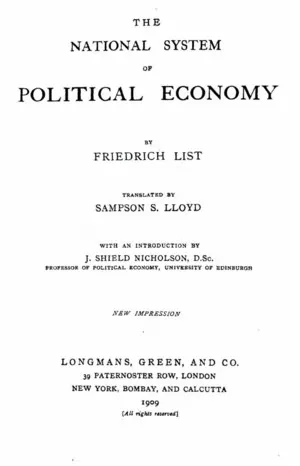
The nation must sacrifice and give up a measure of material property in order to gain culture, skill, and powers of united production; it must sacrifice some present advantages in order to insure to itself future ones. If, therefore, a manufacturing power developed in all its branches forms a fundamental condition of all higher advances in civilisation, material prosperity, and political power in every nation (a fact which, we think, we have proved from history); if it be true (as we believe we can prove) that in the present conditions of the world a new unprotected manufacturing power cannot possibly be raised up under free competition with a power which has long since grown in strength and is protected on its own territory; how can anyone possibly undertake to prove by arguments only based on the mere theory of values, that a nation ought to buy its goods like individual merchants, at places where they are to be had the cheapest—that we act foolishly if we manufacture anything at all which can be got cheaper from abroad—that we ought to place the industry of the nation at the mercy of the self-interest of individuals—that protective duties constitute monopolies, which are granted to the individual home manufacturers at the expense of the nation? (FROM: Chapter XII: THE THEORY OF THE POWERS OF PRODUCTION AND THE THEORY OF VALUES)

— Friedrich List, The National System of Political Economy

Context

Further thoughts

  • Economics
    “One argument used by a very enlightened member of Parliament, during a late discussion on the rate of interest charged by the Bank, was rather a singular one: he said that the Bank of France, and other banks on the Continent, lent at a low rate, and therefore the Bank of England should do so. I can see no connexion between his premises and conclusion. The Bank of France ought to be governed by the market rate of interest and the rate of profits in France; the Bank of England by the market rate of interest and the rate of profit in England. One may be very different from the other. From the whole of his argument, I should infer that he considered a low rate of interest, in itself, beneficial to a country. The very contrary, I imagine, is the truth. A low rate of interest is a symptom of a great accumulation of capital; but it is also a symptom of a low rate of profits, and of an advancement to a stationary state; at which the wealth and resources of a country will not admit of increase. As all savings are made from profits, as a country is most happy when it is in a rapidly progressive state, profits and interest cannot be too high. It would be a poor consolation, indeed, to a country for low profits and low interest, that landlords were enabled to raise money on mortgage with diminished sacrifices. Nothing contributes so much to the prosperity and happiness of a country as high profits. (FROM: ON PROTECTION TO AGRICULTURE: Section V.: On the Effect produced on the Price of Corn by Mr Peel's Bill for restoring the Ancient Standard.)”

    David Ricardo: David Ricardo and the Happiness of a Country

    The Works of David Ricardo (McCulloch ed. 1846, 1888)

  • Economics
    “Motivating nearly all behavior is the inevitable existence of “scarcity”—simply put, our wants and desires exceed what is available to satisfy them. Most of what you enjoy is acquired by your efforts, accompanied by strain, sweat, and anxiety. However, no matter how successful are your efforts, you want even more. (FROM: SCARCITY)”
  • Economics
    “A right of free speech is not an “economically free” right. It uses scarce resources. “Free speech” means the right to communicate with your own resources to other willing listeners—without political intervention about what you say. I can’t force you to hear or read my “speech” any more than I can force you to give me your wealth. I can’t take property of others to communicate, nor can I regard the attention of other people as “free” to me. I must use my own, or rented, resources to communicate, and then only to willing persons. Both these critical features, (1) use of one’s owned or rented resources by the speaker and (2) a willing listener, are often ignored. (FROM: ALERT! FREE SPEECH IS NOT “FREE RESOURCES”)”