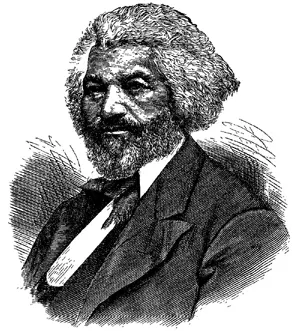
In the previous chapter, "Learning to Read," Douglass described the efforts of his mistress Mrs. Auld to teach him to read the Bible. This endeavor ended when her husband told her, "If he learns to read the Bible it will forever unfit him to be a slave." The chapter "Growing in Knowledge" describes how Mrs. Ault's and Douglass's attitudes and actions changed when she complied with her husband's demand to stop teaching the young slave. According to Douglass, Mrs. Auld "Was naturally a kind and tenderhearted woman . . . singularly deficient in the qualities of a slaveholder." As she sought to control her natural affection for young Frederick, "slavery soon proved its ability to divest her of [her] excellent qualities." Her treatment of Douglass changed dramatically, moving from the generous to suspicious and demanding. "She finally became even more violent to my learning to read than was Mr. Auld himself."
Douglass did not give up on his reading, although he had to continue it in secret. He had white boys his own age as friends, and they would often talk about slavery with Douglass, agreeing with him that he should be free. He used his association with these Irish lads as a cover for his continuing education. He had some money and the freedom to visit his friends when he completed his chores, and on one trip to town, he purchased a schoolbook, The Columbian Orator. This volume contained a mixture of poetry, short dialogues, and political speeches that he read constantly. Here he learned the language of the rights of man. He hid this volume for many years, and took it with him when he finally escaped. His secret reading reinforced his desire for freedom, as did his discussions with his young companions.
Douglass came to disdain his fellow slaves "who were under the delusion that God required them to submit to slavery and to wear their chains with meekness and humility." He understood the evil perpetrated by his "good" master, and his mood darkened. "As I writhed under the sting and torment of this knowledge I almost envied my fellow slaves their stupid indifference. . . . I wished myself a beast, a bird, anything rather than a slave."
In Query XVIII of his Notes on the State of Virginia, Jefferson wrote about the customs of the state, particularly slavery. "The whole commerce between master and slave is a perpetual exercise of the most boisterous passions, the most unremitting despotism on one part, and degrading submissions on the other. . . . The man must be a prodigy who can retain his manners and his morals un-depraved by such circumstances."
Jefferson suggested that the institution of slavery would corrupt both slave and master. Perhaps the reason Frederick Douglass never fell into the habit of "degrading submissions" is that he was not a victim of "unremitting despotism," thanks to Mrs. Auld's early kindness and efforts to teach him to read. The ability to read and the desire for liberty had already embedded themselves in Douglass by the time Mrs. Auld complied with her husband's instructions. Only after an initial period of kindness and concern did she embrace the despotic behavior Jefferson described.
Mrs. Auld’s relationship to Douglass changed when she complied with her husband’s demand, as did her relationship to her family. Douglass wrote, "As my condition in the family waxed bad, that of the family waxed no better." Mrs. Ault apparently became sterner with members of her family as she became stricter and more suspicious of Douglass. His concluding comments in this chapter on his relationship with Mrs. Auld reflect a melancholy and suggest the doubly debilitating effects of slavery noted by Jefferson. “Nature made us friends, but slavery made us enemies. . . . She had changed, and the reader will see that I too, had changed. We were both victims of the same overshadowing evil, she as mistress, I as slave."