

The Online Library of Liberty

Search the library

Press Enter to see all results. Esc closes.

Free Trade

Frédéric Bastiat's theory of plunder (1850)

When a portion of wealth passes from the person who has acquired it, without his consent and without compensation, to someone who has not created it, whether this is by force or fraud, I say that there has been a violation of property rights and that there has been an act of plunder.

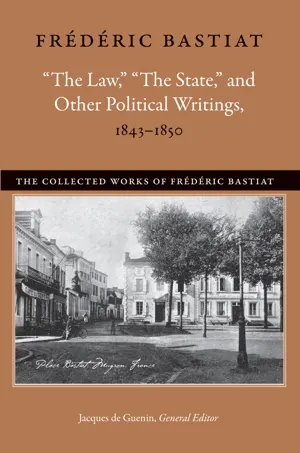
— Frédéric Bastiat, The Collected Works of Frédéric Bastiat. Vol. 2: The Law, The State, and Other Political Writings, 1843-1850

Context

Further thoughts

  • Free Trade
    “Why should an attempt he made to establish a national trading system based upon so-called economic necessity, in states whose formation was controlled by no economic views, states of which the hazards of war and of alliances alone decided the boundaries? Is it not the height of absurdity to transform these frontiers, which chance events have alone determined, and which it may enlarge or contract to-morrow, into formal boundaries which limit trade? Is not an economic system which is founded on a political basis and which is politically modifiable, a monstrosity to which good sense objects?”
  • Free Trade
    “In throwing open our ports to the commerce of the world we shall far better secure their safety than by fortifying them with all the "protected" plates that our steel ring could make. For not merely would free trade give us again that mastery of the ocean which protection has deprived us of, and stimulate the productive power in which real fighting strength lies; but while steel-clad forts could afford no defense against the dynamite-dropping balloons and death-dealing air ships which will be the next product of destructive invention, free trade would prevent their ever being sent against us. The spirit of protectionism, which is the real thing that it is sought to defend by steelplating, is that of national enmity and strife. The spirit of free trade is that of fraternity and peace. ... And a republic wherein the free-trade principle was thus carried to its conclusion, wherein the equal and unalienable rights of men were thus acknowledged, would indeed be as a city set on a hill.”
  • Free Trade
    “A policy for transferring property by exclusive privileges, pensions, bounties, monopolies and extravagance, constitutes the essence of the British monopoly, and is sustained by a conspiracy between the government and those who are enriched by it, for fleecing the people. This policy is the most efficacious system of tyranny, practicable over civilized nations. It is able to subject the rights of man, if men have any rights, to ambition and avarice. It can as easily deprive nations of the right of self-government as it can rob individuals of their property. It can make revolutions reorganizers of the very abuses they overturn, and merely a wheel for turning up or down combinations equally oppressive. What is the difference between recommending the form or the substance of the European monarchies? Would it not be better, like the Lacedemonians, to adopt the form of monarchy without its substance, than to adopt its substance without its form?”