

The Online Library of Liberty

Search the library

Press Enter to see all results. Esc closes.

Law

Frédéric Bastiat asks what came first, property or law? (1850)

It is not because men have enacted laws that personality, freedom, and property exist. On the contrary, it is because personality, freedom, and property are already in existence that men enact laws.

What is the law, then? As I have said elsewhere, it is the collective organization of the individual right of legitimate defense.

Each of us certainly holds from nature and God the right to defend our person, our freedom, and our property, since these are the three elements that constitute or preserve life, elements that are mutually complementary and that cannot be understood independently of one another. For what are our faculties if not an extension of our personality, and what is property if not an extension of our faculties?

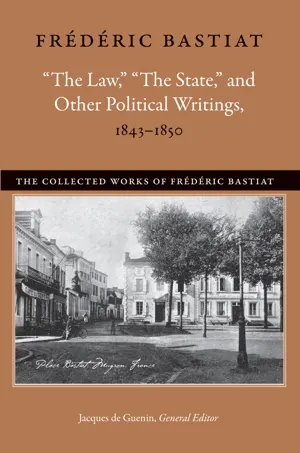
— Frédéric Bastiat, The Collected Works of Frédéric Bastiat. Vol. 2: The Law, The State, and Other Political Writings, 1843-1850

Context

Further thoughts

  • Law
    “It is manifest, therefore, that the jury must judge of and try the whole case, and every part and parcel of the case, free of any dictation or authority on the part of the government. They must judge of the existence of the law; of the true exposition of the law; of the justice of the law; and of the admissibility and weight of all the evidence offered; otherwise the government will have everything its own way; the jury will be mere puppets in the hands of the government; and the trial will be, in reality, a trial by the government, and not a “trial by the country.” By such trials the government will determine its own powers over the people, instead of the people’s determining their own liberties against the government; and it will be an entire delusion to talk, as for centuries we have done, of the trial by jury, as a “palladium of liberty,” or as any protection to the people against the oppression and tyranny of the government.”
  • Law
    “No man can be judged a criminal until he be found guilty; nor can society take from him the public protection, until it have been proved that he has violated the conditions on which it was granted. What right, then, but that of power, can authorise the punishment of a citizen, so long as there remains any doubt of his guilt? The dilemma is frequent. Either he is guilty, or not guilty. If guilty, he should only suffer the punishment ordained by the laws, and torture becomes useless, as his confession is unnecessary. If he be not guilty, you torture the innocent; for, in the eye of the law, every man is innocent, whose crime has not been proved.”
  • Law
    “Of great importance to the public is the preservation of this personal liberty; for if once it were left in the power of any the highest magistrate to imprison arbitrarily whomever he or his officers thought proper, (as in France it is daily practised by the crown,) there would soon be an end of all other rights and immunities. Some have thought that unjust attacks, even upon life or property, at the arbitrary will of the magistrate, are less dangerous to the commonwealth than such as are made upon the personal liberty of the subject. To bereave a man of life, or by violence to confiscate his estate, without accusation or trial, would be so gross and notorious an act of despotism, as must at once convey the alarm of tyranny throughout the whole kingdom; but confinement of the person, by secretly hurrying him to jail, where his sufferings are unknown or forgotten, is a less public, a less striking, and therefore a more dangerous engine of arbitrary government.”