

The Online Library of Liberty

Search the library

Press Enter to see all results. Esc closes.

Revolution

Edmund Burke on the Levelling Spirit

These vices are the causes of those storms. Religion, morals, laws, prerogatives, privileges, liberties, rights of men, are the pretexts. The pretexts are always found in some specious appearance of a real good. You would not secure men from tyranny and sedition, by rooting out of the mind the principles to which these fraudulent pretexts apply? If you did, you would root out every thing that is valuable in the human breast. As these are the pretexts, so the ordinary actors and instruments in great public evils are kings, priests, magistrates, senates, parliaments, national assemblies, judges, and captains. You would not cure the evil by resolving, that there should be no more monarchs, nor ministers of state, nor of the gospel; no interpreters of law; no general officers; no public councils. You might change the names. (FROM: The Policy of the National Assembly Criticised) - Edmund Burke

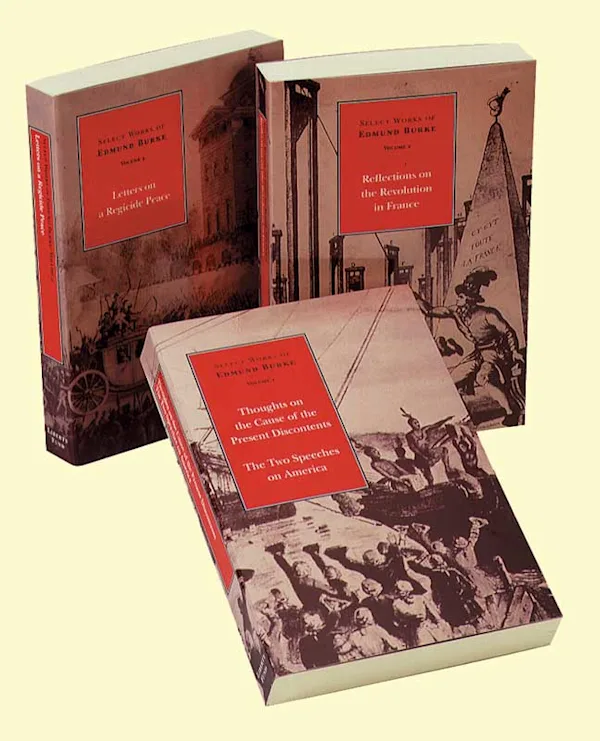
— Edmund Burke, Select Works of Edmund Burke, 4 vols.

Context

Further thoughts

  • Revolution
    “To ask whether the natural rights philosophy of the Declaration of Independence is true or false is essentially a meaningless question. When honest men are impelled to withdraw their allegiance to the established law or custom of the community, still more when they are persuaded that such law or custom is too iniquitous to be longer tolerated, they seek for some principle more generally valid, some ‘law’ of higher authority, than the established law or custom of the community. To this higher law or more generally valid principle they then appeal in justification of actions which the community condemns as immoral or criminal. They formulate the law or principle in such a way that it is, or seems to them to be, rationally defensible. To them it is ‘true’ because it brings their actions into harmony with a rightly ordered universe, and enables them to think of themselves as having chosen the nobler part, as having withdrawn from a corrupt world in [278] order to serve God or Humanity or a force that makes for the highest good. (FROM: CHAPTER VI: THE PHILOSOPHY OF THE DECLARATION IN THE NINTEENTH CENTURY)”

    Carl Lotus Becker: Carl Lotus Becker, Materialism and Idealism in the Declaration of Independence

    The Declaration of Independence: A Study on the History of Political Ideas

  • Revolution
    “The Citizens of America, placed in the most enviable condition, as the sole Lords and Proprietors of a vast Tract of Continent, comprehending all the various soils and climates of the World, and abounding with all the necessaries and conveniencies of life, are now by the late satisfactory pacification, acknowledged to be possessed of absolute freedom and Independency; They are, from this period, to be considered as the Actors on a most conspicuous Theatre, which seems to be peculiarly designated by Providence for the display of human greatness and felicity; Here, they are not only surrounded with every thing which can contribute to the completion of private and domestic enjoyment, but Heaven has crowned all its other blessings, by giving a fairer oppertunity for political happiness, than any other Nation has ever been favored with. (FROM CIRCULAR TO THE STATES, Head Quarters, Newburgh, June 14, 1783)”