“But I have understanding as well as you; I am not inferior to you: yea, who knoweth not such things as these? I am as one mocked of his neighbour, who calleth upon God, and he answereth him: the just upright man is laughed to scorn. He that is ready to slip with his feet is as a lamp despised in the thought of him that is at ease. The tabernacles of robbers prosper, and they that provoke God are secure; into whose hand God bringeth abundantly.”
Religion & Toleration
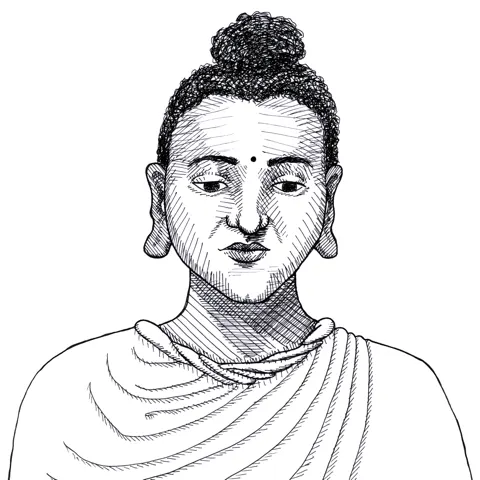
Buddha on Wandering Rightly in the World
“Faithful is he who is possessed of knowledge, seeing the way that leads to Nirvāna; he who is not a partisan; he who is pure and virtuous, and has removed the veil from his eyes. Such a one will wander rightly in the world.”
Context
Many of the Buddha’s sermons emphasized clear vision, as in this quotation from The Gospel of Buddha (1915 edition):
Further thoughts
The Gospel of Buddha was composed by the German-American philosopher and theologian Paul Carus (1852-1919), a tireless promoter of Buddhism in North America and Europe. The Gospel of the Buddha was perhaps his most successful and well-known effort in this regard. In it, Carus presented his interpretations of what he thought were the most important insights and teachings of the Buddha, arranged in a way that mimicked the New Testament (to make them more accessible to his Christian audience). The material in the Gospel draws on a wide variety of Buddhist sources, often in a highly modified and revised fashion. This quotation, for example (from the Gospel’s Chapter LIX: “Words of Instruction”) is almost certainly based on the following passage from the Buddhist scripture the Sutta-Nipata (“Collection of Discourses”):
“The believer, possessed of knowledge, seeing the way leading to Nirvana, who is no partisan amongst the partisans, wise after subduing covetousness, anger, such a one will wander rightly in the world.”
Carus’ version stresses the idea of clear sightedness as the key to achieving the liberation of Nirvana. This ties into another crucial Buddhist teaching, the injunction toward “Right View” or “Right Vision” (Samma Ditthi) usually presented as the first positions on the Noble Eightfold Path.

Found in
Read the passage in context, or cite the edition.
More on Religion & Toleration
- Religion & Toleration
“... it does not follow, that because it is a sin it ought therefore to be punished by the magistrate. For it does not belong unto the magistrate to make use of his sword in punishing every thing, indifferently, that he takes to be a sin against God. Covetousness, uncharitableness, idleness, and many other things are sins, by the consent of all men, which yet no man ever said were to be punished by the magistrate. The reason is, because they are not prejudicial to other men’s rights, nor do they break the public peace of societies.”
John Locke: John Locke believed that the magistrate should not punish sin but only violations of natural rights and public peace (1689)
The Works, vol. 5 Four Letters concerning Toleration
- Religion & Toleration
“Enter into the Royal Exchange of London, a place more respectable than many courts, in which deputies from all nations assemble for the advantage of mankind. There the Jew, the Mahometan, and the Christian bargain with one another as if they were of the same religion, and bestow the name of infidel on bankrupts only... Was there in London but one religion, despotism might be apprehended; if two only, they would seek to cut each other’s throats; but as there are at least thirty, they live together in peace and happiness.”
Voltaire: Voltaire notes that where Commerce and Toleration predominate, a Multiplicity of Faiths can live together in Peace and Happiness (1764)
The Works of Voltaire, Vol. VI (Philosophical Dictionary Part 4)