

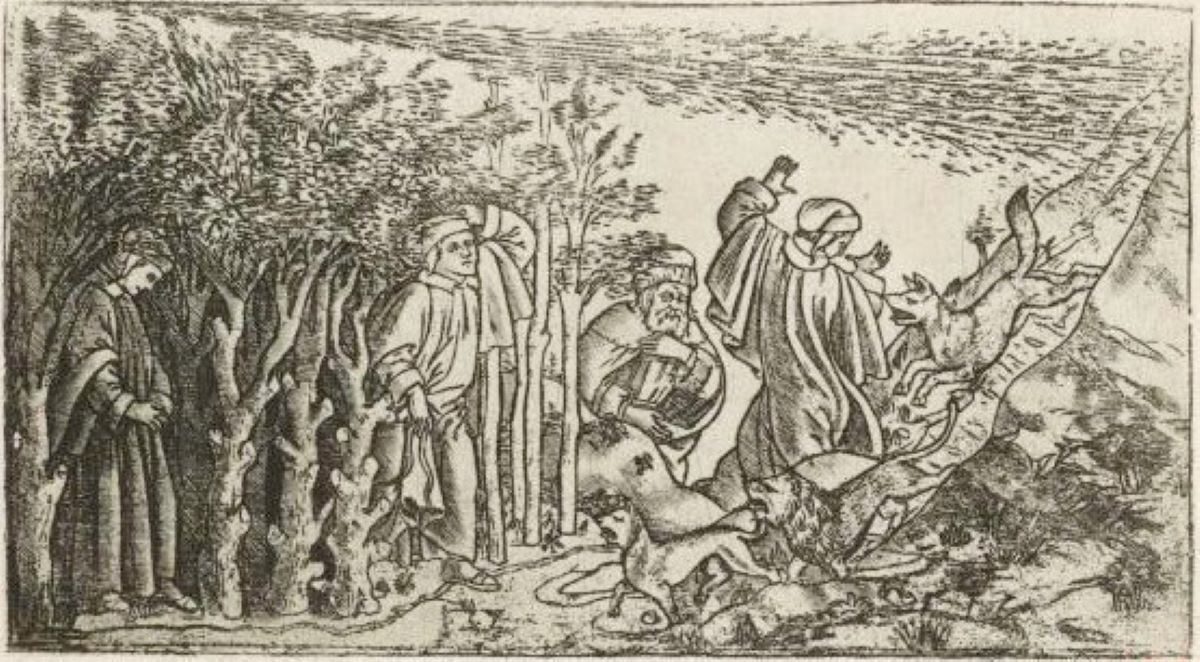
Dante’s Divine Comedy,composed between 1308 and 1320,is a three-part voyage through the realms that lie beyond this world: Inferno (hell), Purgatorio (limbo), and Paradiso (paradise). While it may be obvious to us (even to those of us who believe in the afterlife) that this journey is an imaginary journey, to Dante—at least in Dante’s presentation of it—it is not. And this is the first and most important thing to understand about The Divine Comedy: in his telling of it, it is a real journey that took place in this real world. And, in many ways, as we shall see, it is a journey that continues to take place, for all of us, in our present-day worlds.
Dante had his own personal reasons—which many continue to speculate upon—for presenting his journey into the underworld, limbo, and heaven as a real one. The most likely explanation is that Dante was trying to write his own epic poem—an epic in the tradition of Virgil’s Aeneid (with which Dante was intimately familiar, and which he drew upon for many aspects of his Comedy) and Homer’s Iliad and The Odyssey (with which Dante was only familiar from Virgil and The Aeneid; Dante could read Latin, but he could not read Greek). These epics are presented as histories—recountings of real-life events, written in lyric form. Dante was thus, on a basic level, trying to make sure that his epic was treated with the same degree of acceptance and reverence as Homer’s and Virgil’s epics.
On a deeper level, however, Dante was trying to tell us something far more significant: that our imaginations are important. In fact, they are so important that they have a reality unto themselves: they can generate their own reality, as Dante’s did in his Comedy. Even more significantly, they are their own reality. Just because the happenings that we conjure up in our dreams and imaginations do not occur in the “real” (i.e., external) world does not mean that they have not occurred. They do take place—in our internal, very real worlds, the infinite, very real (and extremely consequential) worlds of our minds. And it is ultimately our minds—our individual and collective psyches—that shape the external world of human affairs. In this very real sense, Dante knew that there was nothing more real—and therefore nothing more important—than the workings of our minds and the contents of our imaginations. He knew that if he could create a work of sufficient imaginative richness and vividness, then the journey that he would portray would become a very real one indeed, and one which could have a profound impact in the turbulent external world—and beyond—of his native Italy.
We are often tempted to dismiss our imaginations as foolish, worthless, or useless—even some of history’s greatest philosophers, including Maimonides and Spinoza, have denigrated the imaginative faculty—but we do so at our peril. There may be nothing more important in the sphere of human development than the imagination. As the great child psychologist Bruno Bettelheim taught, we need to be able to engage with dream-like fairy tales because these sorts of stories, through the opportunities they offer to experiment and play within these imaginative (yet quite realistic worlds), later help us gain an even a greater mastery over life. A person deprived of these imaginative stories, Bettelheim wrote in The Uses of Enchantment, is like a person deprived of dreaming. Even though such a person is not deprived of sleep, the dreamless person “is nevertheless impaired in his ability to manage reality; he becomes emotionally disturbed because of being unable to work out in dreams the unconscious problems that beset him.” The opportunity to engage substantively with our imaginations—whether in dreams or in works of imaginative literature—are absolutely vital, because only through these “voyages into the interior of our mind, into the realms of unawareness and the unconscious,” can we work through the unconscious pressures and psychological roadblocks that are obstructing our ability to flourish. This is why Sylvia Plath wrote that “what I fear most is the death of the imagination.” Because without an imagination we become not only sterile and boring but forfeit perhaps the most important instrument we have in our quest to master life. But with our imaginations we become capable of virtually anything—travelling to the most distant internal and external worlds—and with it we may even (as Dante dreams) conquer death.
If we take up Dante on his offer to join him on his imaginative (yet very real) voyage into the center of our psyches—into the realms of some of the most horrifying and harmonious dominions of pleasure and pain ever conceived of by the human brain—we will emerge on the other side with the eternal Tuscan, better able to master life. But it all begins with—and depends upon—giving free rein, for the duration of the Comedy’s three books, to the realities—and the legitimacy—of our indispensible imaginations…
Next week we shall continue our very real (and fantastically imagined) journey with Dante.


