


Wabash College · Crawfordsville, Indiana
The Goodrich
Seminar Room
A room built for conversation, its limestone walls carved with the names Pierre F. Goodrich believed every free and responsible person should know.
Where it all started
In 1959, on the campus where he had studied, Pierre F. Goodrich completed a seminar room in the library of Wabash College. A year later he founded Liberty Fund.
The room is still there, in Wabash’s Lilly Library. Its limestone walls carry the names of the authors and documents Goodrich considered most important to understanding what it means to be free and responsible: law codes and epics, scripture and philosophy, history, science and poetry.
At the centre sits a large round table. Seminar participants gather there to read and talk through these ideas. The room is meant to show, across space and time, how individuals and the ideas they hold are connected.
Goodrich knew Wabash well. He was a graduate and served as a trustee from 1940 to 1969, and he was active at the college when it adopted a Great Books curriculum in 1946. The seminar room gave that conviction a permanent form.
- Room completed at Wabash College
- 1959
- Names and works on the walls
- 102
- Walls, each one an era
- 4
- Years of thought, from about 2350 BC
- 4,000+
- Round table, with no head
- 1
Centre of the East Wall
The first written word for liberty
At the centre of the East Wall is the Sumerian cuneiform sign amagi, believed to be the first written expression of the word “liberty.” It appears in a legal reform by Urukagina, ruler of Lagash, around 2350 BC.
Literally “return to the mother”: the freeing of debtors to go home.
Four walls, four eras
Pick a wall to see the names carved there. Each name opens a search of the library.
East Wall · 2000–1000 BC
7 names
The earliest law codes, epics and scriptures, with the cuneiform word for liberty at its centre.
South Wall · 900–100 BC
27 names
Prophets, poets and philosophers from Greece, Israel, Persia, India and China.
West Wall · AD 100–800
21 names
The Gospels and the Church Fathers beside Roman law, medicine, history and Sanskrit drama.
North Wall · AD 900–1700
29 names
Medieval scholars, sagas, poets and reformers, through to the scientists and theorists of the 1600s.
- Rhazes
- Al Ghazali
- St. Anselm
- Averroes
- Maimonides
- Beowulf
- Burnt Njal
- Snorre Sturlason
- St. Francis of Assisi
- St. Thomas Aquinas
- Dante
- Petrarch
- Chaucer
- John Wyclif
- Jan Huss
- Savonarola
- Erasmus
- Martin Luther
- Huldrych Zwingli
- John Calvin
- Reformation Chorale
- Shakespeare
- Galileo
- Sir Edward Coke
- Hugo Grotius
- John Robinson
- John Milton
- John Locke
- Isaac Newton
Also on the walls
Names are grouped by era from their dates. Check exact wall placement against the room before launch.
Around the table
The room rests on a few ideas about how education works.
- 01
Humility
Education begins by admitting how much we do not know.
- 02
Curiosity
Humility opens the door to real questions.
- 03
Check the sources
Go to the primary texts. No claim is taken on authority.
- 04
Discussion
Around a table with no head, no one holds the whole truth.
- 05
Continuing education
The conversation goes on long after the seminar ends.
Present problems are not entirely new.
Later generations often rediscover questions earlier ones already understood.
The pursuit of liberty is plural and cross-civilizational.
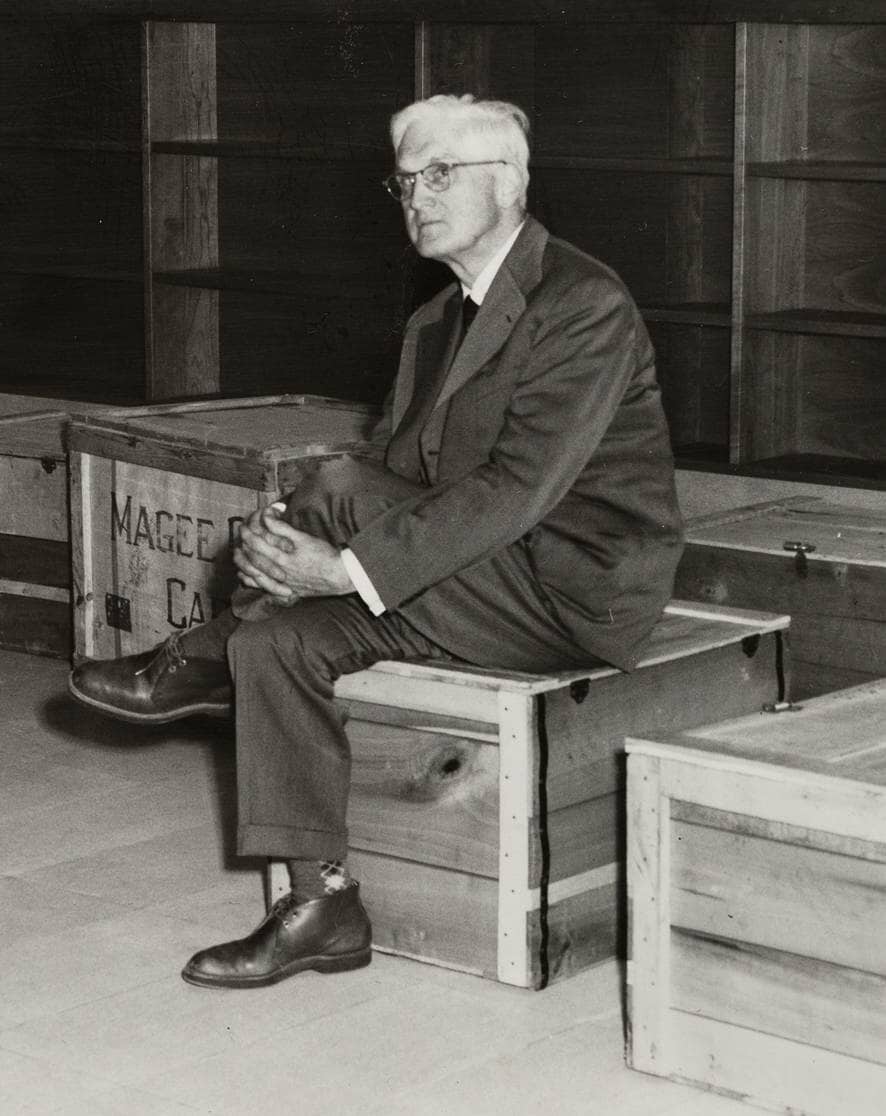
The founder
Pierre F. Goodrich, 1894–1973
An Indiana lawyer and businessman from Winchester, Goodrich built the seminar room in 1959 and founded Liberty Fund in 1960 to carry its conversation forward.
Sources: Liberty Fund, The Goodrich Seminar Room · OLL, Goodrich Seminar Room · OLL, Authors in the room