

Johannes Althusius
1557–1638
Johannes Althusius was a German political and legal philosopher whose ideal commonwealth was a harmonious ordering of natural associations,…

Collection
15 items in this collection
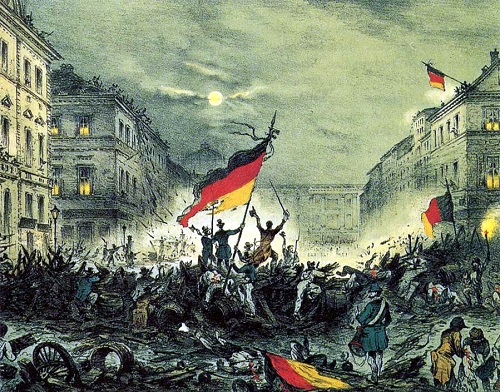
In the 17th, 18th and early 19th centuries a number of German liberals emerged to argue for enlightened reform, deregulation, and constitutional government. The failure to achieve these aims in the 1848 Revolution meant that German liberalism was eclipsed by nationalism, militarism, and socialism for the next 100 years.
In this collection
9 people central to German Liberalism.
1557–1638
Johannes Althusius was a German political and legal philosopher whose ideal commonwealth was a harmonious ordering of natural associations,…

1818–1897
Jacob Burckhardt (1818-1897) was a Swiss liberal historian who wrote on Renaissance culture and art, the growth of the power of the modern…

1762–1814
Fichte was born in Rammenau, near Dresden, studied theology at Jena, and taught at Zurich, Leipzig, Jena before being appointed rector of…

1899–1992
Hayek was one of the most important free market economists of the 20th century. He was a member of the Austrian school of economics, taught…

1767–1835
Wilhelm von Humboldt (1767-1835) was described by Friedrich Hayek as “Germany’s greatest philosopher of freedom.” Humboldt wrote a…

1724–1804
Kant was a German philosopher who taught for many years at the University of Koenigsberg. He made pivotal contributions to the study of…

1789–1846
Friedrich List (1789-1846) was one of the leading German economists in the first half of the 19th century. Best known for his book The…

1632–1694
Samuel Pufendorf was born in Saxony in 1632, the son of a Lutheran clergyman. He studied at Leipzig and Jena and held the first modern…

1838–1906
Eugen Richter (1838-1906) was one of the very few radical liberals in late 19th century Germany. As a member of the Reichstag, he…
In this collection
From The Reading Room, Liberty Matters and the library’s other publications.

Peter Carl Mentzel · May 20, 2024
John Alcorn · Oct 21, 2023

Peter Carl Mentzel · Jun 30, 2023
Passages on this subject, chosen by OLL editors.
[I]f the supreme magistrate does not keep his pledged word, and fails to administer the realm according to his promise, then the realm, or the ephors and the leading men in its name, is the punisher of this violation and broken trust. It is then conceded to the people to change and annul the earlier form of its polity and commonwealth, and to constitute a new one.