

John Dickinson
1732–1808
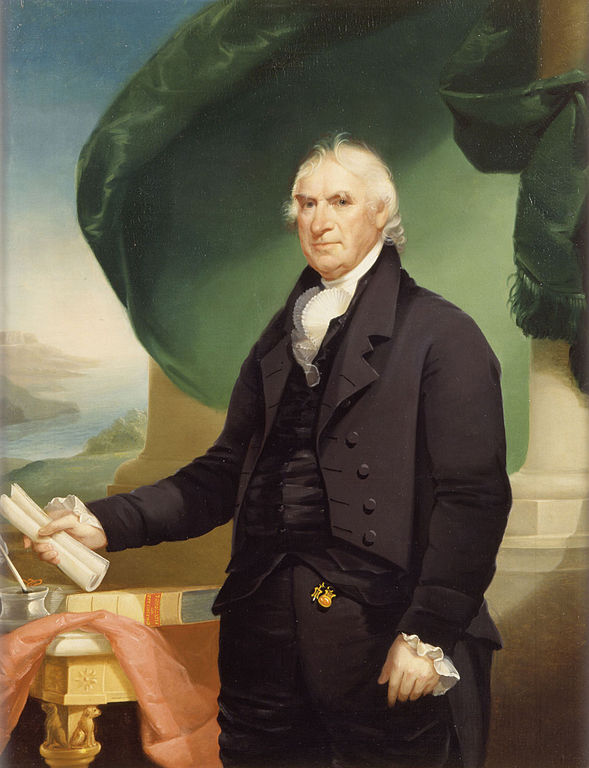
John Dickinson was a successful Philadelphia lawyer who agitated against the Stamp Act and for the independence of the colonies on the eve…


Collection
11 items in this collection
The Anti-federalists were a group who had reservations about ratifying the U.S. Constitution when it was first proposed. Some thought the Articles of Confederation were sufficient to unite the sovereign American states; others were concerned that the rights of the states and of individuals needed additional protection and so supported a Bill of Rights; others were concerned that the Federalists wanted to recreate a head of state with powers too much like those of the British monarch against whom they had just fought a war of independence.
In this collection
9 people central to Anti-Federalists.
1732–1808
John Dickinson was a successful Philadelphia lawyer who agitated against the Stamp Act and for the independence of the colonies on the eve…

1744–1814
Gerry was a member of the Philadelphia Convention from Massachusetts, and one of the number who refused to sign the Constitution, for…

1743–1826
Thomas Jefferson (1743-1826), a Virginian, was the author of the American Declaration of Independence (1776), an active participant in the…

1732–1794
Richard Henry Lee was a Virginia aristocrat who opposed the ratification of the US constitution on the grounds that it took power away from…

1725–1792
George Mason was a member of the Federal Convention, but refused to sign the Constitution, and was a leader of the opposition to its…

1753–1813
Edmund Randolph was a member of the Annapolis, Philadelphia, and Virginia Conventions, in all of which he took a prominent though equivocal…

1773–1833
John Randolph (1773 – 1833) was an American congressman from Virginia, orator, and eccentric leader of the Old Republicans. He was an…

1744–1798
Melancthon Smith of New York, was a member of the Continental Congress, (1785–88), and of the New York State Convention, in which he…

1728–1814
Mercy Otis Warren (1728-1814) was one of the most formidable female intellectuals in 18th century America. She wrote plays, poetry,…
In this collection
From The Reading Room, Liberty Matters and the library’s other publications.
Passages on this subject, chosen by OLL editors.
Within three years of the inauguration of the new federal Constitution, America’s revolutionary leaders divided bitterly over the policies most appropriate for the infant nation. Within five years, two clashing groups were winning thousands of ordinary voters to their side. Within a decade, the collision had resulted in a full-blown party war.
There has never been another struggle like it. These were the first true parties in the history of the world—the first, that is, to mobilize and organize a large proportion of a mass electorate for a national competition. More than that, these parties argued at a depth and fought with a ferocity that has never been repeated. The Federalists and the Jeffersonian Republicans—the friends of order and the friends of liberty as they sometimes called themselves— were both convinced that more than office, more than clashing interests, and more, indeed, than even national policy in the ordinary sense were fundamentally at stake in their quarrel. Their struggle, they believed, was over nothing less profound than the sort of future the United States would have, the sort of nation America was to be. Each regarded the other as a serious threat to what was not yet called the American way. And from their own perspectives, both were right.
For additional information about the American Founding see the following: